China’s Supercomputing Comeback: How Homegrown Technology Powered the World’s Fastest Machine
The global battle to rule in the area of computing power has entered a new phase, with China taking back the number one spot in the global supercomputing ranking. It is the Chinese computer known as LineShine that has beaten the American machine called El Capitan. This is an important moment in the story of China’s technology ambitions because the supercomputer is based on indigenous components only. While LineShine is already in use, its importance goes far beyond the ranking because it represents China’s increased ability to develop such computers independently and also the competition with the United States on that front.

LineShine Claims the Top Spot: China Regains the #1 Position
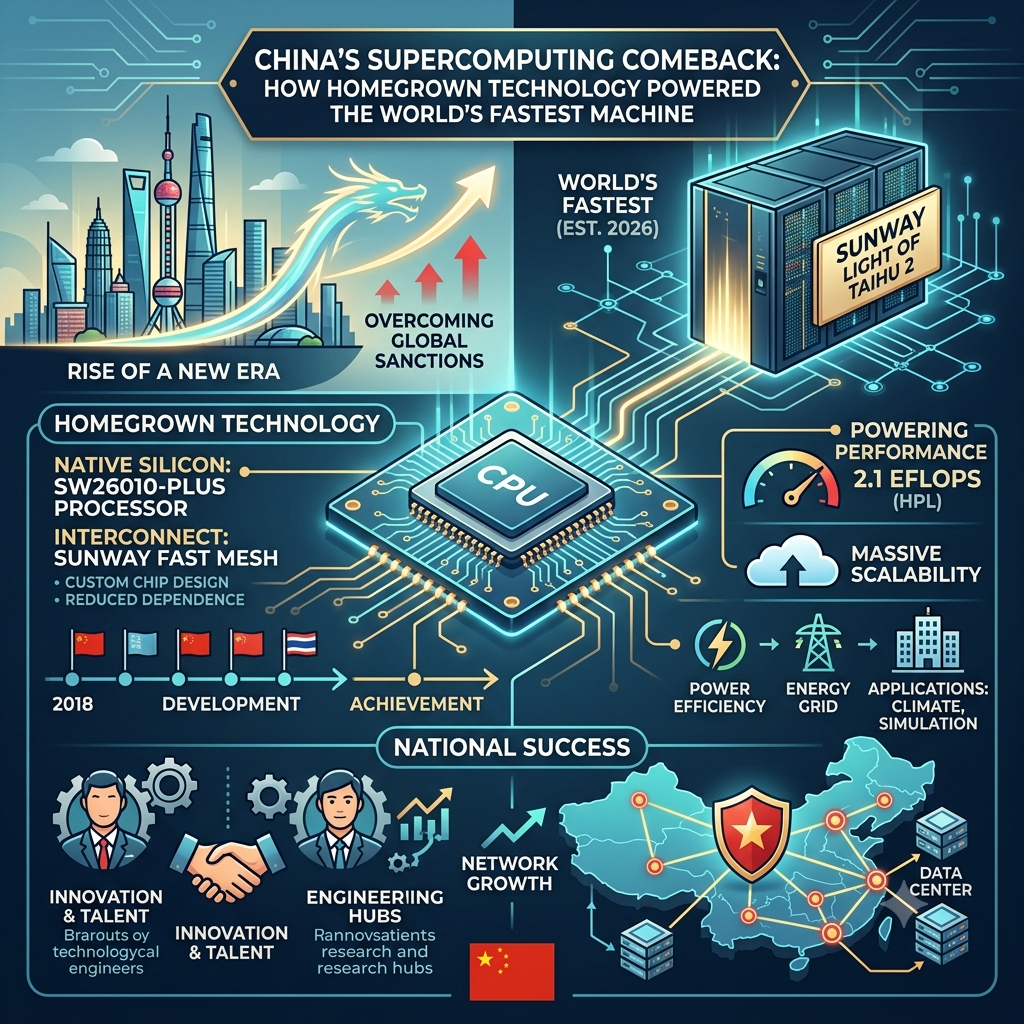
China has once again made headlines in the domain of high-performance computing thanks to the emergence of LineShine, now occupying the top position as the fastest publicly available supercomputer on the recently released TOP500 list. Installed at the National Supercomputing Centre in Shenzhen and maintained by the Shenzhen Cloud Computing Center, LineShine recorded 2.198 exaflops on the High Performance Linpack (HPL) test, outperforming the American El Capitan. The accomplishment represents the return of China to the top of the rankings after several years of being absent from the top positions since 2017. It should be noted that the TOP500 list is considered the most authoritative ranking of supercomputers, reflecting their ability to perform complex calculations. LineShine’s success shows the increasing ability of China to construct state-of-the-art computing facilities and proves many years of research and development efforts.
China’s Rise to Building their Own National Chips and Computers:
The interesting thing about LineShine is that it is 100% constructed with Chinese Technology. For example, LineShine uses domestic components such as the LingKun Processor; LingQi Interconnect Technology; and the Kylin Operating System. This also means that LineShine shows the amount of progress the Chinese have made in creating a domestic Computing Ecosystem with little to No foreign (more technologically advanced) Technology (compared to the available Technology created by the large American Chip manufacturers). In the last 10 years, Beijing has spent a significant amount of funding into Semiconductor Manufacturing, Software Development, and High-Performance Computing Research/Development to decrease their reliance on external vendors for Technology. LineShine’s success indicates that China is finally seeing concrete results from these investments into Technology. By having their own Hardware and Software Stack, China gains greater control over critically important technologies; thereby lessening their vulnerabilities created by International Supply Chains. The LineShine System demonstrates the continued growth of Technology Independence; as well as how the Innovation occurring within China can compete against Internationally with respect to Computing Performance.
US-China Technology Race Reaches a New Level
The emergence of LineShine is not only an example of success in building a supercomputer but a symbol of technology rivalry between China and the United States. Recently, both countries viewed advanced computing as a strategic issue due to its critical role in science, national security, artificial intelligence, and economic development. Various restrictions on exports and technology transfers spurred China into further investments into indigenous semiconductor and computing technologies, whereas the US keeps developing its own capacities in the sphere. Supercomputers are necessary for conducting climate change research, finding cures to diseases, creating new weapons, and other advanced engineering tasks. Thus, leadership in the domain holds substantial geopolitical significance. The comeback of China to the top place on the TOP500 list of supercomputers makes a clear statement about the technological progress achieved by the country and its capacity to compete despite various obstacles.
Does Having the Fastest Supercomputer Guarantee AI Superiority?
While LineShine now owns the title of the most powerful supercomputer in the world by virtue of its place at the top of the TOP500 rankings, it does not mean that China is taking the lead in AI computing. First of all, the TOP500 rankings are made using the High Performance Linpack benchmark test that evaluates the performance of the computer when dealing with scientific and engineering computations. On the other hand, the AI computations may use different hardware architecture and can be tested on other, dedicated to AI, benchmarks. Leading technology companies like Microsoft, Google, Amazon, and xAI create very powerful computing clusters optimized specifically for training AI models. Moreover, many of those systems are not included in the TOP500 rankings, so comparisons are impossible. The matter is clearly demonstrated in benchmark results where LineShine was the top one in the test of traditional computing performance but was only ranked fourth in another test that was related to AI.
Conclusion
LineShine, China’s supercomputer, represents a milestone in the international race towards advanced computers, which reflects the nation’s increased reliance on technology. Despite reaching the top position on the TOP500 list being an important milestone, there is still much to be done in terms of artificial intelligence, quantum computing, and future technologies, leaving the race far from over.