
Google’s ‘Trained Mosquitoes’ Will Kill Disease-Spreading Mosquitoes and Could Revolutionize Global Disease Control
Mosquitoes are among the deadliest creatures on Earth. Every year, they are responsible for spreading diseases such as malaria, dengue, Zika virus, chikungunya, and yellow fever, affecting hundreds of millions of people worldwide. Despite decades of efforts involving insecticides, mosquito nets, and public health campaigns, mosquito-borne diseases continue to pose a serious threat, particularly in tropical and developing regions.
Now, a groundbreaking initiative supported by Google is drawing global attention. Often referred to as “trained mosquitoes,” this innovative approach aims to reduce or even eliminate disease-spreading mosquito populations through advanced biological techniques. Scientists believe this strategy could transform the way humanity fights some of the world’s most
What Are Google’s “Trained Mosquitoes”?
The term “trained mosquitoes” does not mean mosquitoes are literally trained like animals. Instead, it refers to specially bred or modified mosquitoes that are released into the environment to control wild mosquito populations.
Google’s parent company, Alphabet, has invested in mosquito-control technology through its life sciences and innovation projects. The primary goal is to reduce populations of mosquitoes that spread deadly diseases without relying heavily on chemical insecticides.
These specially prepared mosquitoes are designed to interfere with the reproduction cycle of disease-carrying mosquito species, particularly Aedes aegypti, which spreads dengue, Zika, and yellow fever.
How Does the Technology Work?
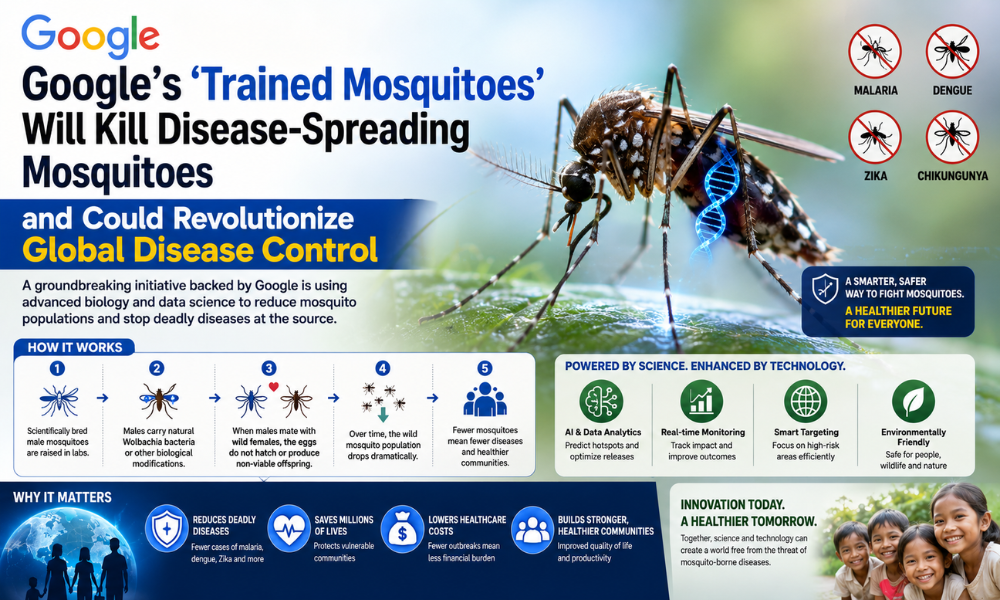
The approach involves releasing millions of male mosquitoes into targeted areas. Male mosquitoes do not bite humans and therefore do not spread diseases.
These male mosquitoes carry a naturally occurring bacterium called Wolbachia or other biological modifications that affect reproduction. When they mate with wild female mosquitoes, the resulting eggs fail to hatch or produce offspring incapable of spreading disease.
Over time, repeated releases dramatically reduce mosquito populations in affected regions.
Scientists describe the process as environmentally friendly because it targets specific mosquito species while minimizing impact on other insects and wildlife.
Why Are Mosquito-Borne Diseases a Global Concern ?
Mosquitoes contribute to some of the world’s most serious public health challenges.
Malaria alone causes hundreds of thousands of deaths annually, especially among young children in Africa. Dengue fever continues to spread across Asia, Latin America, and parts of Europe. Climate change and increasing urbanization are expanding mosquito habitats, allowing disease-carrying species to thrive in new regions.
Traditional mosquito control methods face several challenges:
• Insecticides can harm the environment.
• Mosquitoes can develop resistance to chemicals.
• Large-scale spraying programs are expensive.
• Urban breeding sites are difficult to eliminate completely.
As a result, scientists have been searching for more sustainable and long-term solutions.
Successful Field Trials Around the World
Mosquito population reduction programs using biological methods have already shown promising results.
Field trials conducted in various countries have demonstrated significant reductions in mosquito populations after the release of specially prepared male mosquitoes.
In some locations, mosquito populations have fallen by more than 80 percent. These reductions have been accompanied by decreases in disease transmission, offering hope for communities heavily affected by dengue and other mosquito-borne illnesses.
The success of these programs has encouraged governments, health organizations, and technology companies to invest further in mosquito-control innovations.
The Role of Artificial Intelligence and Data Science
Google’s involvement goes beyond biological research. Advanced technologies such as artificial intelligence, machine learning, and data analytics can help improve mosquito-control programs.
AI systems can:
• Predict mosquito breeding hotspots.
• Analyze weather patterns.
• Track disease outbreaks.
• Optimize mosquito release schedules.
• Monitor program effectiveness in real time.
By combining biotechnology with data-driven decision-making, scientists can target mosquito populations more efficiently than ever before.
Environmental Benefits
One of the most attractive aspects of this technology is its environmental sustainability.
Unlike traditional insecticide programs, biological mosquito control:
• Reduces chemical usage.
• Minimizes ecological damage.
• Targets specific mosquito species.
• Protects beneficial insects such as bees and butterflies.
• Helps maintain ecological balance.
Environmental experts view these advantages as crucial in developing long-term public health solutions that do not create additional environmental problems.
Potential Benefits for Developing Countries
Many of the regions most affected by mosquito-borne diseases have limited healthcare resources. Frequent outbreaks place enormous pressure on hospitals, clinics, and public health systems.
If mosquito populations can be reduced significantly, countries may experience:
• Lower healthcare costs.
• Fewer disease outbreaks.
• Reduced mortality rates.
• Increased productivity.
• Improved quality of life.
Children, pregnant women, and elderly populations could particularly benefit from reduced exposure to mosquito-borne illnesses.
Challenges and Concerns
Despite its promise, the technology is not without challenges.
Some experts emphasize the need for careful monitoring to ensure long-term safety and effectiveness. Questions remain regarding:
• Large-scale implementation costs.
• Public acceptance.
• Ecological impacts over decades.
• Regulatory approvals.
• Continuous monitoring requirements.
Scientists stress that extensive testing and transparent communication with local communities are essential before widespread deployment.
Public perception also plays a critical role. Some people may feel uncomfortable about releasing modified insects into the environment, even when scientific evidence suggests the approach is safe.
Future of Mosquito Control
Experts believe mosquito-control technology is entering a new era. Instead of relying solely on pesticides, future strategies will likely combine biological solutions, artificial intelligence, environmental management, and public health interventions.
Researchers are exploring additional innovations, including:
• Gene-editing technologies.
• Sterile insect techniques.
• Disease-resistant mosquito populations.
• Advanced monitoring systems.
• Predictive outbreak modeling.
Together, these developments could dramatically reduce the global burden of mosquito-borne diseases over the coming decades.
Conclusion
The concept behind Google’s “trained mosquitoes” represents a shift from treating disease outbreaks to preventing them before they occur. By targeting mosquitoes directly, scientists hope to break the transmission cycle that allows deadly diseases to spread among human populations.
If current trials and future deployments continue to succeed, this technology could become one of the most important public health innovations of the 21st century. Millions of people living in disease-prone regions could benefit from safer communities, healthier populations, and fewer outbreaks.