AI and Smart Manufacturing Workshop Held for Industrialists in Rajkot
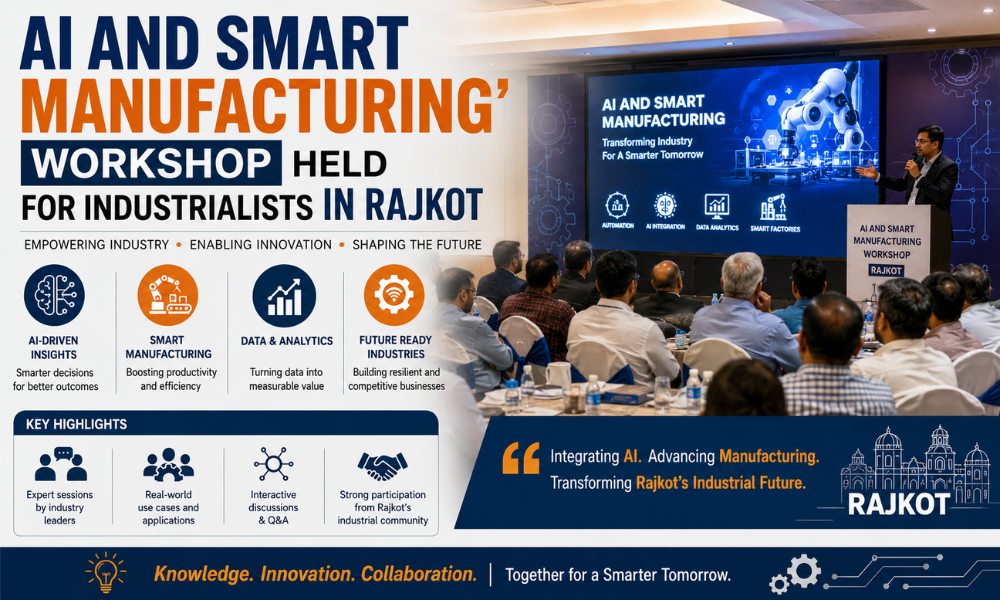
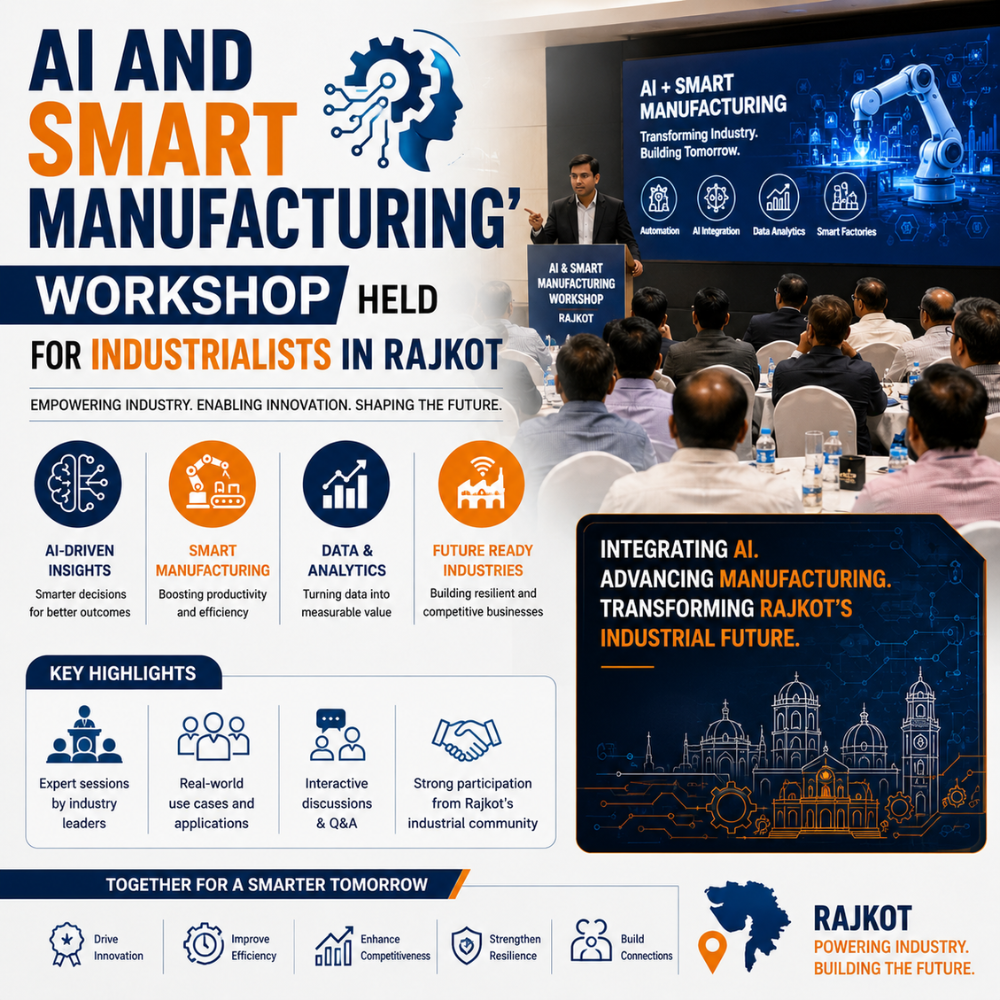
In a fast-moving global economy where technology is rapidly reshaping the factory floor, local industries can no longer afford to remain on the sidelines of the artificial intelligence revolution. That was the clear and urgent message delivered at a landmark workshop organised jointly by the Rajkot Chamber of Commerce and Industry and Nasscom’s Centre of Excellence IoT & AI, held on Thursday, May 14, in Rajkot. Titled “AI & Smart Manufacturing Workshop for Industries,” the free-of-charge event brought together local industrialists, business leaders, and technology experts under one roof with a single purpose: to show Rajkot’s manufacturing community how modern technology can dramatically increase production capacity, slash costs, and keep local businesses globally competitive.
Why Rajkot Needs This Conversation Now
Rajkot is one of Gujarat’s most important industrial cities a hub for engineering goods, auto components, machine tools, brass parts, ceramics, and a wide range of precision manufacturing products that supply both domestic and international markets. Its small and medium enterprises (SMEs) form the backbone of the local economy, employing hundreds of thousands of workers across diverse sectors. Yet, as the global manufacturing landscape undergoes a technological transformation driven by Artificial Intelligence (AI), the Internet of Things (IoT), advanced analytics, and Industry 4.0 frameworks, many of Rajkot’s traditional manufacturers risk being left behind if they do not adapt.
It was precisely this concern and the opportunity that technology adoption presents that drove the Rajkot Chamber of Commerce and Industry and Nasscom’s Centre of Excellence to come together and organise this workshop. The event was designed not as a high-level technology conference for large corporations, but as a practical, accessible, and free learning experience specifically for local industrialists who may be curious about AI but unsure where to begin.
The Key Message: Adopt Technology or Lose Ground
The workshop’s principal speaker was Siddharth Kamath, whose address set the tone for the entire day. Kamath made the case firmly and without ambiguity: in today’s fast-paced and fiercely competitive era, manufacturers must embrace Artificial Intelligence, advanced analytics, and the Internet of Things as essential tools not optional luxuries. These technologies, he argued, offer manufacturers a tangible pathway to increased production capacity, reduced operating costs, improved product quality, and minimised machine downtime.
What the Workshop Covered: Technology on the Shop Floor
The technical content of the workshop was both broad and practical. Through detailed PowerPoint presentations, Kamath and the organising team walked participants through a comprehensive suite of smart manufacturing technologies currently available to Indian industry.
Monitoring systems including computer vision for quality inspection were explained in depth, showing how cameras equipped with AI can scan products at speed and flag defects that human inspectors might miss, reducing waste and rework costs. Smart inventory management tools, which use sensors and AI to track stock levels in real time and trigger automatic replenishment orders, were presented as a solution to the perennial problem of excess inventory or production stoppages due to material shortages.
Predictive maintenance arguably one of the most immediately valuable applications of AI for manufacturers received considerable attention. Rather than waiting for a machine to break down or replacing components on a fixed schedule, predictive maintenance systems use sensor data and machine learning algorithms to detect early warning signs of equipment failure and alert engineers before a breakdown occurs. The cost savings in both direct repair costs and lost production time can be substantial.
MSME Schemes and Government Support
The workshop also took care to inform participants about the government support available to help MSMEs make this technology transition. Specific information was shared about Industry 4.0 and Digital Adoption schemes under central and state government programmes, which provide financial assistance and incentives for small businesses adopting smart technologies.
Three programmes in particular were highlighted as highly relevant for Rajkot’s MSME community: a free diagnostic study to help businesses understand their current technology readiness and identify priority areas for improvement; IoT-based SIM kit installation support, which helps factories begin their IoT journey at low cost; and access to an AI start-up ecosystem that connects manufacturers with technology solution providers. These programmes, participants were told, are designed specifically to lower the financial and knowledge barriers that often prevent SMEs from taking the first step toward digitalisation.
A Platform Built on Partnership
The workshop was inaugurated by Nautambhai Barsiya, who welcomed the gathering and spoke about the Rajkot Chamber of Commerce and Industry’s ongoing commitment to keeping local industrialists informed and equipped. He noted that the Chamber regularly organises seminars and workshops across multiple sectors to help businesses stay current with government policies, global trends, and new technologies and urged participants to take full advantage of the knowledge and networks on offer. Any industrialist with questions or challenges, he said, should not hesitate to bring them to the Chamber’s attention.
The collaboration with Nasscom’s Centre of Excellence IoT & AI added significant depth and credibility to the event. Nasscom, India’s premier technology industry association, has been driving AI and IoT adoption across Indian industry through its network of Centres of Excellence, which bring together government, industry, and technology partners to accelerate practical, on-the-ground adoption.
The Road Ahead for Rajkot’s Industry
The workshop’s message carries particular urgency at a time when India is positioning itself as a global manufacturing hub with initiatives like the Production Linked Incentive (PLI) schemes, the IndiaAI Mission, and the Samarth Udyog Bharat 4.0 programme all pushing manufacturers toward smarter, more technology-driven operations. For Rajkot’s industrialists many of whom have built successful businesses through decades of hard work, engineering skill, and entrepreneurial spirit the technology transition does not mean abandoning what has worked. It means enhancing it with tools that can make their operations faster, leaner, and more competitive in an increasingly demanding global marketplace.