H1-B Visa Application to Be Rejected Even for Minor Signature Errors, US Warns Indians
For the millions of Indians living and working in the United States or aspiring to do so, a new and quietly consequential rule is about to change the way immigration applications must be filed. The United States Citizenship and Immigration Services (USCIS), the agency that processes visa and immigration benefit requests, has announced sweeping new signature requirements that will take effect on July 10, 2026. Under this updated policy, even the smallest error in how an applicant signs their H1-B visa petition, Green Card application, or any other immigration form could result in outright rejection with no opportunity to correct the mistake and no guarantee of a refund of filing fees.
What Has Changed — and Why It Matters
Until now, if USCIS received an immigration application with a missing or incorrect signature, standard procedure was to reject the form at the intake stage and return it to the applicant for correction and resubmission. The process was inconvenient but manageable—applicants could fix the error and try again.
That flexibility is now gone. Under the new interim final rule, USCIS officers have been granted broader authority to reject immigration applications at the intake stage if signatures are missing or invalid and—crucially—to also deny applications during adjudication if signature defects are discovered at any point during the processing of a case, even after the application was initially accepted. This is a significant shift: an application could be well into the review process, weeks or months after submission, when an officer identifies a signature problem and denies it outright.
The consequences are severe. Applicants who fall foul of the rule may lose their filing fees entirely, as the agency is now permitted to retain fees even when rejecting or denying an application due to signature issues. There is no provision to “cure” or correct a deficient signature once the application has been filed. Starting over means paying again—and the filing fees for H1-B petitions and Green Card applications can run into thousands of dollars.
Which Applications Are Affected
The new rule applies broadly across employment-based immigration categories. The most heavily impacted forms include the I-129 (used for H-1B and other non-immigrant worker petitions) and the I-485 (used for adjustment of status to lawful permanent resident, i.e., the Green Card process). L-1 visa petitions, employment authorization documents, and other status adjustment or extension applications are also covered.
Given that Indians dominate the employment-based immigration pipeline—particularly in the H1-B and Green Card backlogs, where wait times can stretch for decades—the community faces a disproportionate share of the risk. A signature error on a Green Card filing for a person already deep in a priority date queue could be catastrophic, potentially costing not just money but years of accumulated waiting time.
What Counts as a Valid Signature
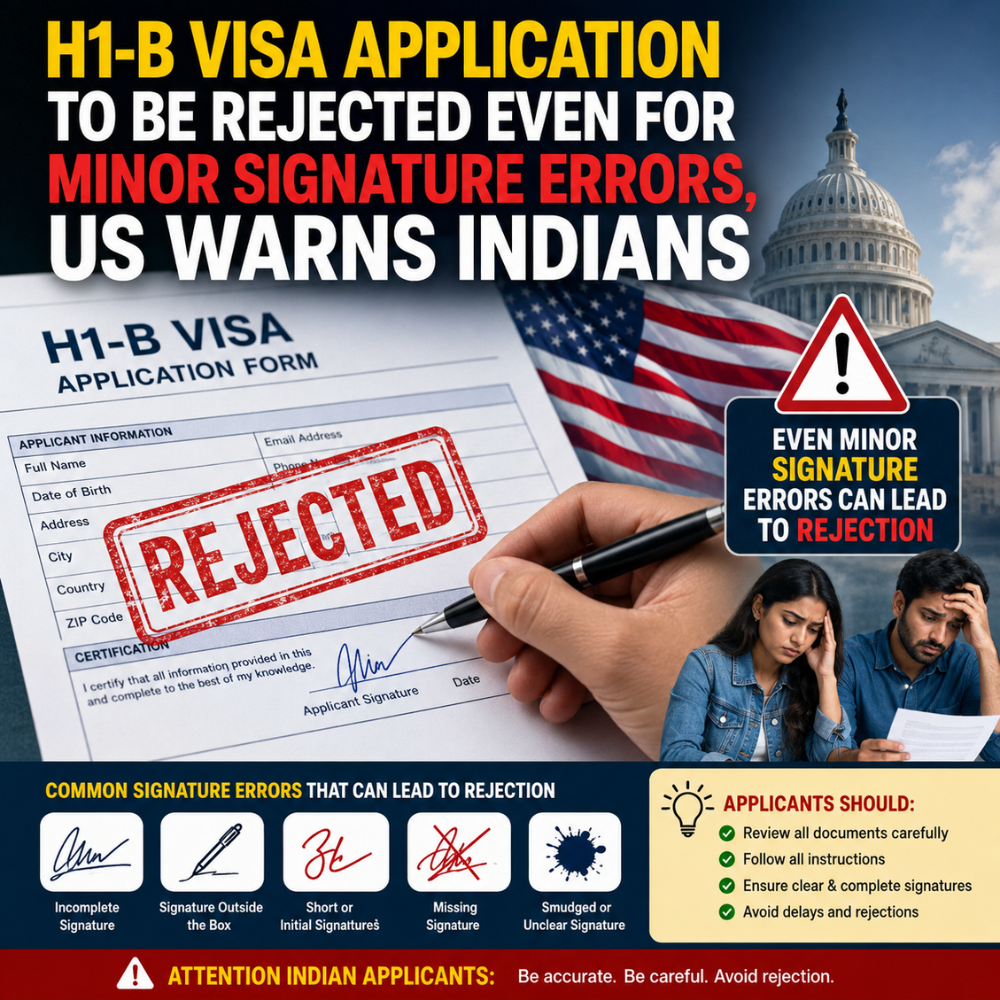
USCIS has provided clear, if strict, guidance on what it considers a valid signature. The agency confirms that handwritten signatures—pen on paper—remain the gold standard and are always accepted. Scanned copies of original handwritten signatures, faxed copies, and clear photocopies of wet-ink signed documents also remain acceptable.
However, several commonly used formats are now explicitly flagged as potentially invalid and subject to rejection. These include typed signatures (i.e., a name typed in any font), electronically pasted signatures (where an image of a signature is dropped into a digital document), signature software or auto-generated signing tools, signature stamps, and signatures made by individuals not authorized to sign on behalf of the applicant or the petitioning company. In cases where applications are signed by immigration attorneys or company representatives without proper authorization documentation, the filing may also face scrutiny.
Why the US Government Is Tightening These Rules
US immigration officials have stated that the rule is a response to rising concerns over improper signature methods, including the increasing use of copied or digitally generated signatures, and filings submitted by individuals who lack proper authority to sign on behalf of applicants or sponsoring employers. The growing reliance on remote document workflows — where applicants, employers, and lawyers sign forms electronically across different cities and time zones — has created conditions where signature shortcuts have become common.
The Department of Homeland Security (DHS) introduced the change through an interim final rule, meaning it was implemented without the usual public comment period preceding final implementation. The rule amends Section 8 CFR 103.2(a)(7)(ii) of the Code of Federal Regulations, formally codifying USCIS officers’ authority to reject or deny benefit requests on signature grounds at any stage of processing.
What Indians in the US Must Do Now
Immigration lawyers and experts across the United States are urging Indian applicants—whether currently in the H1-B process, waiting on Green Card priority dates, or applying for any other immigration benefit—to take the following steps immediately.
First, always use a physical, handwritten signature in ink on official USCIS forms. Do not type your name, use a digital stamp, paste an image of your signature, or use any electronic signing software unless it has been explicitly approved by USCIS for a specific form. Second, if a form must be signed remotely — as is common in employer-sponsored filings — print the form, sign it physically, scan it clearly, and submit the scanned copy. Third, verify that all authorized signatories—such as company HR officers or legal representatives—have the proper documentation confirming their authority to sign on behalf of the petitioner. Fourth, check every document in your application package before submission. Errors caught before filing cost nothing. Errors caught by USCIS after filing could cost everything.
Conclusion
A Costly Reminder
The new USCIS signature rule is, in one sense, a procedural clarification — a tightening of paperwork standards that one might expect any large bureaucracy to enforce. But for the Indian community in America, which navigates one of the most complex immigration systems in the world while managing careers, families, and decade-long waits for permanent residency, it is a pointed reminder of how unforgiving that system can be. One wrong signature—not a fraud, not a misrepresentation, simply an improperly placed ink mark or a pasted image—could erase months of effort and thousands of dollars in a single officer’s decision.
Caution, precision, and expert guidance have never been more important.