
FDs vs PPF: Rates, Tenure, Tax Benefits and Risks Explained
When it comes to sparing cash in India, two choices frequently come up in each discussion: Settled Stores (FDs) and the Open Provident Support (PPF).
For decades, families have depended on these rebellious since they are generally secure and simple to get it. If you inquire your guardians or grandparents how they contributed their reserve funds, chances are they’ll specify at slightest one of these.
But whereas both choices are considered secure speculations, they serve exceptionally distinctive budgetary objectives. One offers adaptability and liquidity, whereas the other is built for long-term riches creation.
So if you’re pondering where to stop your cash — FD or PPF, here’s a basic breakdown of how they compare in terms of intrigued rates, residency, charges, and risk.
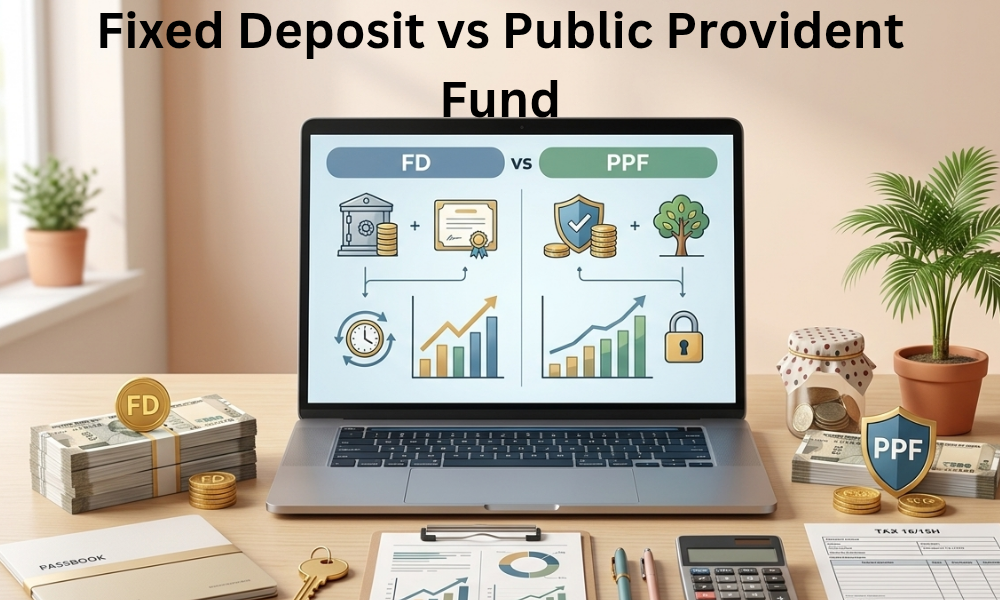
Understanding Settled Stores (FDs)
A Settled Store is one of the least difficult speculation alternatives accessible through banks and budgetary educate. You store a protuberance whole for a settled period, and the bank pays intrigued on it.
The greatest reason numerous Indians lean toward FDs is certainty. You know precisely how much you will gain at the conclusion of the tenure.
Key Highlights of FDs
- Interest rate: Ordinarily around 6–7.5% per year, depending on the bank and residency.
- Tenure: Adaptable — from 7 days to 10 a long time.
- Minimum speculation: Frequently begins from ₹1,000 to ₹10,000, depending on the bank.
- Liquidity: Untimely withdrawal is permitted, in spite of the fact that more often than not with a little penalty.
- Returns: Ensured and settled at the time of booking.
Because of this adaptability, FDs are commonly utilized for short-term objectives like:
- Emergency funds
- Saving for a vacation
- Parking sit out of gear cash
- Short-term money related planning
A Speedy Example
Imagine you contribute ₹2 lakh in a 3-year FD at 7% interest.
At development, your add up to sum would be generally ₹2.45 lakh, depending on compounding frequency.
The advantage here is consistency — you know precisely what you will get.
But there’s a capture, which we’ll examine afterward: taxation.
Understanding the Open Provident Finance (PPF)
The Open Provident Support (PPF) is a government-backed long-term investment funds plot outlined to empower taught investing.
Unlike FDs, PPF isn’t implied for short-term budgetary needs. It’s ordinarily utilized for retirement arranging or long-term riches creation.
Key Highlights of PPF
- Interest rate: Around 7.1% every year, chosen by the government and changed quarterly.
- Tenure: 15 a long time lock-in period.
- Minimum venture: ₹500 per year.
- Maximum venture: ₹1.5 lakh per year.
- Withdrawals: Halfway withdrawals permitted after a few years.
Because of the long residency and charge benefits, PPF is broadly utilized for:
- Retirement savings
- Children’s instruction funds
- Long-term riches accumulation
A Straightforward Example
Suppose you contribute ₹1.5 lakh each year in PPF for 15 a long time at around 7.1%.
By the time the account develops, the add up to esteem can develop to generally ₹40 lakh or more, much appreciated to compounding.
And the best portion? The whole development sum is tax-free.

FD vs PPF: Key Differences
Let’s see at the major contrasts between these two prevalent speculation options.
- Interest Rates
At to begin with look, FD and PPF intrigued rates show up similar.
FDs: For the most part around 6–7.5% depending on bank and residency.
PPF: Around 7.1% per year set by the government.
But the genuine distinction shows up after taxes.
PPF intrigued is totally tax-free, whereas FD intrigued is completely assessable based on your pay charge slab.
This implies the viable return on PPF is frequently higher
- Tenure and Lock-in Period
This is where the two alternatives vary significantly.
FD Tenure
7 days to 10 years
Flexible
Suitable for short-term goals
PPF Tenure
- 15-year lock-in period
- Can expand in squares of 5 a long time after maturity
- Best for long-term arranging
If you might require your cash before long, FD is the simpler option.
- Tax Benefits
Taxes play a tremendous part in choosing between these investments.
FD Taxation
Only 5-year tax-saving FDs qualify for conclusion beneath Segment 80C.
Interest earned is completely assessable as wage.
Banks deduct TDS if intrigued surpasses ₹40,000 per year (₹50,000 for senior citizens).
PPF Charge Benefits
PPF takes after the EEE (Exempt-Exempt-Exempt) assess structure.
This means:
- Investment qualifies for Area 80C deduction
- Interest earned is tax-free
- Maturity sum is tax-free
Because of this, PPF is considered one of the most tax-efficient speculations in India.
- Risk and Safety
Both FD and PPF are generally secure ventures, but their backing is different.
Fixed Store Risk
FDs are low-risk since they are advertised by banks. However:
Deposits are back up plan as it were up to ₹5 lakh per depositor per bank beneath store protections.
If you contribute expansive sums in one bank, broadening may be wise.
PPF Risk
PPF is supported by the Government of India, which makes it one of the most secure venture alternatives accessible.
There is basically no default risk
- Liquidity
Liquidity alludes to how effectively you can get to your money.
FD Liquidity
- Premature withdrawal allowed
- Penalty may apply
PPF Liquidity
- Partial withdrawals permitted as it were after 5 years
- Full withdrawal as it were after 15 years
- So if liquidity things, FD clearly wins.
Which One Ought to You Choose?
The reply depends on your money related objectives, not fair intrigued rates.
Choose FD if:
- You require flexibility
- Your objective is short-term (1–5 years)
- You need unsurprising income
- Liquidity is important
Choose PPF if:
- Your objective is long-term riches creation
- You need tax-free returns
- You are sparing for retirement or future security
- You can remain contributed for 15 years
- Many monetary organizers really suggest utilizing both.
For example:
Use FDs for short-term reserve funds or crisis funds
Use PPF for long-term riches building
This combination equalizations liquidity and charge efficiency.
Conclusion
The Foot Line
Both FDs and PPF have stood the test of time in Indian families — and for great reason.
FDs offer adaptability and certainty, making them perfect for short-term monetary needs. PPF, on the other hand, rewards tolerance and teach, making a difference financial specialists construct riches over the long term with tax-free compounding.
Instead of considering of them as competitors, it may be way better to see them as two apparatuses serving distinctive purposes.
Because in some cases, the most intelligent money related procedure isn’t choosing one over the other — it’s knowing when to utilize each.