Son Rise at Sun: Decoding the Architecture of Dilip Shanghvi’s Global Empire
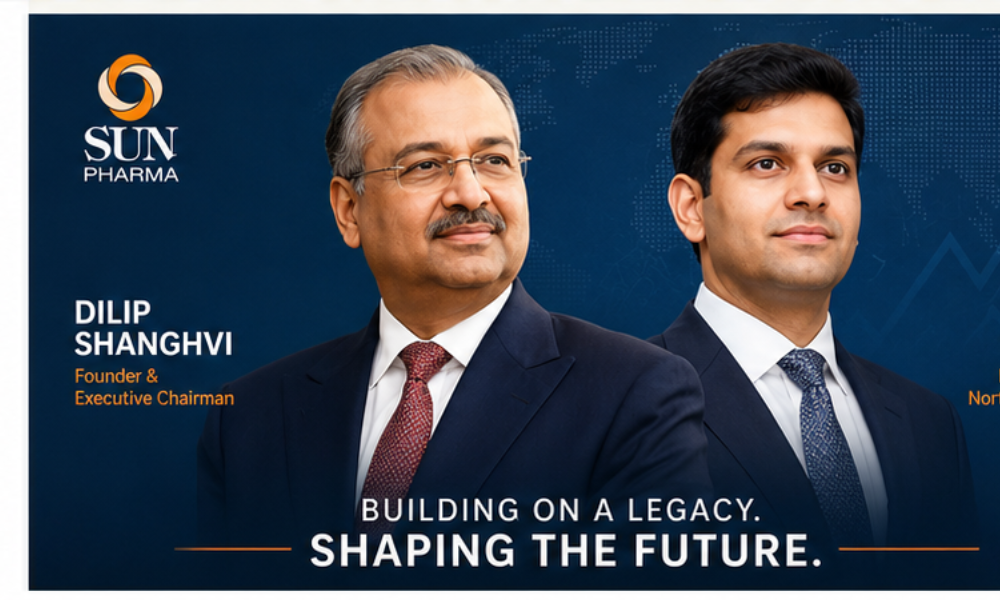
In the world of Indian commerce, few pioneers have built a realm as deliberately and discreetly as Dilip Shanghvi. Not at all like industrialists who flourish on open display, Shanghvi has continuously favored procedure over dramatic skill. However the pharmaceutical monster he created—Sun Pharmaceutical Industries—has gotten to be one of India’s most imposing worldwide enterprises.
Today, Sun Pharma stands at a pivotal turning point. The company is not as it were seeking after forceful worldwide development but is moreover planning for generational authority move. The developing part of Shanghvi’s child, Aalok Shanghvi, signals that the following chapter of the pharma monster may as of now be unfolding.
What began in 1983 as a little medicate fabricating company centered on psychiatric drugs has presently changed into India’s biggest pharmaceutical company by showcase capitalization. The rise of Sun Pharma is eventually the story of taught aspiration, calculated acquisitions, and a tireless center on long-term esteem creation.
From Kolkata Dealer to Worldwide Pharma Titan
Dilip Shanghvi’s entrepreneurial journey did not start with enormous capital or acquired a mechanical foundation. Born into a middle-class Gujarati family in Kolkata, Shanghvi at first worked in his father’s discount pharmaceutical trade. That introduction gave him knowledge to advertise holes in the pharmaceutical industry.
Instead of entering stuffed medication sections, Shanghvi centered on specialty psychiatric drugs—a choice that would characterize Sun Pharma’s early victory. By focusing on specialized treatments with lower competition, the company continuously built validity among specialists and distributors.
What recognized Shanghvi from numerous business visionaries of his period was his tolerance. He was never fixated with overnight scales. Instead, he concentrated on operational productivity, reliable productivity, and vital expansion.
Over time, that cautious approach became Sun Pharma’s most noteworthy strength.
The Procurement Machine That Changed Indian Pharma
Building Through Buyouts
Sun Pharma’s change into a worldwide powerhouse was driven less by natural development and more by keen acquisitions. Shanghvi aced the craftsmanship of buying troubled or underestimated resources and coordinating them into Sun Pharma’s ecosystem.
This procedure got to be particularly obvious with two point of interest deals:
The securing of Taro Pharmaceuticals
The takeover of Ranbaxy Laboratories
Both acquisitions were considered unsafe at the time. Taro included drawn out lawful fights, whereas Ranbaxy came burdened with administrative issues and reputational harm. However Shanghvi saw openings where others saw chaos.
The Ranbaxy procurement, in specific, changed the scale of Sun Pharma overnight. It extended fabricating capacity, worldwide reach, and got to directed markets like the United States. More imperatively, it built up Sun Pharma as a genuine worldwide contender or maybe than simply an Indian generics company.
Industry examiners progressively started depicting Shanghvi as a “buyout artist”—a businessman able to restore battling pharmaceutical resources through operational teaching and key clarity.
The Organon Bargain: Sun Pharma’s Greatest Bet Yet
Expanding Past Generics
Sun Pharma’s aspirations are no longer restricted to nonexclusive drugs. The company is presently forcefully moving into strength pharmaceuticals, women’s healthcare, dermatology, oncology, and biologics.
That vital move got to be apparent with the proposed procurement of Organon, the US-based healthcare company spun out of Merck. The exchange, estimated at about $11.75 billion, is anticipated to be the biggest abroad pharma securing ever endeavored by an Indian company.
The Organon bargain is vital for a few reasons:
It gives Sun Pharma get to to more than 140 worldwide markets
It essentially fortifies the company’s women’s healthcare portfolio
It develops Sun Pharma’s nearness in Europe, Latin America, China, and Korea
It diminishes reliance on commoditized generics
For Shanghvi, the bargain speaks to more than scale—it speaks to evolution.
The pharmaceutical industry is quickly changing. Bland sedate estimating in the United States has gotten to be brutally competitive, and companies subordinate exclusively on generics confront contracting edges. Forte medications, in any case, offer more grounded benefit and more prominent mental property protection.
Sun Pharma’s future clearly lies in this higher-value segment.
The Rise of Aalok Shanghvi
Preparing the Following Generation
While acquisitions overwhelm features, the more interesting story may be the unfurling interior of Sun Pharma’s authority structure.
For a long time, Dilip Shanghvi kept near control over key decision-making. In any case, later organizational changes show that the company is effectively planning for succession.
Aalok Shanghvi, Dilip Shanghvi’s child, has relentlessly risen through the positions after joining the company in 2006. Not at all like typical successors parachuted into administration positions, Aalok has worked over numerous trade capacities, including:
- Marketing
- Business development
- Research and development
- Emerging markets
- Active pharmaceutical ingredients
Most essentially, Aalok presently directs Sun Pharma’s North American business—the company’s most deliberately critical market.
This obligation is not ceremonial. The US pharmaceutical showcase is highly competitive and intensely controlled. Overseeing this trade unit successfully requires profound operational understanding and worldwide key vision.
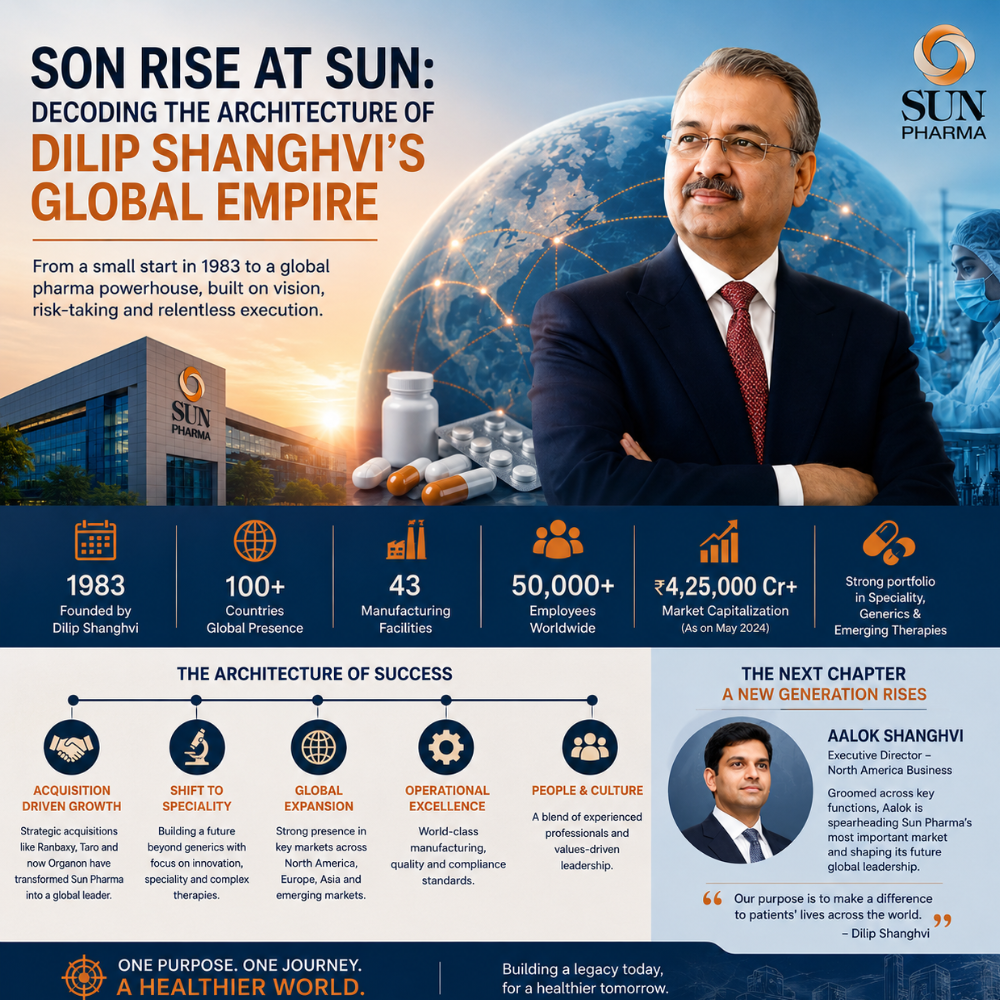
By putting Aalok in such a basic part, Dilip Shanghvi shows up to be testing and preparing for another era of administration in genuine time.
Professional Administration Meets Family Control
A Carefully Outlined Progression Blueprint
One reason Sun Pharma’s progression arranging stands out is its adjustment between promoter authority and proficient management.
Unlike numerous family-owned Indian combinations where progression makes vulnerability, Sun Pharma shows up to be building a half breed structure. As of late, company ingenious Kirti Ganorkar was raised as Overseeing Executive whereas Dilip Shanghvi transitioned into the part of Official Chairman.
This move signals two critical things:
- The Shanghvi family still holds key oversight
- Proficient supervisors stay central to operations
That adjustment is basic for a multinational pharmaceutical company working in profoundly controlled markets worldwide.
Sun Pharma’s administration progressively takes after worldwide organizations or maybe than conventional family-run Indian businesses. This institutionalization seems to be one of the company’s greatest competitive preferences in the coming decade.
Reinventing the Commerce Model
For decades, Indian pharmaceutical companies flourished by fabricating low-cost bland drugs to send out markets. But that show is getting to be less profitable due to estimating weight and administrative scrutiny.
Sun Pharma recognized this move prior to numerous competitors.
The company has forcefully extended its strength medicate portfolio, counting treatments in:
- Dermatology
- Ophthalmology
- Oncology
- Immunology
Products like Ilumya, Cequa, Winlevi, and Odomzo have developed as vital development drivers.
Sun Pharma is moreover contributing intensely in inventive sedate pipelines and immunotherapy research. The securing of oncology-focused Checkpoint Therapeutics assists highlights the company’s intention to move up the pharmaceutical esteem chain.
This move from volume-driven fabricating to innovation-led pharmaceuticals seems to characterize Sun Pharma’s future.
Risks Underneath the Empire
Can Sun Pharma Support Its Momentum?
Despite its qualities, Sun Pharma faces significant risks.
The Organon procurement includes colossal budgetary commitments and may essentially increment obligation levels. Joining a gigantic worldwide healthcare trade moreover brings operational complexity.
Additionally, the pharmaceutical industry remains defenseless to:
- Regulatory crackdowns
- Patent litigation
- Pricing pressure
- Manufacturing compliance challenges
- Succession itself too carries instability. Founder-led companies frequently battle amid administration moves, particularly when the following era acquires an organization working at worldwide scale.
Whether Aalok Shanghvi can effectively lead Sun Pharma into its following stage remains one of corporate India’s most closely observed questions.
Conclusion
The Bequest Past Wealth
Dilip Shanghvi’s genuine accomplishment lies not only in building an affluent venture but in making an versatile institution.
Sun Pharma has over and over rehashed itself:
From psychiatric medications to generics
From household operations to worldwide markets
From low-cost fabricating to strength innovation
That capacity to advance may eventually characterize the company more than any single securing or quarterly result.
As Aalok Shanghvi steps into authority, Sun Pharma enters an unused era—one where the challenge is no longer building the domain, but supporting and changing it for the future.
And if Dilip Shanghvi’s career offers any lesson, it is that the most solid domains are not built boisterously. They are built calmly, deliberately, and one calculated choice at a time.