
India’s Inflation Story Is Changing — And Every Household Can Feel It
India’s retail swelling may still seem “under control” on paper, but the reality of interior Indian homes tells a more layered story. From costly foodstuffs and rising utility bills to the developing vulnerability around fuel costs, swelling is no longer fair and financial terms are examined by policymakers — it’s getting to be a portion of regular discussions at eating tables all over the country.
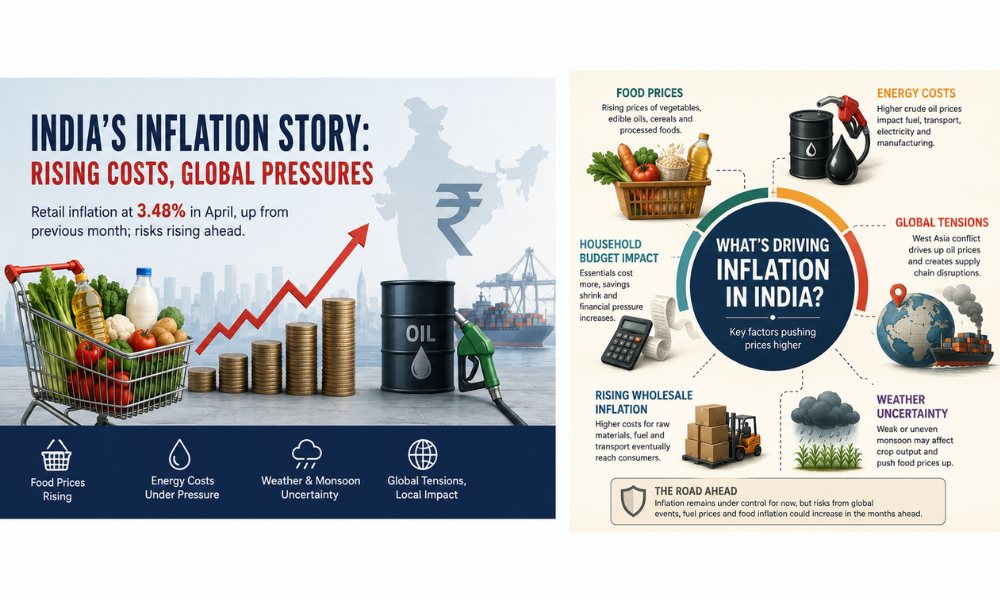
Recent information appears India’s retail expansion rose to 3.48% in April, somewhat higher than the past month. Whereas that number remains underneath the Save Bank of India’s consolation edge of 4%, financial specialists are starting to stress around what lies ahead.
The concern is not essentially approximately where expansion stands nowadays. It is around the strengths building underneath the surface.
One of the greatest reasons is nourishment expansion. Costs of vegetables, edible oils, handled nourishments, and day by day fundamentals are relentlessly rising once more. Nourishment swelling climbed to 4.2% in April, signaling that family budgets may proceed to stay beneath weight in the coming months.
For middle-class families, this move is as of now obvious. Basic supply bills are getting to be harder to anticipate. Eating out costs more than it did a year prior. Indeed little way of life costs — drain, cooking oil, transport, school snacks — are including up quicker than salaries.
And not at all like extravagance investing, nourishment expansion harms everyone.
Why Worldwide Clashes Matter to Indian Kitchens
To begin with, clashes in West Asia may appear distant, evacuated from the everyday life of a normal Indian family. But in today’s interconnected economy, geopolitical pressures travel rapidly through oil costs, shipping costs, and supply chains.
India imports a huge parcel of its unrefined oil. So at whatever point worldwide oil costs rise strongly, the impacts swell through the economy nearly immediately.
That swell is presently visible.
The progressing pressures in West Asia have pushed up vitality costs universally, and financial analysts accept this may become one of the greatest swelling dangers for India in 2026.
Higher unrefined oil costs don’t fairly influence petrol pumps. They increment transportation costs, fabricating costs, coordinations charges, aircraft passages, bundling costs, and in the long run the costs customers pay in stores.
Even when fuel costs stay incidentally steady due to government mediation, businesses inevitably pass on higher input costs to customers.
This is why swelling frequently feels more regrettable than the official number suggests.
A 3.5% expansion rate may show up sensible factually, but if fundamentals like nourishment, transport, power, and gas are rising much quicker, family units’ involvement is far more budgetary weight than the feature figure indicates.
The RBI’s Adjusting Act
The Save Bank of India presently faces a fragile challenge.
On one hand, swelling is still inside its target extent. On the other hand, dangers are clearly expanding. Financial specialists caution that delayed weight from fuel and nourishment costs might in the long run constrain the central bank to reconsider its arrangement position.
This makes a troublesome adjusting act.
If the RBI raises interest rates forcefully to control expansion, borrowing gets to be more costly. Domestic credits, car advances, and trade credit all got to be costlier. That can moderate financial growth.
But if rates remain as well as swelling proceeds rising, acquiring control debilitates encourage, influencing buyer certainty and savings.
For presently, the RBI shows up cautious or maybe more frightened. But the tone of financial dialogue is gradually moving from positive thinking to vigilance.
The Covered up Part of Weather
Another major concern is the monsoon.
India’s economy may have modernized essentially, but farming still remains profoundly associated with swelling patterns. A powerless or insufficient rainstorm can rapidly decrease trim yield, thrust up nourishment costs, and strain country incomes.
Reports as of now recommend that climate instabilities may include weight to nourishment swelling afterward this year.
This thing since nourishment swelling in India carries on in an unexpected way from expansion in numerous created economies. In India, nourishment carries a much bigger weight in family investing, particularly for lower and middle-income groups.
When vegetable costs spike or eatable oils end up costly, shoppers cannot essentially “cut back” effectively. These are essentials.
That is why indeed direct expansion can make a critical stretch for millions of families.
A Modern CPI Arrangement — But Ancient Stresses Remain
India has too moved to a changed Customer Cost List (CPI) arrangement with a modern bushel of merchandise and a modern base year.
This altar is imperative since investing propensities advance over time. Urban families nowadays spend in an unexpected way compared to a decade back. Computerized administrations, transport designs, handled nourishments, and way of life costs have all changed.
Updating the CPI wicker container makes a difference to financial specialists’ degree swelling more accurately.
However, whereas factual strategies progress, the public’s concern remains basic: “Can my wage keep up with rising costs?”
For numerous family units, the reply progressively feels uncertain.
Why Discount Swelling Things Too
Retail expansion regularly gets the most consideration since buyers feel it straightforwardly. But discount swelling tells another vital story.
India’s discount expansion as of late hit a 38-month high, driven generally by vitality and unrefined oil costs.
This is because discount swelling more often than not comes to shoppers with a delay.
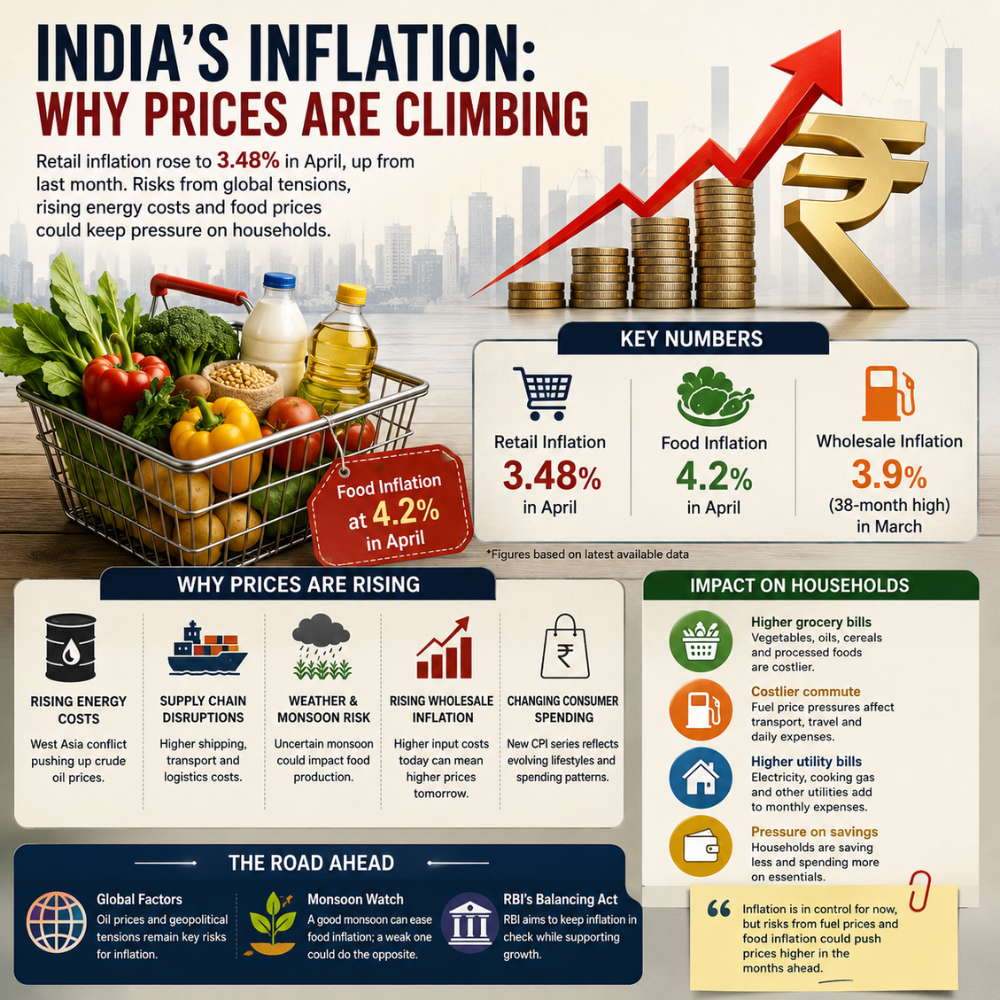
If producers are paying more for fuel, crude materials, and transportation nowadays, retail costs regularly rise afterward. In other words, current discount expansion can end up tomorrow’s shopper inflation.
That plausibility is what financial specialists are observing closely.
The Greater Picture
Despite these concerns, India’s economy still remains moderately versatile compared to numerous worldwide peers. Swelling is lower than a few progressed economies experienced in later a long time, and development proceeds to stay strong.
But strength is not cruel immunity.
Global instability, unstable oil costs, climate-related disturbances, and supply chain dangers are making a more delicate environment than before.
For conventional Indians, the challenge is getting to be mental as much as monetary. Individuals are getting to be more cautious with investing. Families are deferring optional buys. Customers are progressively prioritizing reserve funds and basics over way of life upgrades.
Inflation changes behavior unobtrusively some time recently it changes financial features dramatically.
Conclusion
What Comes Next?
The other few months will likely depend on three major factors:
Global oil prices
The rainstorm season
Food cost stability
If unrefined oil remains raised and nourishment costs proceed climbing, swelling may move closer to — or indeed over — the RBI’s consolation zone.
However, if product costs stabilize and agrarian yield remains sound, India may still dodge a more honed swelling shock.
For presently, the message is clear: swelling in India is no longer fair a transitory concern. It is getting to be a basic challenge molded by worldwide legislative issues, climate vulnerability, and household utilization patterns.
And whereas financial analysts talk about rates and arrangement reactions, Indian families are as of now living the reality one month to month budget at a time.