Google I/O 2026: How Gemini 3.5, AI Agents, and Smart Glasses Are Reshaping the Future
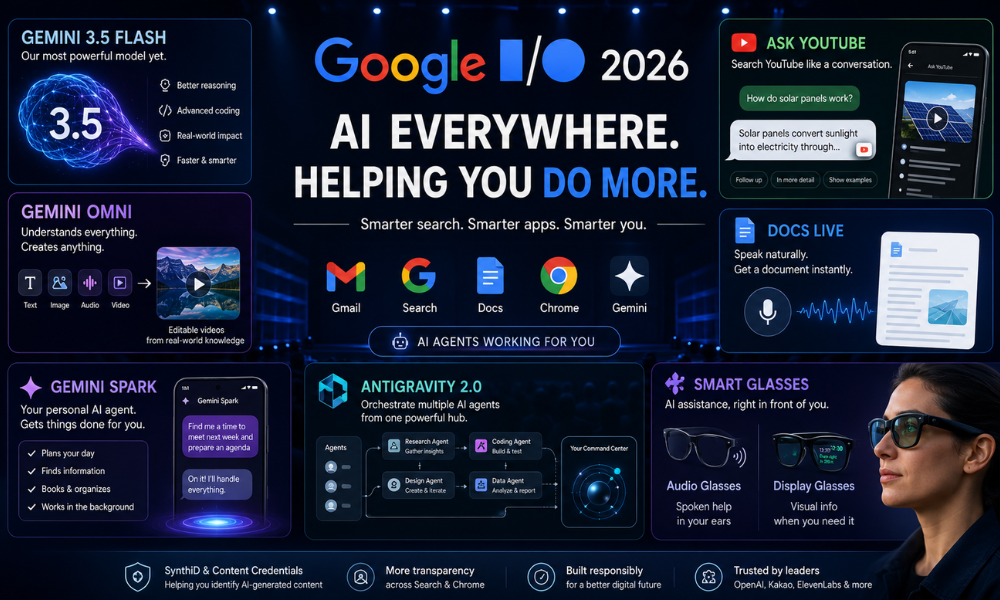
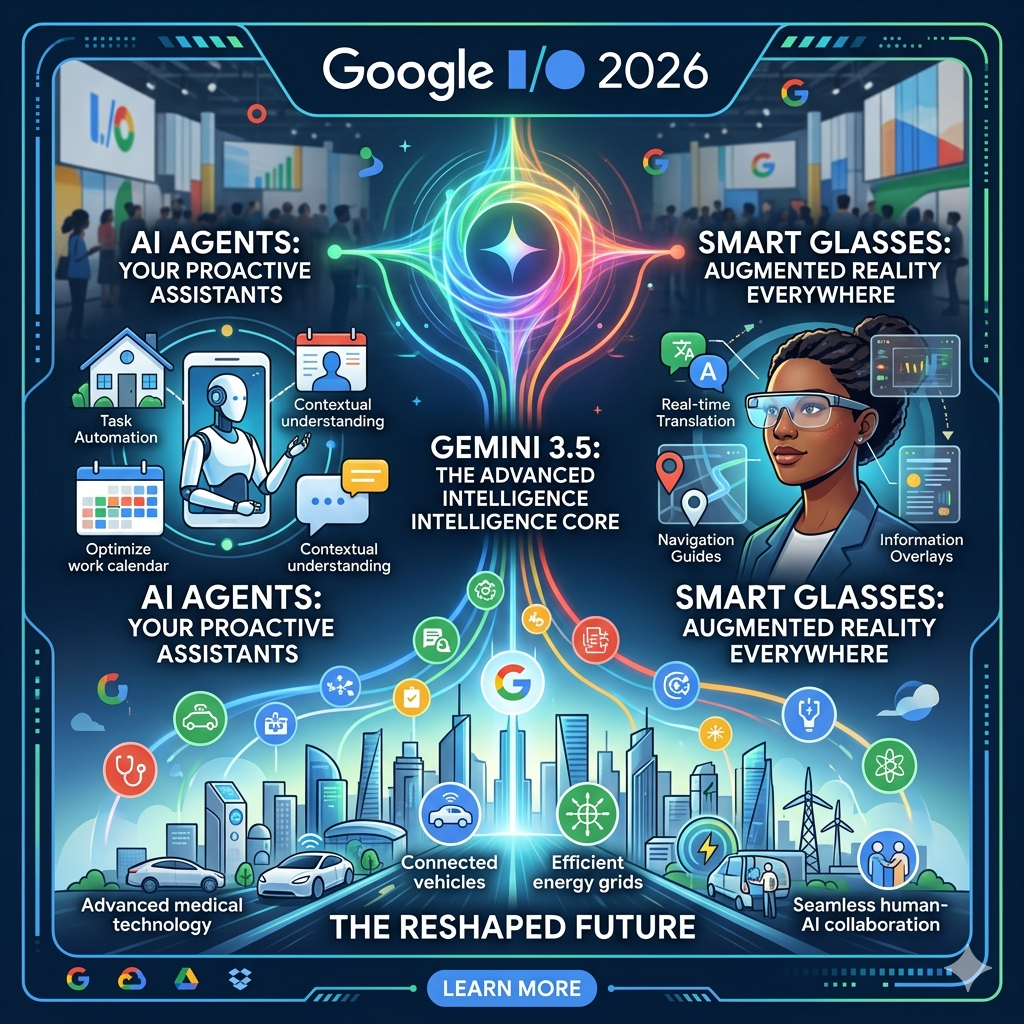
What was evident at the Google I/O 2026 conference was that artificial intelligence technology would not remain a secondary part of Google products anymore. All through this year’s conference, Google’s primary agenda revolved around the concept of incorporating AI into becoming an intelligent personal assistant that could search, create, organize, edit, and do many more things on behalf of its users. From the unveiling of such innovations as the Gemini 3.5 Flash and Gemini Omni technologies, AI-integrated YouTube searches, voice-powered Google Docs, and even revolutionary AI smart glasses, Google had lots of innovations to show off during the conference. Another fascinating thing about Google was its ability to demonstrate AI agents capable of running on Search, Gmail, Chrome, and other platforms in the background.
The Emergence of AI Agents in Google’s Products
One of the most important announcements at Google I/O 2026 came from the company regarding its plans concerning the introduction of intelligent AI agents in many of its popular services. It seems that Google is eager to turn all these AI systems into something similar to assistants that will be able not only to respond to any queries but also perform some functions independently. The first notable point here is the launch of the product called Gemini Spark, which is an AI agent in the Gemini application. This tool is capable of handling any complex processes in the background mode automatically. Moreover, the Daily Briefing feature was launched, which provides personalized notifications by compiling data from different services such as Gmail, Calendar, and others. Finally, even Search is getting transformed due to the development of new AI agents that can look for information and even help users perform various actions through Search alone.
Gemini 3.5 Flash and Omni: Google’s Next-Generation AI Revolution
At the event, Google revealed its newest and leading AI model, Gemini 3.5 Flash per the company’s statement on this latest release offering significant enhancements over prior Gemini AI models in terms of coding, reasoning, and other productivity type tasks as well as additional performance gain across a number of important benchmarks and significant gains in both speed and performance.
Additionally, they also introduced Gemini Omni, an AI system that can process yet provide text, image, audio and video, which allows customers to communicate using multi-mode forms of communication (as opposed to solely typed prompts). Furthermore, Gemini Omni Flash can provide the ability to create/edit video content – generated from all these modes of content – using real-world known information and conversational context.
This exciting development shows how Google is trying to move GPT-type AI systems (NLP-based Chatbots) into an AI-based ecosystem that provides human-like AI experiences by better mimicking current human responses when interpreting content and interjecting relevant knowledge; creating new creative reasoning with multi-mode capabilities to set the foundation for future digital experiences with its entire ecosystem.
Google Upgrades YouTube, Docs, and Creative Apps to Be Conversational
Google has also unveiled significant AI improvements to YouTube, Docs, and its creative tools, making them all more conversational and user-friendly. One of the biggest innovations was Ask YouTube, a function through which people could query YouTube via conversations rather than mere keywords. People will be able to ask complex questions, follow up on them naturally, and receive relevant responses powered by AI technology. Google Docs also got a major boost from Docs Live, a new ability that lets people convert their spoken ideas to written content. Rather than providing complex prompts, people could simply talk normally, while Gemini would take care of the rest by creating structured content out of it. In terms of creative functions, Google launched an AI-powered space called Flow that enables people to brainstorm and create ideas, as well as edit their work seamlessly. Another notable addition included Google Pics, an image editor equipped with object recognition, which allowed people to easily edit specific parts of their pictures.
Smart Glasses, Antigravity 2.0, and Google’s Future Visions
Google announced the future visions of AI-enabled computing through wearable technology and intelligent AI systems during I/O 2026. The company formally announced the launch of its new smart glasses project. Two types of smart glasses were officially released: the first set is the Audio Glasses, which will provide AI-assisted voice support, while the other is Display Glasses, which show visual content right in front of users’ eyes. These products are in stark contrast to previous models since these smart glasses are closely intertwined with the capabilities of AI assistants from the Gemini project. Moreover, Google launched the Antigravity 2.0 project, which is a more advanced version of the coding platform Antigravity. In the updated Antigravity 2.0, the platform now serves as the hub where multiple AI assistants can be managed all together for diverse tasks. Initially designed to be used only in coding, the updated platform is geared towards managing AI-based assistants more efficiently and effectively.
Conclusion
Google I/O 2026 illustrated how much AI is increasingly being adopted by Google. In particular, smarter Search and conversations through YouTube, along with AI agents, innovative products, and even futuristic smart glasses, were some of the exciting ideas that Google announced at its annual developer conference. The development of AI is being driven mainly by Gemini 3.5 Flash and Gemini Omni. This means that Google is slowly shifting from being a company that provides simple software to becoming one that offers more intelligent solutions, which can communicate and even produce in an entirely natural way.