




Dhuvaran Nuclear Power Plant – India’s Largest Nuclear Power Project Gujarat
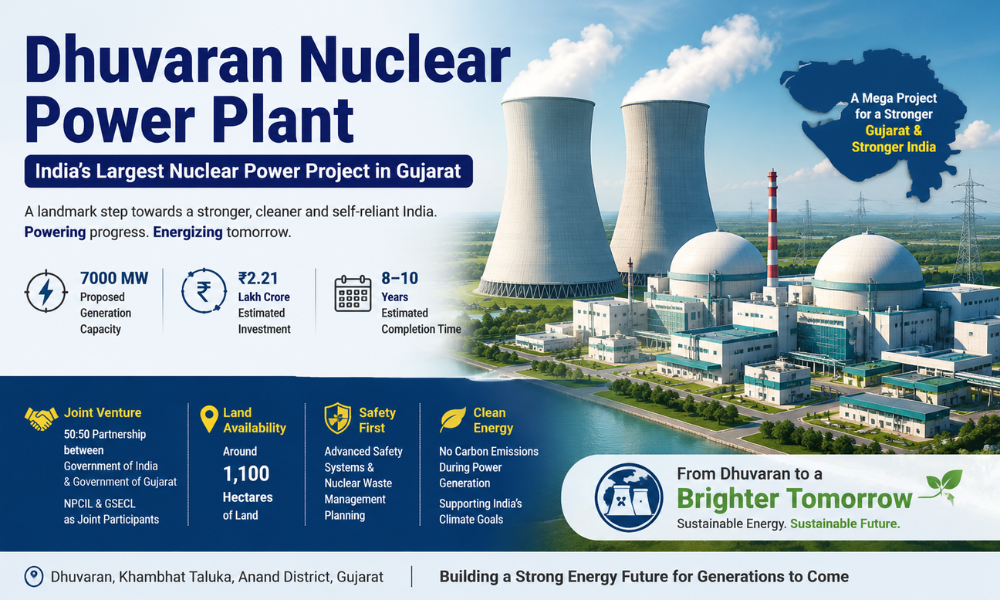
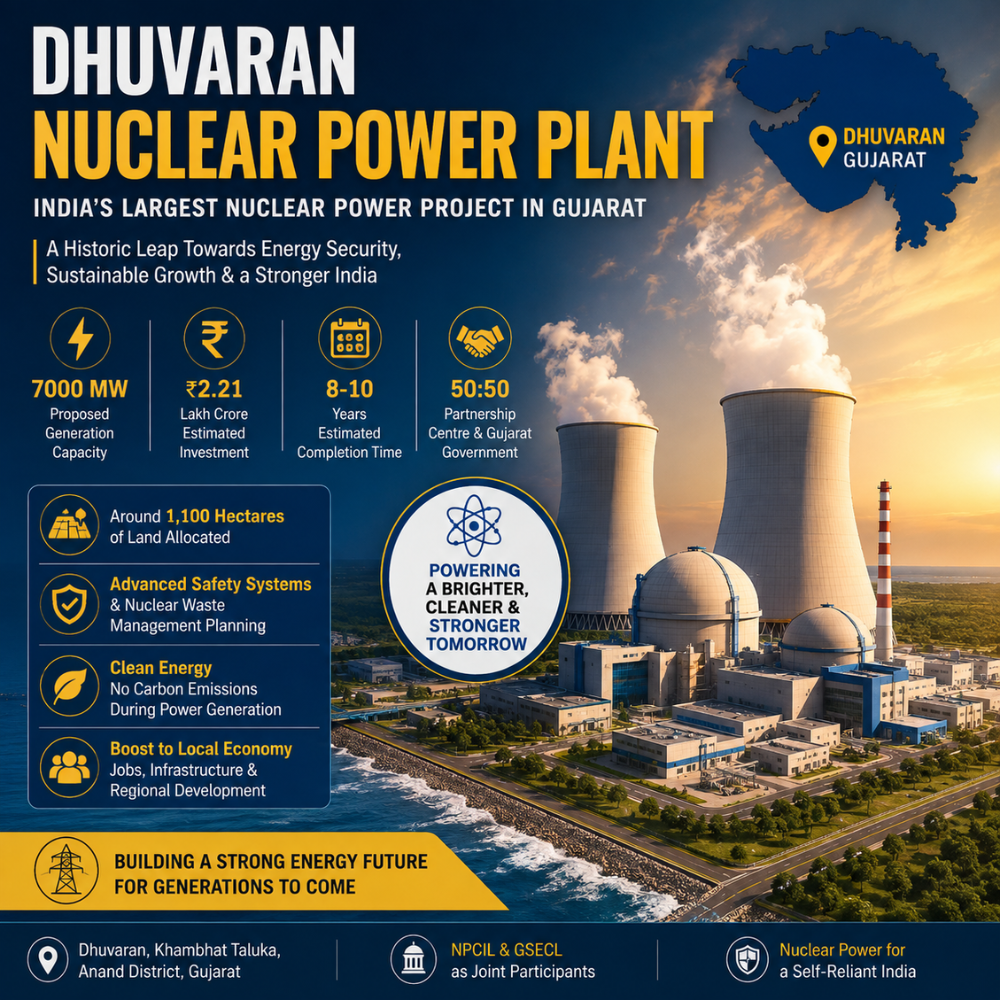
Gujarat is set to witness a major transformation in its energy landscape with the proposed dhuvaran nuclear power plant in Dhuvaran, located in Khambhat taluka of Anand district. According to the newspaper report provided, the project is planned with a massive 7,000 MW generation capacity, making it one of the most ambitious nuclear power developments in the country. The report describes the project as a future nuclear power complex and highlights an estimated investment of around ₹2.21 lakh crore.
The proposed development is expected to play an important role in meeting India’s growing electricity requirements while supporting the country’s long-term transition toward cleaner and more reliable sources of power.
Dhuvaran Nuclear Power Project: A Major Energy Initiative
Dhuvaran has a long association with electricity generation in Gujarat. The newspaper report notes that a 396 MW coal-based power project was started at Dhuvaran in 1965, representing an important chapter in Gujarat’s early power-generation history. Later, in 2010, a 595 MW gas-based power project was developed at the location, although it was subsequently shut down.
The proposed nuclear project represents a significant change in the site’s future role. Instead of relying primarily on conventional fossil-fuel-based generation, the planned development would introduce large-scale nuclear electricity generation.
With a proposed capacity of 7,000 MW, the Dhuvaran project has the potential to become a major component of Gujarat’s future power infrastructure.
₹2.21 Lakh Crore Investment and Large-Scale Development
One of the most notable aspects of the Dhuvaran Nuclear Power Plant is the scale of the proposed investment. The headline in the supplied report states that approximately ₹2.21 lakh crore would be spent on the 7,000 MW nuclear power project. The report also indicates that completing such a mega project could take approximately 8 to 10 years.
Projects of this scale require extensive planning, engineering, construction, safety systems, environmental assessment and supporting infrastructure. A nuclear power complex is significantly more complex than a conventional power station because it requires multiple layers of safety, specialized technology and strict regulatory oversight.
The long development period therefore reflects the scale and technical requirements involved in establishing a major nuclear energy facility.
7,000 MW Capacity to Strengthen India’s Power Infrastructure
India’s electricity demand continues to grow with industrial expansion, urban development, infrastructure projects and increasing household consumption. A large-scale nuclear power project can contribute to meeting this demand through continuous electricity generation.
The proposed 7,000 MW Dhuvaran Nuclear Power Project would represent a substantial addition to the country’s power-generation capacity. Once operational, a facility of this scale could provide a stable source of electricity for homes, businesses and industries.
The project could also contribute to strengthening Gujarat’s position as an important industrial and energy hub. Reliable electricity is particularly important for manufacturing, engineering, infrastructure, technology and other industries that require consistent power supplies.
Central and Gujarat Government Participation
According to the report, the project is proposed through a 50:50 partnership involving the central government and the Gujarat government, with participation from the Nuclear Power Corporation of India Limited (NPCIL) and the Gujarat State Electricity Corporation Limited (GSECL).
Such cooperation can help combine central-level nuclear expertise with the state’s infrastructure and energy-development capabilities. Large infrastructure projects require coordination among government bodies, technical organizations, local authorities and other stakeholders.
The partnership structure highlighted in the report is therefore an important part of the proposed project’s development framework.
Around 1,100 Hectares of Land
The newspaper report states that approximately 1,100 hectares of land is available for the project, highlighting the enormous physical scale of the proposed development.
A project covering such a large area would require careful planning for the main generating facilities as well as supporting infrastructure. This may include access roads, electricity transmission systems, water-related infrastructure, administrative facilities, safety arrangements and other essential services.
Land availability is an important consideration for any large power-generation project, particularly one involving multiple generating units and extensive safety infrastructure.
Focus on Nuclear Waste Management and Safety
Nuclear power offers significant advantages in terms of electricity generation, but responsible management of radioactive materials and nuclear waste is an essential part of operating a nuclear facility.
The newspaper article specifically highlights planning for the safe disposal and management of nuclear waste from the proposed project.
Modern nuclear facilities are designed around multiple safety systems and carefully controlled procedures for handling radioactive materials. Nuclear waste management requires specialized processes, secure storage and long-term planning. Therefore, the proposed Dhuvaran project will need to meet applicable safety and regulatory requirements throughout its development and operation.
Safety will remain one of the most important considerations as the project progresses.
Nuclear Energy and Lower Carbon Emissions
Another important point highlighted in the newspaper report is the environmental aspect of nuclear electricity generation. Unlike conventional fossil-fuel power generation, nuclear power does not involve the routine combustion of coal or gas to produce electricity.
The report notes that electricity generation from nuclear energy does not release carbon dioxide or other toxic smoke directly through combustion, making nuclear energy relevant to efforts to address climate change.
For India, which is balancing rapid economic growth with the need to reduce the environmental impact of energy production, nuclear power can form part of a broader low-carbon electricity strategy.
Benefits for Gujarat and the Local Region
The proposed Dhuvaran project could have wider economic implications beyond electricity generation. Large infrastructure developments generally create demand for construction, engineering, transportation, logistics, services and other supporting activities.
The newspaper report also suggests that restarting major power-generation activity at Dhuvaran could increase economic activity in the surrounding area.
For Gujarat, additional reliable electricity capacity could support industrial development and future investment. Local businesses may also benefit from increased demand for services and infrastructure during the construction and operational phases.
A Long-Term Vision for India’s Energy Future
The Dhuvaran Nuclear Power Project represents a long-term vision for expanding India’s nuclear electricity capacity. With a proposed 7,000 MW capacity, substantial investment and a development timeline of around eight to ten years, it is clearly envisioned as a mega infrastructure project rather than a small power-generation facility.
The project also comes at a time when India’s energy requirements are increasing. A diversified energy mix involving renewable energy, nuclear power and other sources can help improve energy security while supporting economic growth.
Conclusion
The Dhuvaran Nuclear Power Plant in Gujarat is being planned as a landmark energy project with a proposed 7,000 MW capacity. Based on the newspaper report, the project is expected to involve an investment of approximately ₹2.21 lakh crore, around 1,100 hectares of land, participation through a 50:50 central-government and Gujarat-government partnership, and an estimated completion period of 8 to 10 years.
With its combination of large-scale electricity generation, nuclear technology, safety planning and potential economic benefits, the proposed Dhuvaran project could become an important part of Gujarat’s future energy infrastructure. Its successful development would also demonstrate India’s continued focus on expanding reliable, large-scale and lower-carbon electricity generation.
Conclusion
Dhuvaran Nuclear Power Plant – India’s Largest Nuclear Power Project in Gujarat therefore stands as a significant proposed development to watch as India’s energy sector continues to evolve.