





Power Ministry Pushes States to Speed Up Smart Meter Rollout
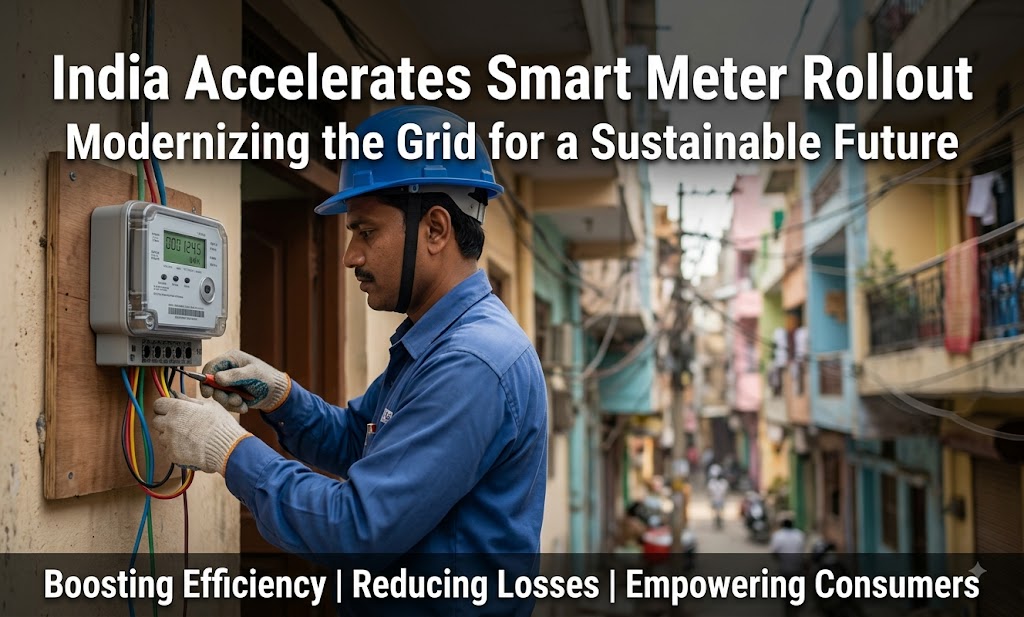
India’s Ministry of Power has directed all states and union territories to continue with, and ramp up, the installation of smart electricity meters in areas covered by communication networks. The ministry’s Wednesday letter comes at a time when the country’s smart metering programme is lagging far behind the targets and adds fresh pressure on states and distribution companies to meet the deadline.
What the Ministry Has Asked For
In the letter, the ministry referred to the Central Electricity Authority (Installation and Operation of Meters) Amendment Regulations, 2026, which requires all consumers in network coverage areas to be supplied electricity through smart meters conforming to Indian Standards, within the timelines stipulated by the government.
The ministry has directed all states and union territories to adopt and hasten the installation of smart meters for all categories of consumers as per this circular. It has been decided to achieve this goal under the umbrella of the Revamped Distribution Sector Scheme (RDSS) along with other state specific schemes, with a deadline of March 2028 under the RDSS.
Why the Push Is Coming Now
Smart meters are not a new thing in India. States have been mandated to start their smart metering programmes years ago. However, the parliamentary committee report on the power ministry’s Eleventh Report of the Committee on Demands for Grants for 2026, tabled this year, has revealed that the government is far off on its targets. The government had set a target of installing 25 crore smart meters by March 2025, but as of mid-February 2026, barely 5.83 crore were in place, the report noted.
The committee observed that while the installation pace had picked up since then, the number of meters being installed currently, at 1.35 lakh per day, may still not be sufficient to meet the target, given the deadline. This concern was perhaps the reason why the ministry sent out the reminder letter to the states.
The Case for Smart Meters
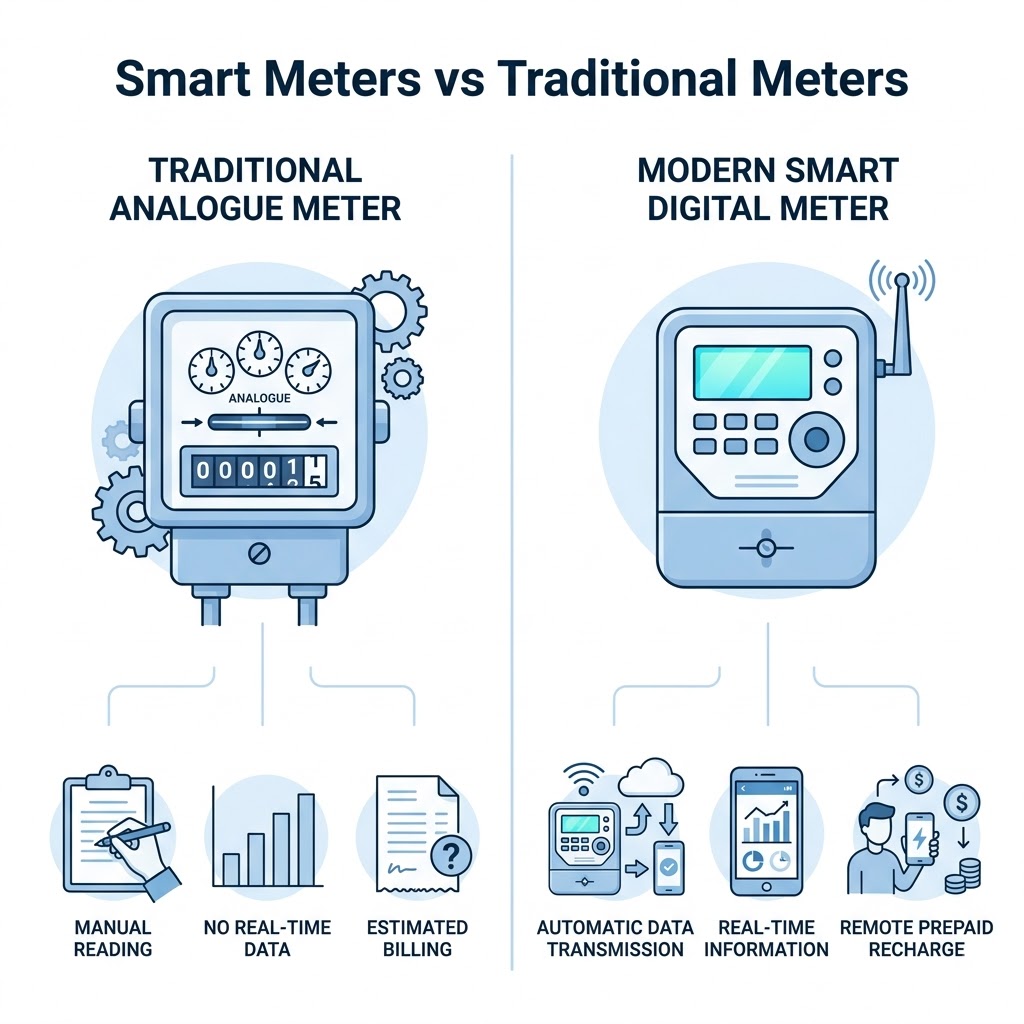
The ministry cited various benefits of smart meters in its circular. It said that they enable a time-of-day pricing mechanism, which allows consumers to reduce their bills by transferring their load consumption from peak to off-peak hours.
For the distribution companies, smart meters help in arriving at accurate energy accounting, thus helping them in improving their operational efficiency and addressing long-standing issues in the sector’s accounting and billing practices.
There is also a financial angle. Smart meters under RDSS are largely being deployed in prepaid mode, which suits both sides. Consumers get the convenience of recharging in small amounts rather than facing large periodic bills, while utilities benefit from advance revenue collection and lower working capital requirements. Rollout under RDSS follows a public-private partnership structure known as the TOTEX model, where a metering service provider handles supply, installation, and operation of the system. The government has also set local content requirements, including a minimum of 60 percent domestic content for the meters themselves and full local sourcing for the head-end and data management systems that support them.
Persistent Problems on the Ground
Despite the push, the rollout has not been smooth everywhere. The parliamentary panel flagged that consumers across several states have been complaining about billing inaccuracies, errors that crop up during data migration from old meters to new ones, worries about how their consumption data is being used and stored, and frequent replacement of meters that have already been installed. These are not minor teething issues. The panel warned that unresolved complaints of this kind risk eroding consumer trust and could undermine the entire point of switching to smart metering in the first place.
The report also pointed to uneven progress in reducing aggregate technical and commercial (AT&C) losses, a long-standing measure of how much power and revenue utilities lose through theft, faulty billing, and inefficiency. While there has been improvement at the national level, the panel noted that this has not been consistent across states, suggesting that structural problems and weak implementation of reforms persist in several places, even where financial support is available under RDSS. Billing and collection efficiencies at the national level currently stand at roughly 87.6 percent and 97 percent respectively, figures the panel said are still holding back proper revenue realisation for utilities.
What This Means Going Forward
The ministry’s letter effectively puts the ball back in the states’ court. With the RDSS deadline set for March 2028 and the current installation pace still judged inadequate by the parliamentary panel, the pressure on states and distribution utilities to move faster is likely to keep building. At the same time, the consumer-facing issues around billing errors and data concerns will need to be addressed alongside the push for speed, or the programme risks losing public confidence even as it gains ground numerically.
For now, the message from the centre is straightforward: the regulatory framework is in place, the funding support exists under RDSS, and states have been formally asked to accelerate what has so far been a slower-than-planned transition to smart metering across the country.
A State-by-State Picture
Progress has never been uniform across India, and that unevenness is part of what the ministry is now trying to correct. Some states, Bihar among them, have reported faster installation numbers than others, while several larger states continue to lag behind their own targets. The ministry has previously constituted a working group tasked with advising distribution companies on how to speed up prepaid smart metering, improve consumer engagement, and make better use of the data these meters generate.
The shift to smart metering also fits into a broader goal of financial viability for the power sector. Distribution companies in many states have long struggled with debt, and better metering is seen as one of the more direct ways to reduce losses and improve revenue collection over time. Coordinated effort between the central government, state governments, and electricity regulators remains essential here, since tariff decisions and subsidy support ultimately rest with the states themselves.
Conclusion
Balancing Speed With Trust
The challenge the ministry now faces is getting states to move quickly without repeating the complaints that have already surfaced. Rushing installations without fixing data migration errors or resolving billing disputes could easily add to the backlog of consumer grievances rather than reduce it. Regulatory commissions and utilities may need to invest as much in consumer communication and grievance redress as they do in the physical rollout of meters, if the programme is to retain public support over the next two years.
With March 2028 now acting as the operative benchmark, the coming months are likely to see closer monitoring of state-wise and utility-wise progress, along with continued pressure from both the ministry and Parliament to ensure the gap between targets and actual installations does not widen further.