
Indian Banks Collected Rs 26,190 Crore in Minimum Balance Penalties Over Four Years
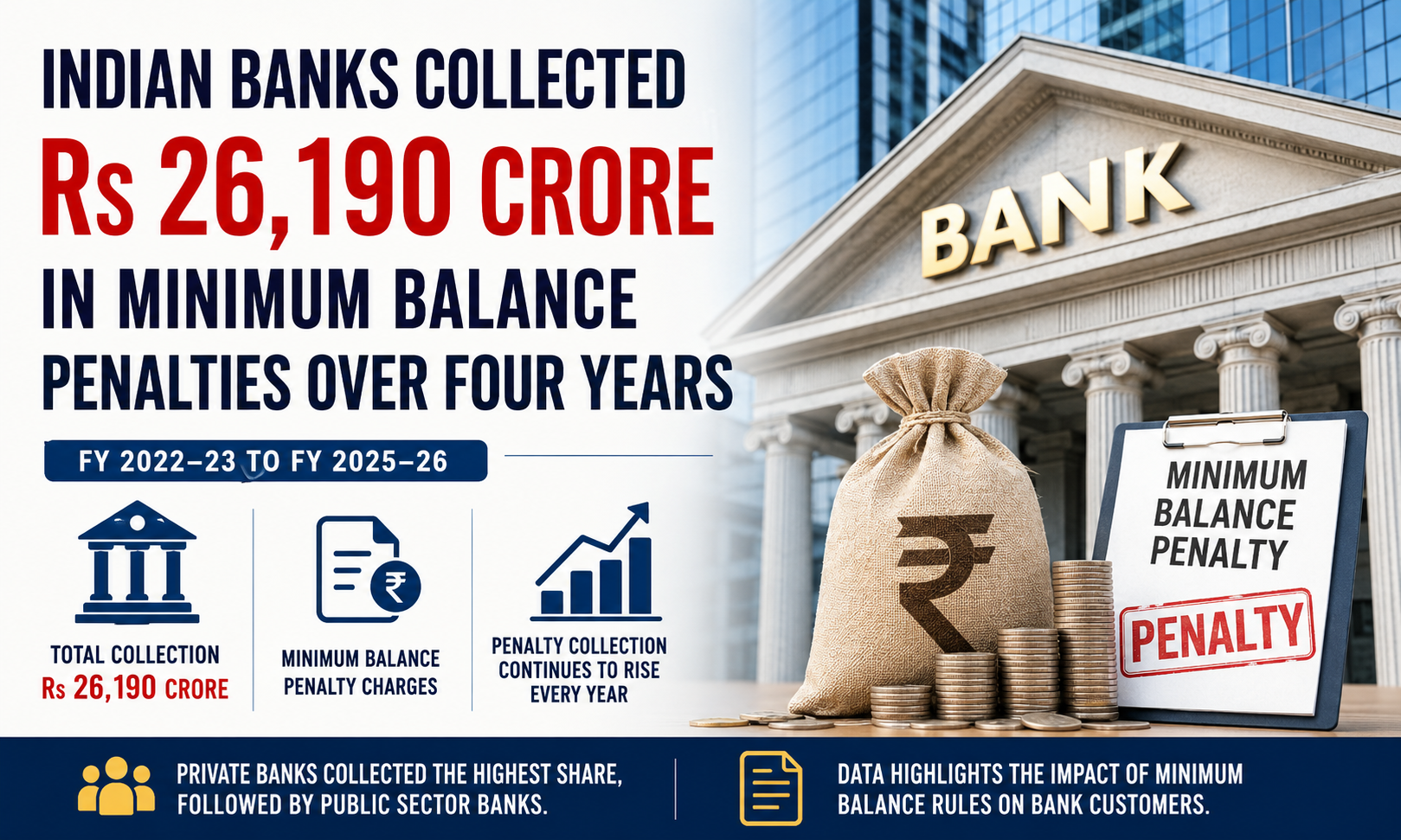
India’s banking sector has generated substantial revenue through penalties imposed on customers who fail to maintain the prescribed minimum balance in their savings accounts. According to government data, banks across the country collected Rs 26,190 crore as minimum balance penalties over the last four financial years, highlighting the significant contribution of these charges to banking revenues. The figures have once again sparked discussions about banking policies, customer-friendly services, and financial inclusion, especially for low-income account holders.
Banks Continue to Earn Huge Revenue Through Minimum Balance Charges
Most banks in India require customers to maintain a minimum average monthly balance (MAB) in their savings accounts. If customers fail to maintain this balance, banks levy penalty charges. Although these charges vary from one bank to another depending on the type of account and branch location, the overall collection has steadily increased over the years.
Government data presented by the Ministry of Finance reveals that from the financial year 2022-23 to 2025-26, banks collected approximately Rs 26,190 crore from customers solely as penalties for not maintaining the required minimum balance.
Why Do Banks Charge Minimum Balance Penalties?
Banks maintain that minimum balance requirements help them manage operational costs, maintain liquidity, and provide better customer services. The money kept in savings accounts also enables banks to lend funds for various economic activities.
However, when customers fail to maintain the required balance, banks impose charges as per their terms and conditions. These charges differ based on account categories such as regular savings accounts, premium accounts, salary accounts, and rural banking accounts.
Many banks also waive these charges for certain categories, including Jan Dhan accounts, pension accounts, and government-sponsored schemes.
Year-Wise Collection of Minimum Balance Penalties
The amount collected by banks through minimum balance penalties has shown a consistent upward trend over the last four financial years.
According to the available data:
- FY 2022-23: Thousands of crores collected through penalties.
- FY 2023-24: Collections continued to rise.
- FY 2024-25: Penalties increased further.
- FY 2025-26: Banks collected approximately Rs 7,086 crore, making it one of the highest annual collections.
The continuous rise indicates that millions of customers continue to incur charges for failing to meet minimum balance requirements.
Private Banks Collected the Highest Share
The data reveals that private sector banks accounted for a significant portion of the total penalty collection.
Private banks collectively recovered around Rs 4,848 crore in minimum balance penalties during FY 2025-26 alone. Among them, Axis Bank recorded the highest collection of approximately Rs 1,788 crore, followed by HDFC Bank, which collected over Rs 1,081 crore.
These figures indicate that large private banks earn substantial non-interest income through service charges, including minimum balance penalties.
Public Sector Banks Also Collected Significant Amounts
Public sector banks were not far behind. Combined, government-owned banks collected around Rs 2,237 crore during FY 2025-26 through minimum balance penalties.
Among public sector lenders, the State Bank of India (SBI) recorded the highest collection, accounting for nearly Rs 471 crore. Other public sector banks also contributed significantly to the overall figure.
Although public banks generally charge lower penalties than many private banks, their extensive customer base results in considerable overall collections.
Impact on Customers
Minimum balance penalties mainly affect ordinary savings account holders. Customers with irregular income, students, senior citizens, and individuals from economically weaker sections often find it difficult to maintain the prescribed minimum balance throughout the month.
Repeated deductions due to penalties reduce their available savings and may create additional financial stress. For many customers, especially those in rural and semi-urban areas, even small monthly deductions can become a significant burden over time.
Consumer rights groups have repeatedly urged banks to adopt more flexible policies for such account holders.
Financial Inclusion Concerns
India has made remarkable progress in financial inclusion through initiatives like the Pradhan Mantri Jan Dhan Yojana, which has brought millions of unbanked citizens into the formal banking system.
However, banking experts argue that high minimum balance penalties may discourage people from actively using their savings accounts. Customers with limited financial resources may avoid maintaining regular banking relationships if frequent deductions reduce their account balances.
Experts believe that banks should strike a balance between operational requirements and customer welfare.
Banks Defend Their Policies
Banks argue that minimum balance rules are clearly communicated to customers at the time of account opening. They also point out that different account variants are available, including zero-balance accounts and basic savings bank deposit accounts designed specifically for customers who cannot maintain higher balances.
Financial institutions maintain that service charges are an important source of non-interest income that helps cover infrastructure, technology upgrades, digital banking services, cybersecurity investments, and customer support operations.
They further state that customers are free to choose account types that best suit their financial needs.
Calls for More Customer-Friendly Banking
Financial experts suggest several measures that could reduce the burden on customers without significantly affecting banks’ revenues.
Some recommendations include lowering minimum balance requirements for small account holders, offering grace periods before penalties are imposed, sending advance alerts when account balances fall below the prescribed limit, and increasing awareness about zero-balance banking options.
Digital banking platforms can also help customers monitor their balances in real time, reducing the chances of accidental penalty charges.
Growing Importance of Transparency
The publication of government data has once again highlighted the need for greater transparency in banking charges. Customers are increasingly demanding clear disclosure of all applicable fees, including minimum balance penalties, SMS charges, ATM usage fees, and other service-related deductions.
Greater transparency not only helps customers make informed decisions but also strengthens trust between banks and account holders.
Conclusion
The collection of Rs 26,190 crore through minimum balance penalties over four financial years demonstrates the significant role that service charges play in the Indian banking sector. While banks consider these charges necessary for operational efficiency and financial sustainability, many customers view them as an additional burden, particularly those with limited incomes.
As India’s banking ecosystem continues to expand and financial inclusion remains a national priority, policymakers and financial institutions may need to explore customer-friendly alternatives that balance operational needs with consumer protection. Better communication, flexible account options, and transparent fee structures can help ensure that banking services remain accessible, fair, and beneficial for every section of society.