China’s New Digital Passport for Robots: Every Humanoid Now Gets a Unique Identity
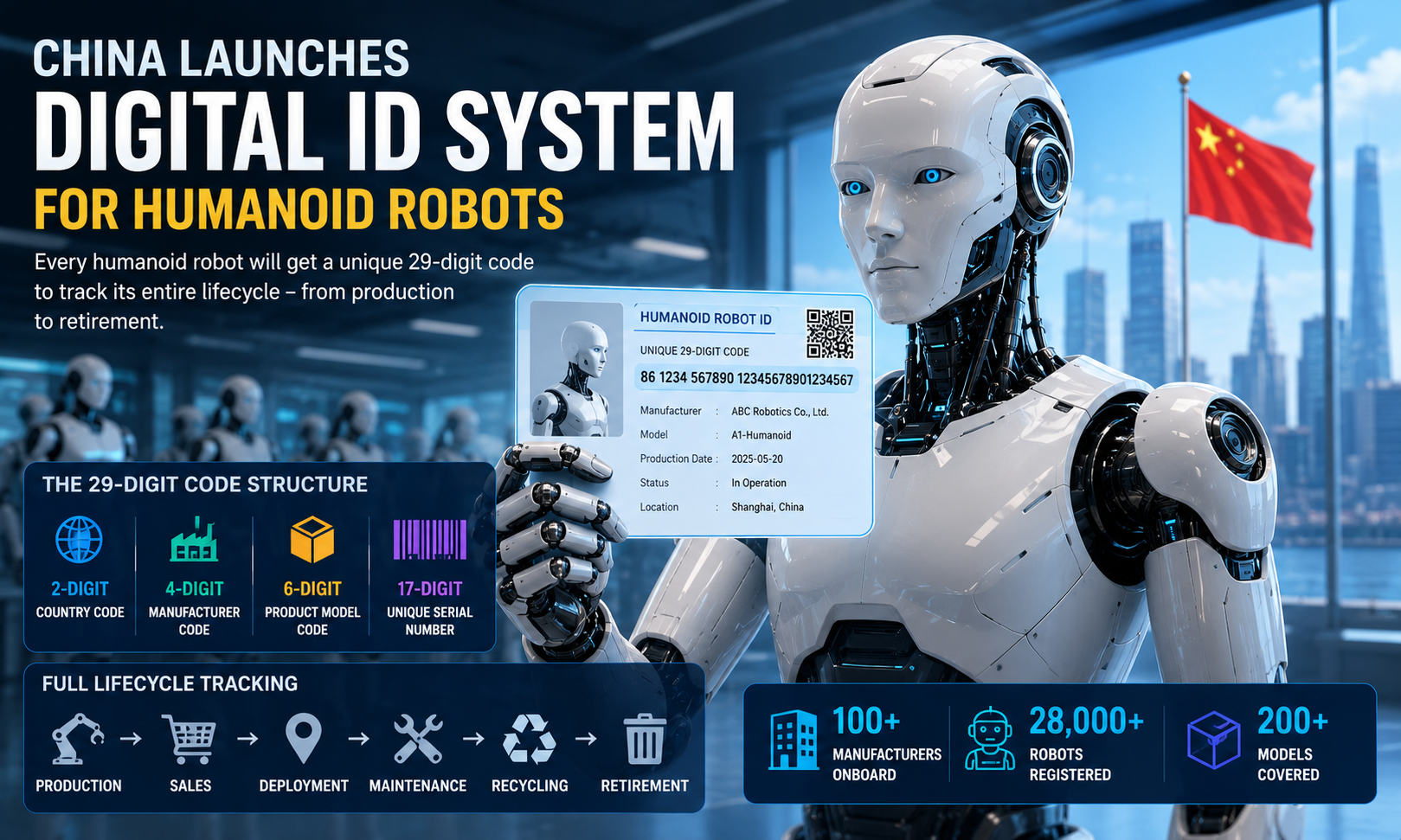
In tandem with the advances being made in the design and creation of humanoid robots, it seems the authorities are considering different ways of regulating and monitoring the same robots. This is seen as an innovative attempt by the Chinese authorities who have introduced the concept of giving humanoid robots, running on AI technology, a digital identity. According to the new regulations, all humanoid robots will be assigned unique identifier codes that have 29 digits. These unique identification codes can therefore be likened to passports issued to robots. The primary aim is to facilitate tracking of individual robots throughout their existence, right from production to destruction.
China Establishes Digital Identity for Robots
A novel concept referred to as Humanoid Full Lifecycle Management Service Platform has been initiated by Chinese authorities, who aim at providing digital identities for all humanoid robots used on the territory of China. The decision has been taken as Chinese robotics industry grows fast, while robots with AI become increasingly common in different sectors ranging from manufacturing and logistics to science and customer services. Similarly to passports and identification cards used by people, such digital IDs are going to help track the entire lifespan of robots.
The Humanoid Full Lifecycle Management Service Platform will serve as an integral part of a management system connecting manufacturers, retailers, service providers, end-users, and recyclers of these intelligent machines. Providing unique IDs will ensure that authorities can effectively monitor the sector. It also indicates China’s intent to dominate the market of artificial intelligence and robotics in future, as humanoid robots become more efficient, diverse, and commonplace.
Understanding the Process of Generating the 29 Digit Code
One of the essential features of the robot identification system implemented by China is a unique identification code that identifies any humanoid robot. In other words, it represents a digital passport of a certain machine that stores specific data related to that robot. The identification code consists of four separate components, which include two digits representing the code of a particular country, four digits representing a company producing a machine, six digits referring to the robot model, and a unique 17-digit serial number.
In general, the use of the identification code allows registering and collecting important data about any robot, including its production date and location, manufacturer, model, deployment location, repair history, current owner, place of eventual disposal, etc. Such a detailed tracing process makes it possible to follow and control robot movements and conditions. Moreover, the use of the identification code allows preventing potential mix-ups of similar models. Considering the growing number of humanoid robots, such an approach provides more effective monitoring and management of thousands of robots.

Enhancing Robotics Safety, Accountability and Governance
One of China’s main objectives with respect to its robot identification system is to enhance safety, accountability, and governance in the fast-growing area of robotics. The emergence of humanoid robots assuming greater responsibility within the workplace and in public places raises increasing concerns about malfunctions, defects, and the potential risks associated with operation. The new digital identity system offers a reliable method for tracing each and every robot back to its manufacturer and service history and provides a mechanism for easily determining the root cause of an issue.
When a robot fails to function properly or creates safety issues, authorities can readily access the records that relate to that robot’s digital identification number, allowing regulators and manufacturers to investigate these problems, perform recalls where appropriate, and limit similar problems from adversely affecting other robots. Additionally, the system provides greater clarity regarding accountability by documenting the individual or entity that designed, built, sold, serviced, and/or operated an individual robot. The platform creates a foundation for establishing standardized approaches within the industry and encourages users to utilize robotics technologies in a responsible manner. The ultimate intent of China’s digital identity system is to assist in building greater confidence in humanoid robots by assuring that innovative development occurs while maintaining appropriate regulatory oversight and public safety.
Industry Regulations for the New Framework: ‘No Code, No Market Access’
The introduction of a new framework by China comes with stricter regulations for the manufacturers. Among the regulations introduced is that called the “No Code, No Market Access” regulation. For humanoid robots, it entails that a manufacturer must register the robot in the national database where it receives an identification number. The 29 digits of code help in tracking all activities of the robot right from when it enters the market.
It is now the responsibility of the manufacturers to ensure that their products remain safe and of high quality. In case any problem persists in a certain model of the robot, manufacturers would be obliged to recall them and solve the issue. There is also the prevention of reselling of refurbished robots that were initially scrapped. Currently, it has been reported that over 100 robot manufacturers have been registered in the platform, together with 28,000 registered humanoid robots in 200 different models.
Conclusion
The establishment of digital identity for humanoid robots by China is a great move toward regulation of the future of artificial intelligence-based robots. This is because every robot will be assigned a unique digital identity, which will help ensure that there are no accidents or any form of danger associated with these machines. Since humanoid robots are becoming prevalent, they can act as an example to other countries in the coming years.