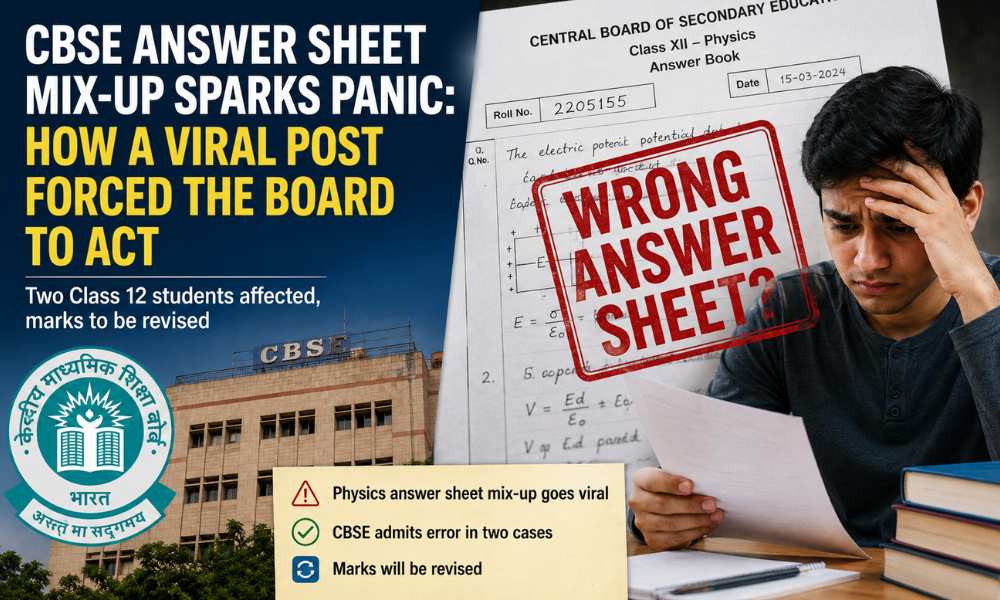
CBSE Answer Sheet Mix-Up Sparks Panic: How a Viral Post Forced the Board to Act
The latest controversy over the answer sheets of CBSE has caused a huge stir amongst students, their parents, and teachers all over India. Starting out from one student’s post on social media, the entire matter has snowballed into an important debate regarding transparency and accuracy in evaluating board examinations. The class 12 student named Vedant Srivastava has accused CBSE of sending someone else’s Physics answer sheet to him during his re-evaluation session, making him concerned about any potential mistake in the marking of the test which might influence his future prospects at college. Now, CBSE has conceded to having discrepancies in two different cases and has promised to update the scores accordingly.
Answer Sheet Mismatch Controversy Related to Viral Physics Answer Sheet
The controversy started when the Class 12 student, Vedant Srivastava, posted a series of statuses on social media highlighting the fact that the Physics answer sheet posted by CBSE during their re-evaluation process did not belong to him at all. According to the student, the handwriting, content, and answer in the said uploaded script were completely unknown to him, which came as a shock and made him doubtful about his score in the subject. The student mentioned that he had made a request for the photocopy of his evaluated answer sheet to CBSE using their Online Script Monitoring (OSM) system and was shocked to see a completely unknown answer script of Physics uploaded by CBSE. This led Vedant to think about the accuracy of the process of verification and distribution of answer scripts to the concerned candidate. Many students and parents got alarmed about the issue and were worried that this was not the only subject where such mistakes might occur.
Problems with CBSE exam scores will be addressed.
An issue has arisen regarding the way the CBSE (Central Board of Secondary Education) evaluates exam answers and has committed itself to providing corrections based on sightings of the flaw by students posting on social media. One such posting involved a student from the Technical Institute of Pune named Vedant Srivastava who sent an email to CBSE protesting the incorrect answer sheet for his Physics exam, and was sent a reply on 14 March 2018 acknowledging that the original answer sheet given to him was inaccurate and providing him with documentation of his original Physics score sheet and further stating that within weeks he would have an updated mark that correctly reflected his performance on his exam. This response would validate the student’s allegations he made to CBSE by way of social media postings. Other students have come forward with similar issues regarding their Chemistry exam score sheets. After verifying the issues raised by the Chemistry student were legitimate, CBSE also issued an admission validating the Chemistry student’s claims. Many are questioning the security of their ability to accurately evaluate students’ answers digitally and share their results electronically and hence the reliability of those processes for students’ future academic and professional career paths. This incident, in light of the number of students that have been affected by the CBSE examination controversies, received considerable attention from the public and the media, prompting CBSE to take immediate steps to rectify and prevent similar errors from occurring again as soon as possible after the original error gained public notoriety via social media.
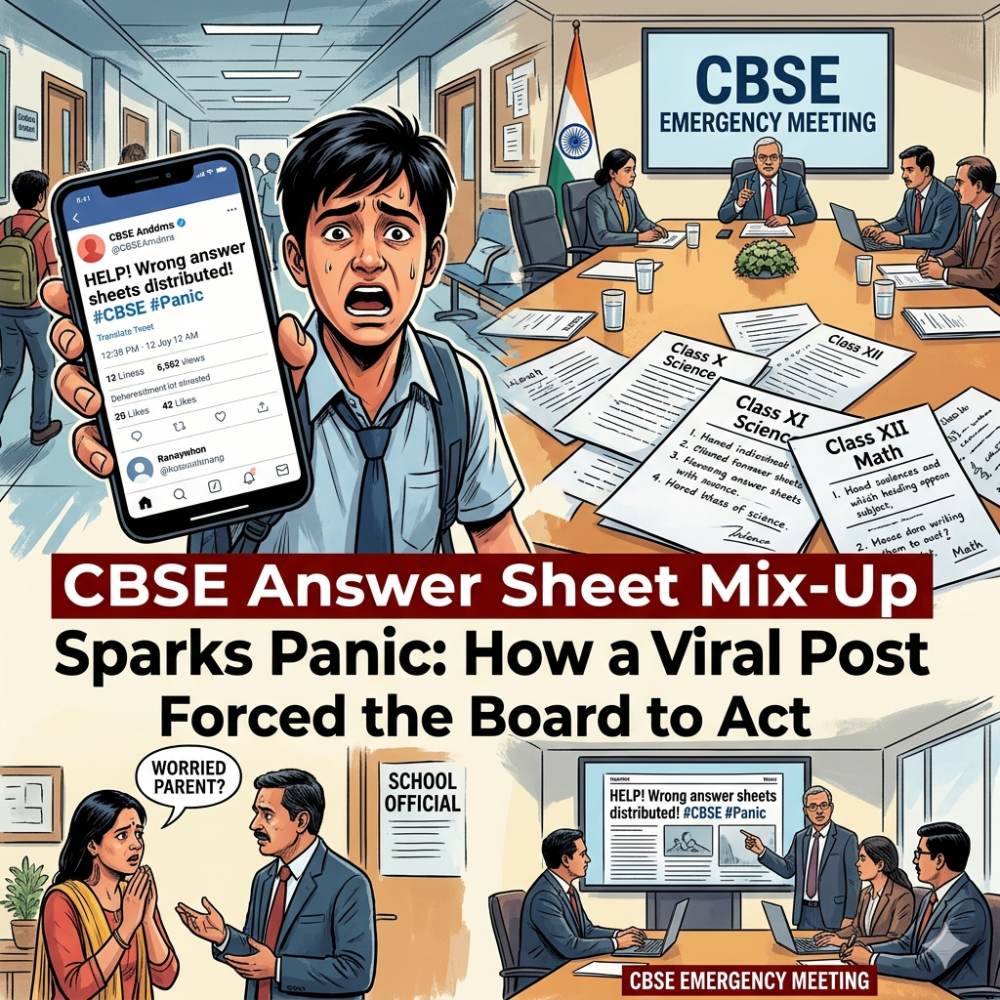
Pressure through Social Media and Emergence of Student Accountability
From the incident, it is evident that there is increasing power through social media in making big organizations responsible for issues raised by individuals. For instance, Vedant Srivastava used X to voice his complaints, which attracted the attention of many people and prompted CBSE to investigate immediately. Such an incident would not have received any response or been attended to at all in previous years. Students today can use social media platforms to express themselves concerning academic issues and demand action immediately. Through the discussions on social media, the issue was able to gain popularity and force the CBSE to address it as soon as possible. Most students praised the role of social media in making institutions transparent. The case made more students aware of their rights and gave them courage to speak about their grievances.
Bigger Questions Around CBSE’s Online Script Monitoring System
The recent controversy surrounding the answer sheet has caused public outcry over the effectiveness and reliability of the CBSE’s Online Script Monitoring system. The Online Script Monitoring System was designed with the purpose of increasing transparency around the post-result process in order for students to receive photocopies of evaluated answer scripts and apply for verification and/or re-evaluation; however, due to discrepancies between the two systems, both students and their parents have raised questions about whether or not the answer scripts were uploaded, tracked and verified correctly, and how is it possible for this type of error to happen given that so many records are processed through the CBSE each year? A minor error in the evaluation or document sharing could have major repercussions for a student’s future, potentially affecting scores, admissions to colleges, scholarship opportunities, and job prospects. The issue has re-ignited calls for improving quality checks, improvement to digital tracking systems, and improvement to grievance redress systems of the CBSE. In response to all of this, the CBSE reported that corrective action will be taken based on individual cases, but overall this incident is an indication that the CBSE has a strong desire for continued improvements in accountability to the public and reliability of technology, particularly in the highly competitive nature of the Indian exam system.
Conclusion
However, the problem with the CBSE answer sheets has only reiterated the importance of transparency and precision in the Indian education sector. Even as the CBSE admits that there have been discrepancies in scores and pledges to rectify them, the case has posed a lot of questions regarding the reliability of the digitized methods for evaluation and verification of scores. The stress levels of students, who rely so much on their board examination scores for future prospects, increase significantly if even a single error is made during the process. In any case, the situation has also indicated that social media does hold some power in holding institutions accountable.