




China’s 1,000 Km/h Train: A Glimpse Into the Future of Travel
The thought of traveling between two major cities in less than an hour once sounded like science fiction. For decades, cutting edge motion pictures and innovation expectations envisioned trains moving at extraordinary speeds through progressed burrows and attractive tracks. Nowadays, be that as it may, that future appears closer than ever. China has supposedly tried a high-speed preparation capable of coming to 1,000 kilometers per hour, an improvement that has started worldwide consideration and excitement.
If such innovation gets to be commercially effective, it might totally rethink transportation as we know it. Long street trips may end up pointless, residential flights might confront solid competition, and individuals may start considering almost removing in a totally diverse way.
The Prepare That Turned Heads
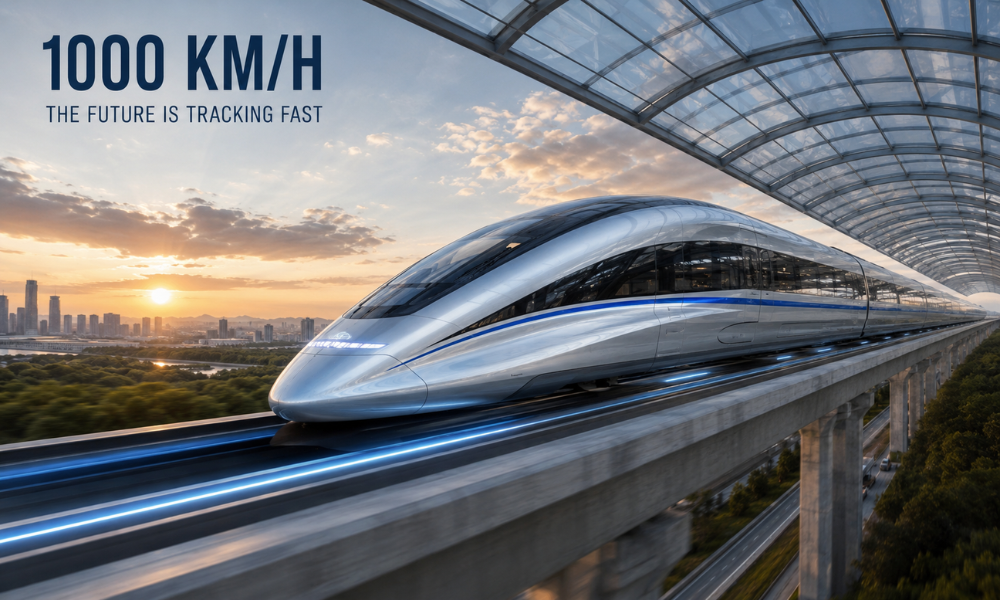
China has as of now built up itself as a worldwide pioneer in high-speed rail innovation. The nation operates the world’s biggest high-speed rail network, interfacing hundreds of cities with trains that frequently run at speeds between 250 and 350 km/h. But this modern exploration pushes the boundaries distant past conventional rail systems.
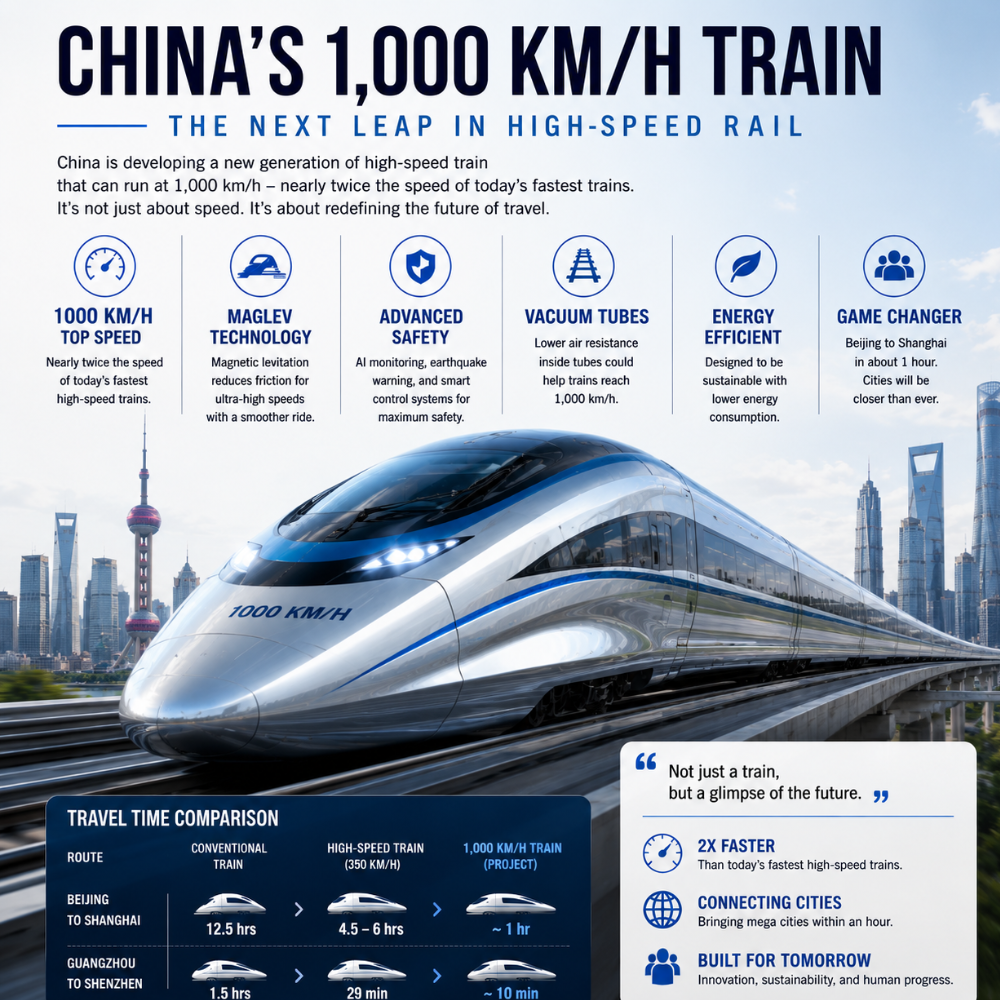
The as of late examined model prepare is planned to travel at an bewildering speed of 1,000 km/h. To understand how quick that truly is, consider this: a travel that ordinarily takes a few hours by street or indeed a household flight can possibly be completed in less than one hour.
For example, the separation between Delhi and Patna, which frequently requires long prepared ventures or flights with air terminal holding up time, seems hypothetically to be secured in around an hour. Such speed would drastically alter commerce, travel, tourism, and everyday commuting.
How Is This Indeed Possible?
The prepare allegedly employed advanced levitation innovation, commonly known as maglev. Not at all like conventional trains that run on wheels, maglev trains drift somewhat over the tracks utilizing effective magnets. Since there is nearly no physical contact with the rail, grinding is enormously reduced.
Less contact implies the prepare can move much quicker whereas moreover lessening wear and tear on the system.
However, coming to speeds near to 1,000 km/h presents another challenge: discussing resistance. At amazingly tall speeds, discussion gets to be one of the greatest deterrents. To overcome this, engineers are testing with low-vacuum or near-vacuum tubes where the prepare can travel with negligible discuss drag.
This concept is comparable to the “Hyperloop” thought proposed by a few innovation companies in the last a long time. By combining attractive levitation with low-pressure burrows, transportation frameworks seem to accomplish airplane-like speeds while remaining ground-based.
Why the World Is Paying Attention
Transportation has continuously formed civilizations. Nations with speedier and more dependable transport frameworks frequently involve more grounded financial development, way better exchange, and strides in quality of life.
China’s exploration is critical since it appears how forcefully nations are contributing in the next-generation framework. The plausibility of 1,000 km/h travel is not a fair approximate speed—it speaks to a bigger move toward more brilliant, more proficient mobility.
Imagine living in one city and working in another found hundreds of kilometers absent. Envision going to an assembly in the morning in one state and returning home by lunch. Envision understudies being able to get to colleges in removed cities without moving permanently.
This innovation seems to recoil geological boundaries in ways that past eras never imagined.
Could It Supplant Discuss Travel?
One of the most curious questions encompassing this innovation is whether ultra-fast trains might in the long run compete with airplanes.
Airplanes are quick, but airplane terminals include long security lines, boarding strategies, stuff checks, and travel to and from terminals. A prepare station, on the other hand, is regularly found closer to city centers and as a rule offers speedier boarding.
If a preparer can travel at 1,000 km/h effectively, the add up to travel time may become shorter than flying for numerous residential routes.
For case, a traveler traveling between two cities may spend:
One hour coming to the airport
Two hours for security and boarding
One hour flying
Another hour taking off the airplane terminal and coming to the destination
That same travel may possibly have been a coordinated city-center-to-city-center trip in a division of the time.
This is why specialists who accept ultra-fast rail frameworks may become genuine competitors to short-distance travel in the future.
The Designing Challenge
While the concept sounds energizing, turning it into a dependable open transport framework is inconceivably difficult.
Building low-pressure burrows over long separations would require gigantic venture. The framework must be greatly exact since indeed a little deformity may become perilous at such tall speeds.
Safety is another major concern. Engineers are required to guarantee that travelers stay secure and comfortable amid speeding up, braking, and crisis situations.
There are too many questions about vitality utilization, upkeep costs, and natural impact.
High-speed innovation is not as it were around making trains speedier. It is too almost making frameworks that are economical, reasonable, and commonsense for regular use.
China’s Innovative Ambition
China’s fast advance in foundation has gotten to be one of the characterizing stories of the cutting edge period. Its high-speed prepare organize as of now interfaces farther locales and major financial centers with exceptional effectiveness. Millions of individuals utilize these trains daily.
The improvement of a 1,000 km/h prepare fits into China’s bigger vision of mechanical administration. The nation has been contributing intensely in fake insights, electric vehicles, renewable vitality, semiconductor fabricating, and progressed transportation.
By pushing transportation innovation to unused levels, China is not fair tackling travel problems—it is moreover sending a message around advancement, national desire, and future readiness.
What Seems This Cruel for India?
For nations like India, improvements like these give both motivation and opportunity.
India has as of now started modernizing its railroad framework with semi-high-speed trains like the Vande Bharat Express. Metro frameworks are growing quickly over major cities, and bullet-prepared ventures are beneath development.
Although a 1,000 km/h prepare may still appear distant absent for India, mechanical progressions as a rule spread over time. What starts as a costly test venture can inevitably get to be more reasonable and broadly adopted.
India’s developing economy, gigantic populace, and expanding urbanization make quick transportation progressively important.
Efficient transport frameworks can:
Boost financial productivity
Reduce travel fatigue
Improve tourism
Connect littler cities with major financial hubs
Encourage territorial development
Watching how China creates and executes such innovations may offer profitable lessons for policymakers and engineers worldwide.
Environmental Affect: Superior or Worse?
Interestingly, ultra-fast rail frameworks may too impact natural sustainability.
Air travel contributes altogether to carbon outflows. If progressing rail frameworks fueled by clean vitality can supplant brief household flights, they may offer assistance to diminish natural damage.
Electric trains are for the most part considered more energy-efficient than airplanes for numerous courses. Be that as it may, the natural benefits would depend intensely on how power is created and how the foundation is built.
Large-scale development ventures can too influence biological systems, so supportability arranging would stay essential.
The Human Side of Speed
Beyond innovation and financial matters, there is something profoundly passionate around quicker travel.
For centuries, human civilization has persistently attempted to diminish travel time. From steeds to steam motors, from cars to airplanes, each major jump in transportation has changed how individuals encounter the world.
Faster travel implies families can meet more frequently. Businesses can collaborate more effectively. Understudies can get to way better openings. Restorative crises can be taken care of more quickly.
When removal gets to be less of a boundary, social orders frequently become more connected.
Is the Future As of Now Here?
Although the thought of customary 1,000 km/h preparation travel is still in the test arrange, the heading is clear: transportation is advancing rapidly.
What feels cutting edge nowadays may end up ordinary inside a few decades.
Not long back, indeed 300 km/h trains appeared inconceivable. Nowadays, they work routinely in a few nations. The same design may be rehashed with ultra-fast attractive transportation systems.
Of course, challenges stay. Costs, security, framework, and open acknowledgment will all decide whether these frameworks become commercially viable.
Still, one thing is evident: the race to construct the future of transportation has as of now begun.
Conclusion
Final Thoughts
China’s detailed test of a 1,000 km/h prepare is more than fair an innovative experiment—it is a see into how humankind may travel in the coming decades.
The extent reflects desire, advancement, and the worldwide want to make transportation quicker, more astute, and more efficient.
Whether or not these trains got to be standard before long, they speak to an imperative step toward the following period of mobility.
And maybe the most interesting portion is this: future eras may see today’s flights and long-distance street ventures the same way we presently see at steam trains from the past.
The future is moving fast—possibly at 1,000 kilometers per hour.