
Why More Indians Are Choosing Freelancing Over Traditional Jobs
Being a freelancer is no longer a side-line activity in India; it is now rapidly becoming a favoured option among Indian professionals. Due to the emergence of technology, especially those that allow employees to work remotely, professionals in India are now reconsidering the traditional nine-to-five work structure. Modern workers want to enjoy greater freedom in what they do and how much money they earn. In consequence, Indian individuals are leaving behind conventional employment and embracing freelancing.
The Advent of Telecommuting and Digital Possibilities
One of the most significant factors responsible for the increase in the trend of freelancing in India is that of telecommuting and the rise in online platforms. With better connectivity and relatively cheaper gadgets, people can now do freelance jobs irrespective of their geographical limitations. Sites like Upwork, Fiverr, and Freelancer have enabled people from India to get hired globally. Whether it is writing, designing, programming, or marketing, freelancing provides ample scope and options for people with different skills. Moreover, many firms all over the world nowadays tend to prefer telecommuting freelancers rather than hiring employees to cut down on costs. As such, India has emerged as one of the countries that provide freelancers with abundant prospects.
Priorities for Modern Workers include Flexibility and Work-Life Balance.
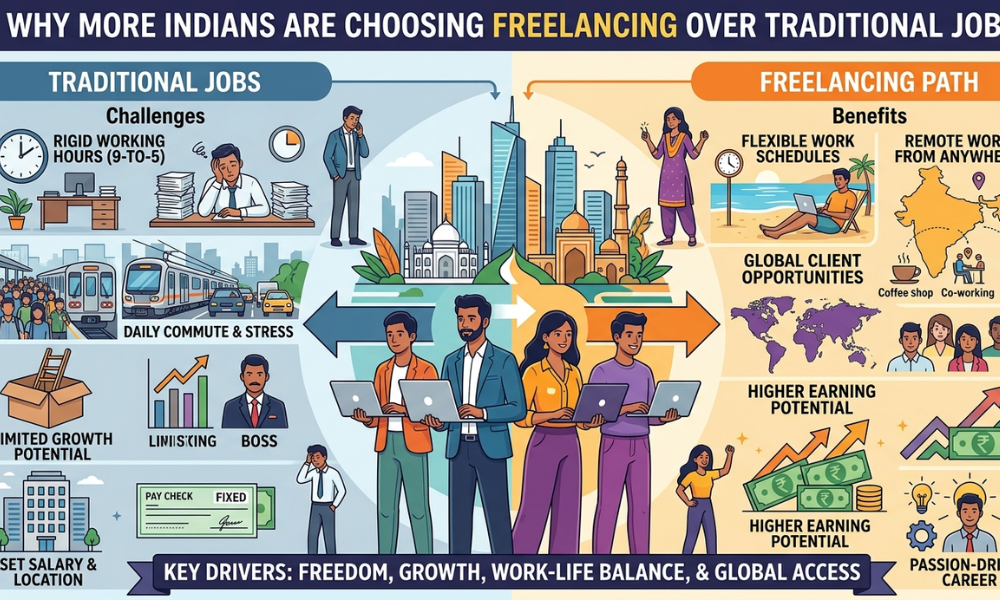
More and more, flexible working hours and better work-life balance are becoming priorities for many workers in today’s workforce, something that is often lacking in traditional employment arrangements. Freelancing, as a type of self-employment, gives individuals the ability to decide when, where and how they work, thus allowing them to determine their own schedules. Instead of being subject to fixed office hours and long commutes, freelancers can create their workdays according to their various professional/economic and personal needs. This type of flexible scheduling is becoming very popular among younger professionals, parents, and those who want to pursue many different interests. Additionally, people can often work from home or while traveling in their freelancing pursuits, allowing for far more freedom than traditional employment can offer. Moreover, due to the shift in mindset from working a lot of hours to working smarter, freelancing has become an increasingly attractive and stable option for many people in India.

Higher Earning Potential and Multiple Income Streams
The ability to earn more money and create various income sources are two of the main reasons for the outstanding growth of the freelance jobs market. With multiple clients and/or projects, freelancers have many ways to increase their income, whereas salaried employees receive a fixed income each month. Freelancers also have complete control over their income by determining their own billing rates based on skill level, experience, and demand for their services. In time, experienced freelancers may charge higher rates than less experienced freelancers or work with international companies that pay in stronger currencies than dollars. Freelancers may also have access to additional income through consulting, creating content, and/or selling digital products, creating a many-ways-to-make-money scenario. Although it can take some time to establish a steady income as a freelancer, successful freelancers often negotiate for more money and become more independent financially than they would have in a traditional job. Due to their potential for financial growth and the degree of control they offer over how and/or where to earn money, freelancing is an attractive option for ambitious professionals.
Dissatisfaction with Traditional Job Culture
There has been a significant rise in the number of people in India who leave traditional jobs after realizing they do not enjoy working in the established workplace environments. Many feel frustrated in a typical trade job due to long hours, hierarchy structure and office politics with no real career advancement opportunities. Commuting on a daily basis, particularly in large metropolitan areas, has also taken its toll on the bodies and minds of most workers. Additionally, many feel the skill set they possess is not being fully utilized and that they do not have enough creative input in their job within an office. On the other hand, freelancing provides the independence and opportunity for creative expression and ownership of one’s work. This allows freelancers the ability to select projects based on their personal interests, providing them with greater job satisfaction than they would have received from an employer in a corporate environment. In addition, the uncertainty many experienced through layoffs due to the pandemic has caused many to be less secure about the longevity of their job, creating a perception of the restlessness of employees, making the idea of freelancing an attractive alternative to trying to find a career path that provides greater fulfillment and self-direction.
Conclusion
Freelancing in India is not merely a fad but represents a significant change in the perception of employment and success. With increasing global connectivity, flexibility, and higher income levels, many professionals have opted for this route. Freelancing may pose several difficulties, yet the advantages generally supersede the disadvantages. In light of the expanding digital economy, it is probable that the practice will become increasingly commonplace. The key to freelancing lies in its ability to allow individuals to create their own career paths according to their objectives.