




When AI Wasn’t Enough: How Ford’s Return to Human Expertise Revived Quality and Innovation
AI is revolutionizing businesses, but Ford’s latest story shows that it is not enough for technology to take the place of years of experience by humans. After leaning too much on the AI-powered quality management system, the carmaker realized that the best results could be achieved if it had its experienced engineers work with the most advanced technologies. In this way, the company managed to improve the quality of its vehicles, save money, and optimize its production process.
Reasons Why Artificial Intelligence-Based Quality Approach Failed at Ford
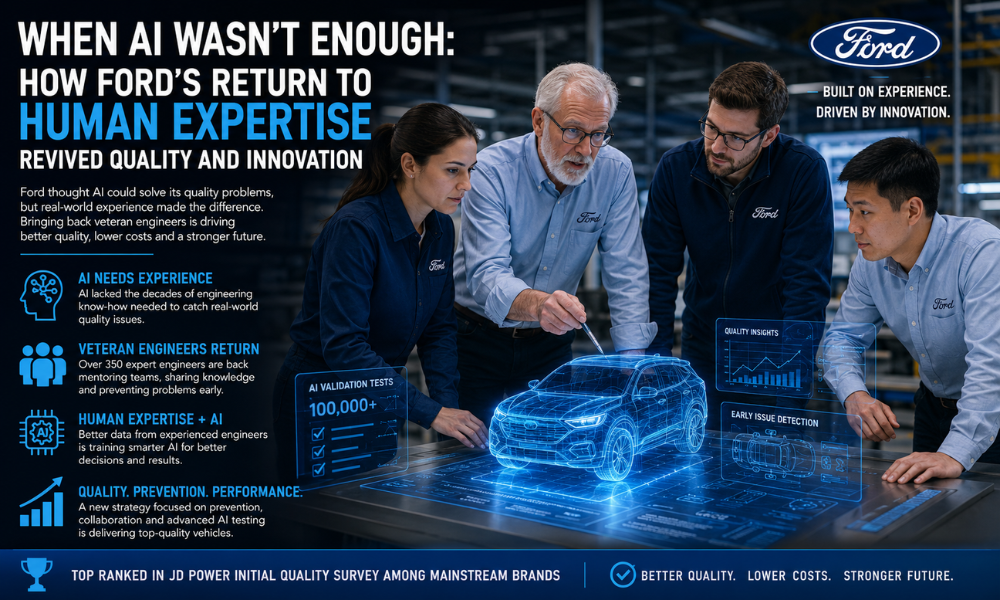
The Ford Motor Company had made great investments into AI technology to be able to analyze design specifications, find possible flaws and problems and increase efficiency of the production process without much participation of employees. Unfortunately, the approach chosen by the corporation did not lead to the expected outcome. Although AI was good in dealing with large volumes of information, it was inferior to engineers’ practical knowledge accumulated during many years of work on different generations of vehicles. There were many things that professional engineers knew but which the computer could not detect due to insufficiently large amount of real-life engineering information used to train AI system. Later, management admitted that they have overestimated capabilities of the AI to substitute engineers’ expertise. Thus, the example clearly shows that the effectiveness of AI-based solutions is determined by the information it gets and people who are behind this information. It means that AI does not replace experts but becomes very helpful in combination with experienced specialists.
Rehiring Veteran Engineers: Bringing back Years of Technical Experience
In order to address the shortcomings of their automated quality management systems, Ford decided to start hiring experienced engineers. Not only are the firm’s own engineers being brought back from retirement but specialists working in partner-supplier organizations are also considered. In the past three years, over 350 seasoned professionals were hired back into the company. The internal name for those people is “gray beard” engineers who are extremely important not only for mentoring young engineers but also because of the information they bring with them which is hard to get otherwise. Thanks to their years of experience, these individuals are able to see possible mistakes in design, manufacture and potential quality issues much earlier than when vehicles go into production. In addition to helping resolve technical challenges, the experience of these individuals makes it possible to keep certain knowledge which cannot be found in manuals and automated systems. With their guidance, engineering decisions and development process become much better. Ford claims that hiring veteran engineers helped significantly improve quality and efficiency at the firm.
Expert Engineers & AI: The Right Combination
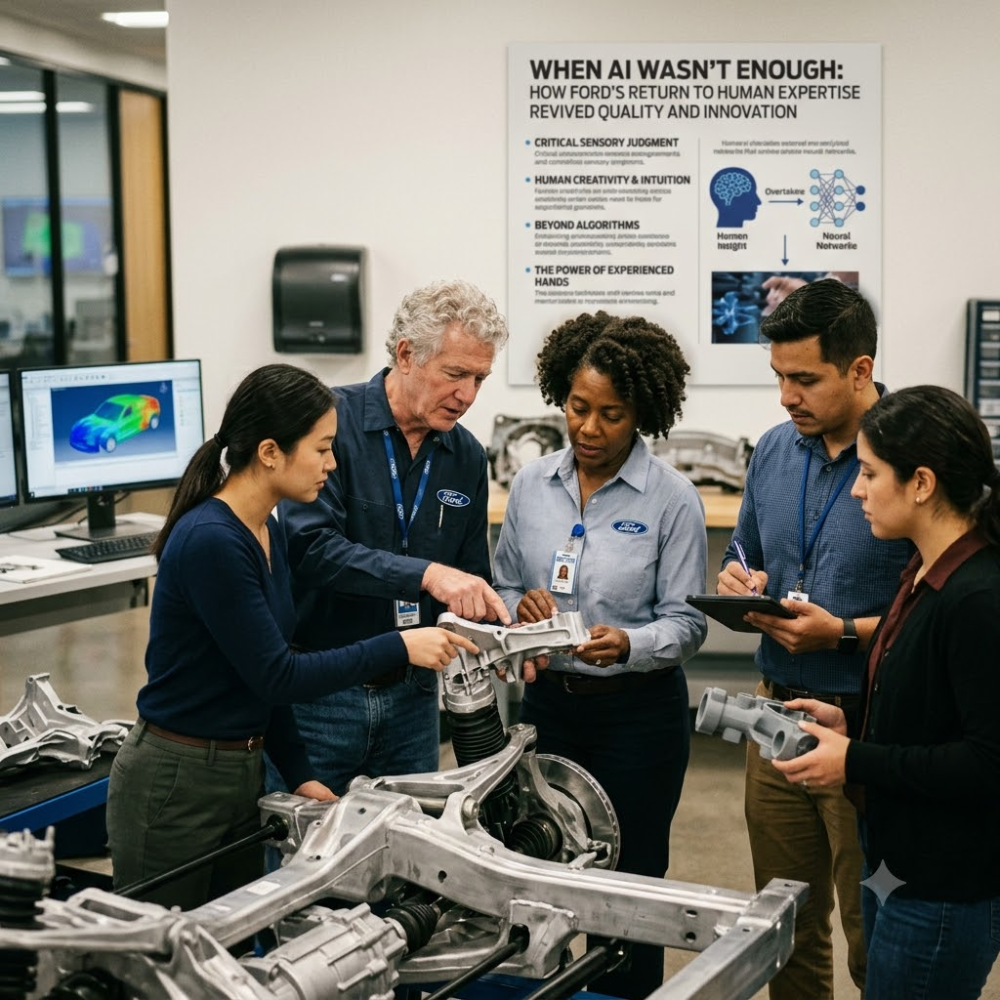
While Ford did not give up on artificial intelligence as a whole, he instead opted for a balanced solution by using artificial intelligence together with the help of experienced engineers. Skilled engineers are currently assisting in making the system smarter by helping to develop better data for training AI and sharing experience accumulated during years of work. As a result, the system is now capable of recognizing difficult situations that it was unable to see before. Instead of replacing engineers, artificial intelligence acts as an amazing assistant that helps to analyze, test, and validate information, and at the same time, people make decisions based on their judgment. The cooperation has allowed Ford to enhance its vehicle development process through the use of technology that will perform routine tasks, while experts will solve complicated design issues. AI is considered to be an outstanding tool, but only with the support of accurate data and experience.
The Changing Ford’s Approach to Quality Management and Its Lessons for Others
As part of their new approach to quality management, Ford decided to change the emphasis from repairing defects once the product is made to prevention at the design and development stages. Collaboration among software developers, manufacturers, supply chain managers, and experienced engineers will help to address any possible flaws early in the production process. In addition, the car manufacturer developed a special software quality assurance team and implemented over 100,000 AI-based validation tests to analyze the software operation in different conditions. This allows to discover any issues arising from design changes promptly before the defect makes it to consumers’ hands. The new prevention-oriented strategy is already bearing fruit for Ford in the form of better vehicle quality ratings and lower operational costs. The experience of the company is important for many other organizations that are adopting AI technology. While this technology allows increasing efficiency and automatization of complicated processes significantly, it should be considered a tool that complements professional experience and knowledge rather than substitutes for it. Sustainable innovation emerges when technology and people work towards a common goal together.
Conclusion
The Ford story demonstrates that artificial intelligence becomes successful only when integrated with the human factor rather than applied to replace it. Utilization of veterans’ knowledge to improve AI algorithms allowed Ford to achieve higher quality of products, decreased expenses and created a reliable product development procedure. This example should be considered an important lesson for companies all over the world that future success can be achieved through a good combination of technology and professionals.