




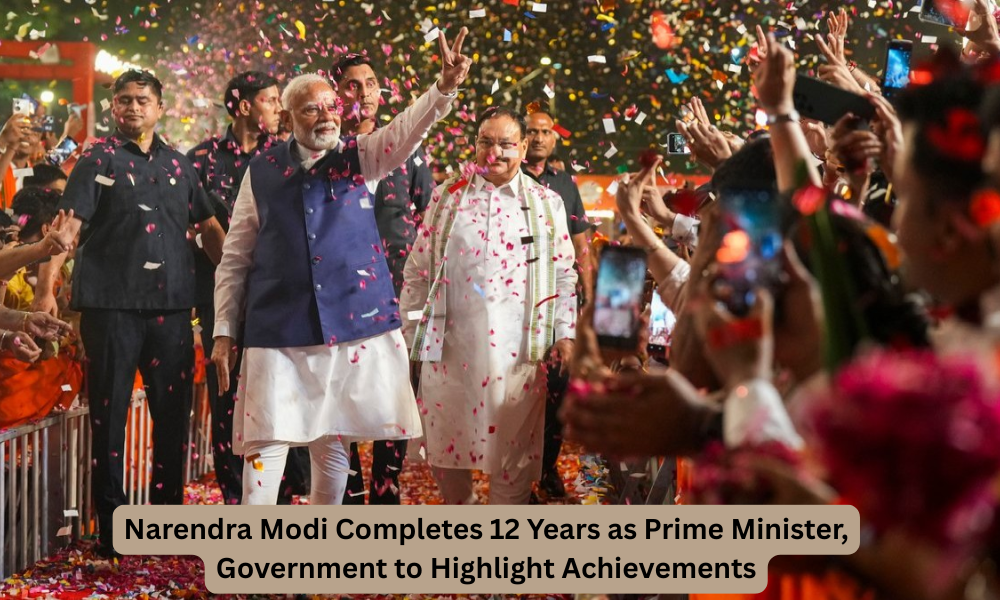
Narendra Modi Completes 12 Years as Prime Minister, Government to Highlight Achievements
Narendra Modi has completed 12 years in office as the prime minister of India, marking a significant milestone in the country’s political history. Since assuming office on May 26, 2014, Modi has emerged as one of India’s longest-serving prime ministers. Over these years, his government has focused on economic reforms, infrastructure development, digital transformation, welfare schemes, foreign policy, and national security.
The Bharatiya Janata Party (BJP) and the central government are expected to launch nationwide campaigns to showcase the achievements of the Modi government. Supporters view his tenure as a period of rapid development and strong leadership, while critics continue to debate several policy decisions and their impact. Nevertheless, Modi’s leadership has undeniably shaped modern Indian politics and governance.
Major Achievements of the Modi Government
- Economic Reforms and Growth
One of the major focuses of the Modi government has been economic reform. The introduction of the Goods and Services Tax (GST) was considered one of the biggest tax reforms in independent India. GST replaced multiple indirect taxes with a unified taxation system aimed at simplifying business operations across the country.
The government also promoted the “Make in India” initiative to encourage manufacturing and attract foreign investment. Efforts were made to improve India’s ranking in the Ease of Doing Business Index, helping startups and industries grow.
In recent years, India has emerged as one of the fastest-growing major economies in the world. Large investments in infrastructure, digital services, and manufacturing have contributed to economic expansion.
- Digital India Revolution
The Modi government launched the “Digital India” campaign to improve digital connectivity and governance. Today, digital payments through UPI (Unified Payments Interface) have transformed financial transactions in India. Millions of people now use mobile apps and online banking services daily.
Government services such as passport applications, tax filing, banking, and welfare distribution have become increasingly digitized. The expansion of internet access and smartphone usage has also boosted online education and e-commerce.
India’s digital payment ecosystem is now considered one of the most advanced in the world.
- Welfare Schemes for the Poor
Several welfare schemes launched during Modi’s tenure targeted economically weaker sections of society. Some important schemes include:
- Pradhan Mantri Jan Dhan Yojana for financial inclusion and bank accounts.
- Ayushman Bharat for healthcare coverage to poor families.
- Ujjwala Yojana providing free LPG connections to women from low-income households.
- PM Awas Yojana aimed at providing affordable housing.
- Swachh Bharat Mission promoting cleanliness and construction of toilets.
These schemes were designed to improve the living standards of millions of Indians, especially in rural areas.
- Infrastructure Development
Infrastructure development has been another major area of focus under Modi’s leadership. The government invested heavily in highways, railways, airports, metro systems, and ports.
Projects such as the Bharatmala and Sagarmala initiatives aimed to improve road and port connectivity. The modernization of railway stations and the introduction of high-speed trains also received attention.
India witnessed rapid growth in expressways and urban infrastructure, helping improve transportation and connectivity across states.
- Strong Foreign Policy
Prime Minister Modi strengthened India’s global presence through active diplomacy and international partnerships. India improved relations with major countries such as the United States, Japan, Australia, France, and Middle Eastern nations.
India also played a significant role in global forums like the G20, BRICS, and the United Nations. During Modi’s tenure, India hosted major international events and expanded its influence on global issues such as climate change, trade, and security.
The evacuation operations during international crises and India’s vaccine diplomacy during the COVID-19 pandemic further enhanced the country’s image globally.
- National Security and Defense
The Modi government adopted a strong stance on national security. Major decisions included the surgical strikes after the Uri attack and the Balakot airstrike following the Pulwama attack.
The government also emphasized modernization of defense forces and promotion of indigenous defense manufacturing under the “Atmanirbhar Bharat” initiative.
The abrogation of Article 370 in Jammu and Kashmir in 2019 was one of the most significant political decisions during Modi’s tenure. Supporters viewed it as a step toward national integration, while critics raised concerns over its political and constitutional implications.
- Handling the COVID-19 Pandemic
The COVID-19 pandemic posed a major challenge for the Modi government. During the crisis, India launched one of the world’s largest vaccination drives. Indigenous vaccines were developed and distributed across the country.
The government introduced relief packages, free ration schemes, and healthcare support measures to assist citizens during lockdowns and economic disruptions.
Although the handling of the second wave received criticism due to shortages of oxygen and hospital facilities, the vaccination campaign was widely recognized for its scale and speed.
Challenges and Criticism
Despite several achievements, the Modi government has also faced criticism and challenges over the years.
- Demonetization in 2016 led to economic disruption and hardship for many small businesses and workers.
- Rising unemployment and inflation remain concerns for sections of the population.
- Farmers’ protests against agricultural laws became a major political issue, eventually leading to the repeal of the laws.
- Critics have raised concerns about freedom of expression, social polarization, and democratic institutions.
- Economic inequality and rural distress continue to be debated issues.
These challenges highlight the complexity of governing a diverse and populous country like India.
Political Impact of Modi’s Leadership
Narendra Modi has transformed the political landscape of India with his strong communication skills, mass appeal, and centralized leadership style. Under his leadership, the BJP expanded its presence across several states and won consecutive general elections.
Modi’s image as a decisive leader has remained central to the BJP’s political strategy. His government’s focus on nationalism, welfare schemes, and development has resonated with a large section of voters.
At the same time, opposition parties continue to challenge his policies and governance approach, making Indian democracy highly competitive and dynamic.
Conclusion
The completion of 12 years for Narendra Modi as prime minister marks an important chapter in India’s political journey. His tenure has been characterized by ambitious reforms, infrastructure growth, digital transformation, welfare initiatives, and a stronger global presence for India.
While supporters praise his leadership for accelerating development and strengthening India’s international standing, critics continue to question certain policies and governance decisions. Regardless of differing political views, Modi’s impact on India’s governance and politics is undeniable.