




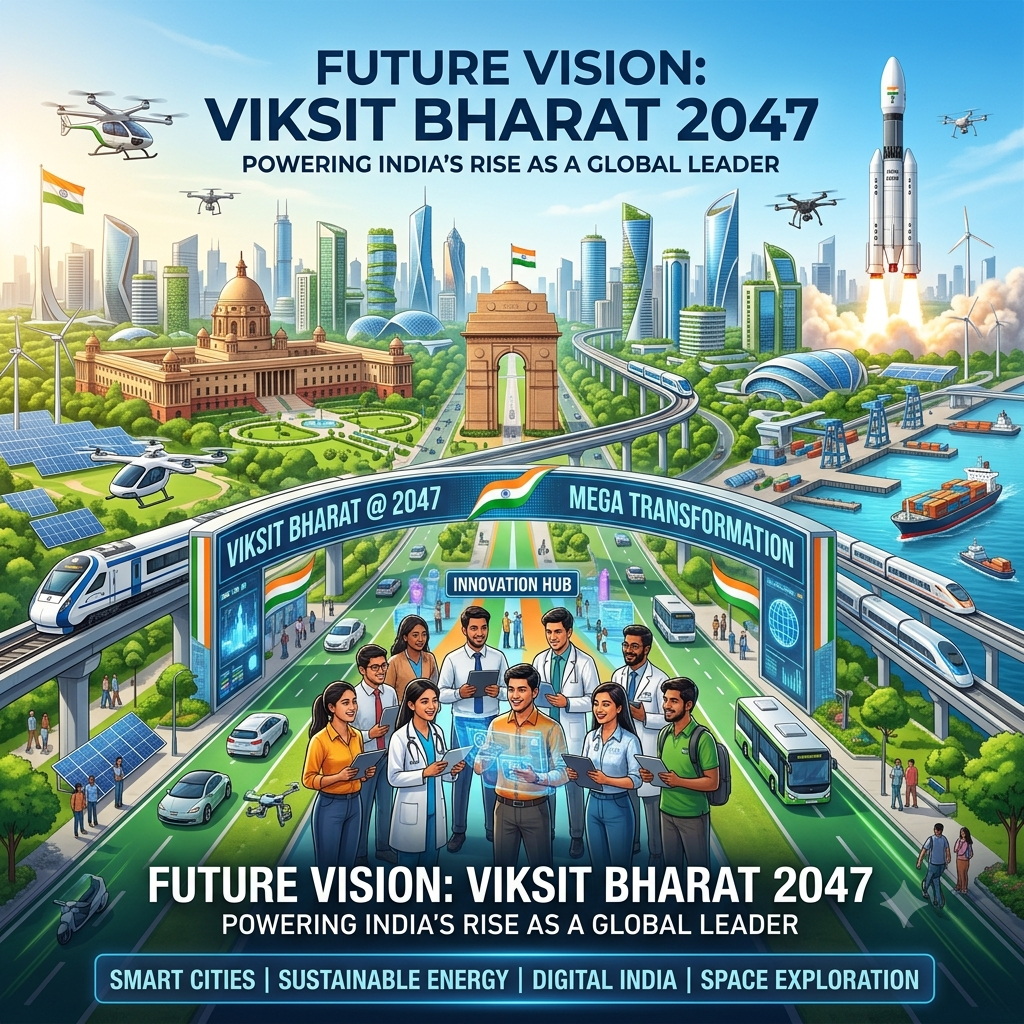
Future Vision: Viksit Bharat 2047 – The Mega Transformation Powering India’s Rise as a Global Leader
The dream of Viksit Bharat 2047 is not merely confined to the growth of the economy. Rather, it is an extensive approach adopted by India with a focus on developing world-class infrastructure, generating employment opportunities, improving connectivity, industrial development, and establishing itself as one of the most developed nations in the world after completing 100 years since its independence. There are huge expenditures being made on building highways, railroads, ports, airports, cities of the future, renewable energy, and digital infrastructure.
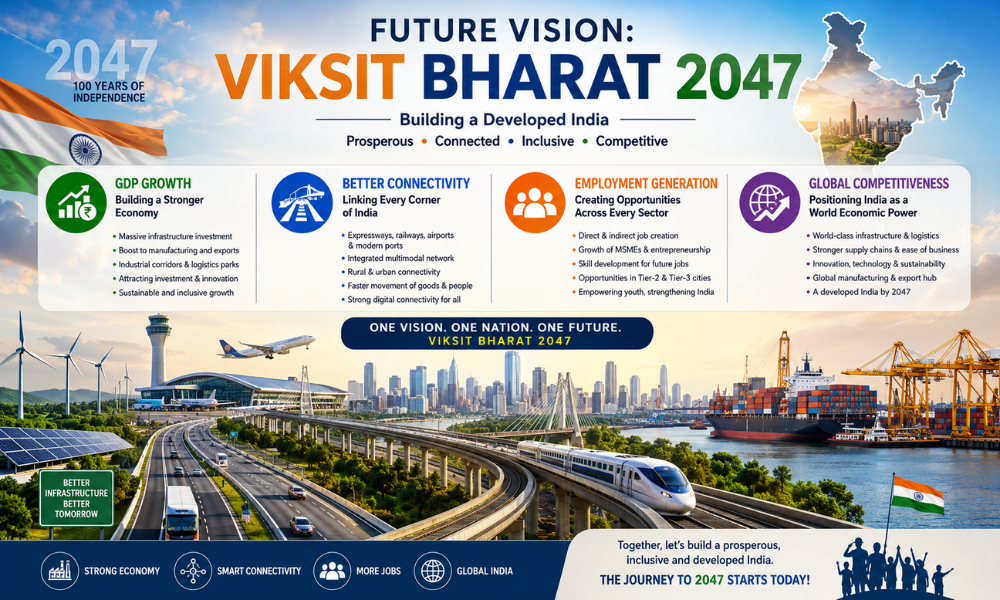
Economic Growth: GDP Growth through Infrastructure Development
Infrastructure is one of the key elements that lead to the creation of a successful economy. This is another crucial component of the Viksit Bharat 2047 initiative. In recent years, India has made considerable investments in express highways, industrial corridors, freight corridors, airports, seaports, green energy projects, and digital infrastructure. Such an approach leads not only to the generation of economic activity at the initial stage of infrastructure building but also increases the competitiveness of the economy in terms of productivity and lowering of costs. Initiatives such as Make in India, Production Linked Incentive (PLI) scheme, and industrial manufacturing clusters help attract enterprises in order to build their production capacity in the country that would result in higher GDP and higher volumes of exports. More effective logistic systems help lower transportation costs and speed up product delivery thus making the products from India competitive on global market. The infrastructure development also attracts investors due to the stability and effectiveness of business processes. The expansion of industry leads to higher taxes, greater consumer expenditure and stronger economy. Combining public and private investments India builds the basis for further economic growth. This economic momentum is expected to play a major role in transforming India into a developed nation by 2047 while improving living standards for millions of citizens.
Connectivity Improvements: Connecting all parts of India
Good connectivity is crucial for the economic growth of any country, and the Viksit Bharat 2047 plan attaches much importance to the creation of an interconnected logistics network throughout India. India is developing its expressways, highways, metro rail network, airports, dedicated freight corridors, inland waterways, and modern ports at a rapid pace. Such projects help to save time, cut down expenses and facilitate the movement of goods and passengers. Some of the projects like PM Gati Shakti, Sagarmala, and Bharatmala will help to integrate roads, railway lines, ports, and logistics into a single connected entity. Connectivity also helps the rural areas gain easy access to education, healthcare facilities, and jobs. Raw materials and finished products can be easily transported, which leads to increased efficiency of businesses. In addition, digital connectivity through expansion of broadband connectivity and digital services is important for good governance, education, and entrepreneurship. Thus, every part of the country becoming well-connected will lead to economic activities in other than the metropolitan cities.
Generation of Employment Opportunities: Offering Employment Opportunities in All Sectors
Another crucial strength of India’s infrastructure development efforts is the capability to offer employment opportunities in many sectors. Under the concept of Viksit Bharat 2047, there is an enormous generation of jobs directly or indirectly through mega projects for workers having different skills. Highway and bridge construction, airports, railway lines, ports, industrial zones, and renewable energy plants all require engineers, technicians, architects, machinists, and skilled workers. In addition to this, related industries such as steel plants, cement factories, logistics, manufacturing units, hotels, and information technology companies face higher demands for labor due to improved infrastructure. With improving infrastructure, there are higher chances of investment in smaller towns and industrial clusters which offer job opportunities in those places. Initiatives of skill development by the government also prepare the youth for advanced manufacturing jobs, automation, clean energy, and IT sectors. Infrastructure development helps in encouraging entrepreneurs by facilitating their activities in terms of transport, communication, and marketing.
Global Competitiveness: Ensuring India’s Status as a Global Economic Powerhouse
The final objective of Viksit Bharat 2047 is to ensure that India becomes one of the leading developed economies in the world. This means ensuring global competitiveness in manufacturing, technology, trade, logistics, innovation, and sustainability. With modern infrastructure, industries in India can make products more efficiently, cut down on logistics costs, and remain competitive in the global market. The government’s emphasis on industrial corridors, export-oriented manufacturing, semiconductor fabrication, renewable energy, and digitization is helping India attract multinational corporations looking for secure supply chain options. Improvement in ports, airports, logistics corridors, and freight corridors makes exporting easier and cheaper. In addition, India’s investments in green energy, e-mobility, and sustainable infrastructure reflect its commitment to sustainable development. Innovations and digital technologies make businesses and industries in India more productive. With efficient business regulations and improvement in infrastructure, India remains an attractive place to invest in and manufacture products. These efforts collectively make India stronger in the global economy.
Conclusion
Viksit Bharat 2047 goes beyond being just an Indian achievement as it serves as a blueprint for creating a stronger, smarter, and richer India. The initiatives related to infrastructure, connectivity, manufacturing, technology, and sustainable development are interrelated and serve as the bedrock for future economic growth and quality of life improvements. As these initiatives create jobs, investments, and increase the country’s competitiveness, they bring India closer to being a developed nation in 2047. If sustained policies, innovations, and citizen participation are maintained, India will have the chance to materialize its vision and become a powerful player on the international stage.