





Indus Water Treaty (Sindhu Jal Sandhi) – Water Sharing Agreement Benefits to Ladakh Farmers in India
Water has always been one of the most valuable resources in the Himalayan region, particularly in Ladakh, where agriculture depends heavily on limited sources of water. A recent development highlighted in the provided newspaper report brings attention to an important change in the way glacier water is being utilised for farming. Instead of allowing a substantial quantity of water to flow away through the Indus system, the water is being directed towards agricultural fields, creating new possibilities for local farmers.
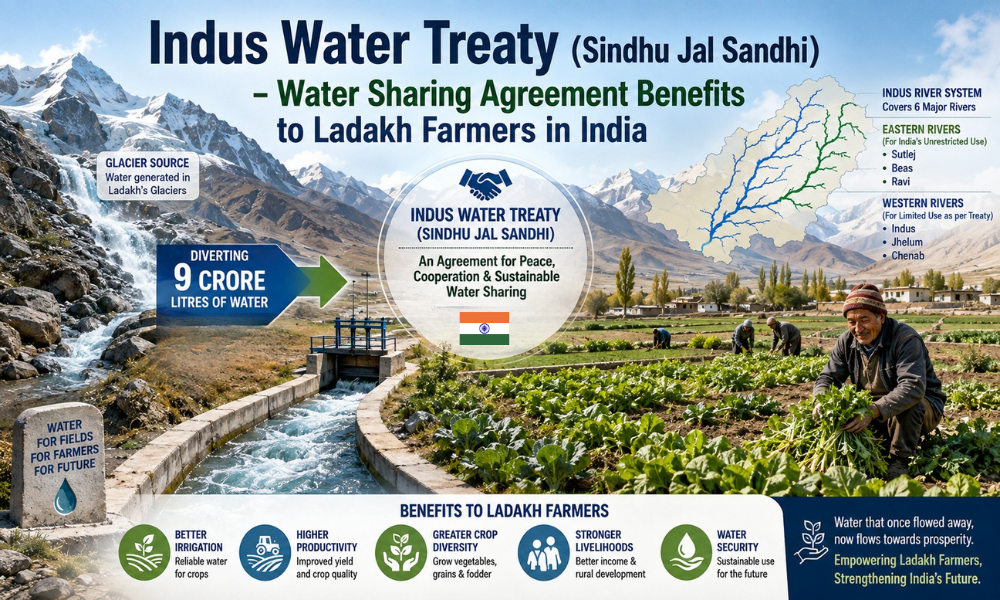
The report highlights the diversion of around 9 crore litres of water from a glacier-fed source towards farmland through an irrigation channel. According to the report, this water had previously flowed towards the Sindhu (Indus) River and subsequently towards Pakistan. The development is significant because Ladakh faces a naturally difficult agricultural environment, with cold temperatures, limited rainfall and a short farming season.
Why Water Is So Important for Ladakh Farmers
Ladakh is a high-altitude region where agriculture is challenging. Much of the landscape is mountainous and dry, and farmers have traditionally depended on streams, melting snow and glacier water to irrigate their fields. The availability of water at the right time can make a major difference to crop production and rural livelihoods.
For farmers, having a dependable irrigation source means they can cultivate land more effectively instead of depending entirely on unpredictable natural water availability. Water can support the cultivation of vegetables, grains, fodder and other crops suited to Ladakh’s climate.
The newspaper report focuses on this practical aspect of water utilisation. The objective is not simply to store water but to make it available where it can directly support agricultural activity.
The Indus Water Treaty (Sindhu Jal Sandhi) remains an important part of the history and water-management relationship between India and Pakistan. At the local level, however, the availability and utilisation of water have an immediate meaning for farmers.
The newspaper report’s focus on diverting approximately 9 crore litres of glacier water towards agricultural fields in Ladakh highlights a larger development need: making better use of available water to strengthen farming in one of India’s most challenging agricultural regions.
Understanding the Indus Water Treaty
The Indus Waters Treaty, also known as the Sindhu Jal Sandhi, was signed between India and Pakistan in 1960. The agreement concerns the waters of the Indus river system, which includes the Sutlej, Beas, Ravi, Jhelum, Chenab and Indus rivers. According to the Government of India’s Ministry of Jal Shakti, the treaty allocated the Eastern Rivers Sutlej, Beas and Ravi for India’s unrestricted use, while India’s use of the Western Rivers Indus, Jhelum and Chenab was subject to specified provisions.
The treaty also permitted India certain uses of the Western Rivers, including domestic purposes, non-consumptive uses and limited irrigation under its provisions.
Therefore, the subject is more complex than simply describing water as being “given to” one country or another. The treaty established specific rules governing how the river system could be used.
A New Focus on Local Water Utilisation
The newspaper report presents the Ladakh development from a local farming perspective. The reported diversion of approximately 9 crore litres of glacier water towards agricultural land illustrates the importance of capturing and using water before it leaves the region.
For a farmer in a cold and dry region, even a relatively small improvement in irrigation can be valuable. When water reaches fields during the farming season, it can help farmers prepare land, sow crops and maintain plants during periods when natural moisture is insufficient.
The reported irrigation effort also reflects a broader idea: water resources should be managed according to local needs while respecting environmental and legal requirements. Instead of looking only at the quantity of water available in a river, planners increasingly have to consider where that water can create the greatest local benefit.
Potential Benefits for Ladakh Agriculture
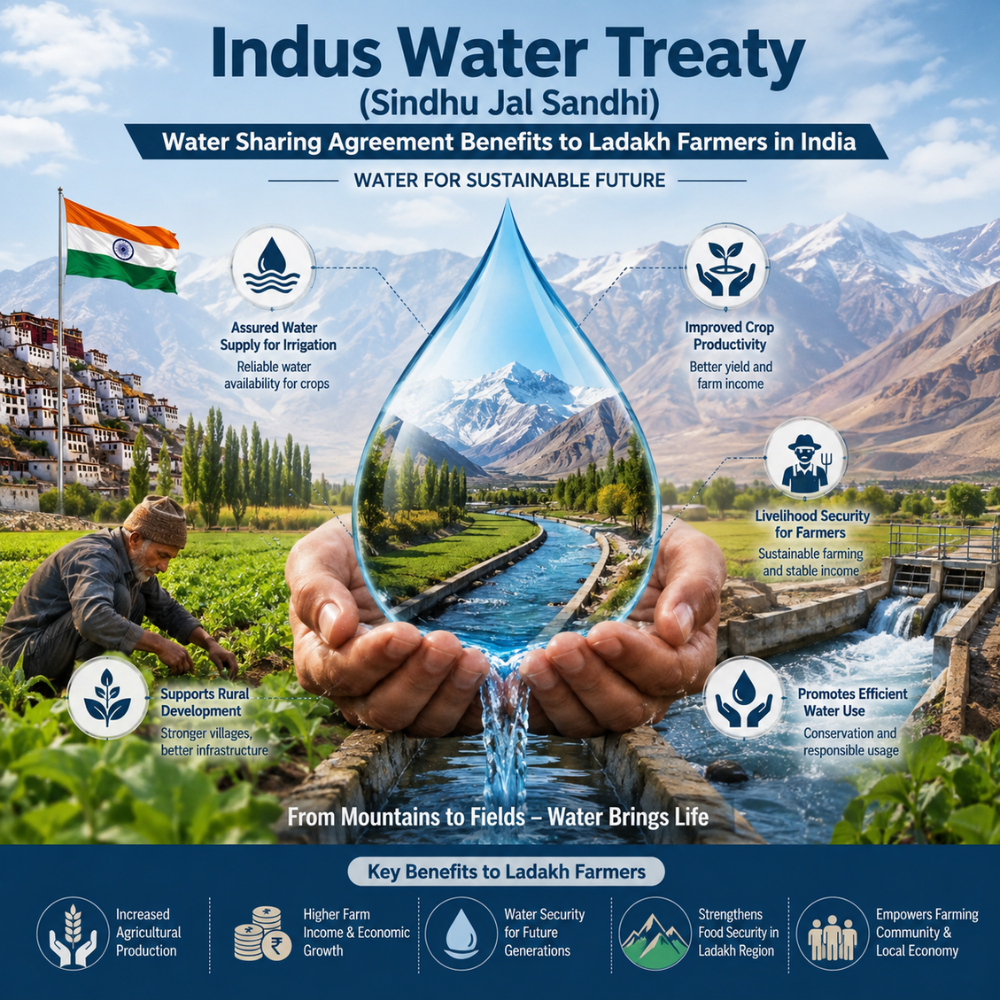
Improved irrigation can bring several benefits to farmers in Ladakh.
- Better agricultural productivity:
Reliable water availability can help farmers cultivate crops more consistently and reduce losses caused by water shortages. - Expansion of cultivated land:
Where suitable land exists but irrigation is inadequate, additional water infrastructure may make agricultural activity possible. - Greater crop diversity:
Access to irrigation can allow farmers to grow a wider range of vegetables, grains and fodder suited to local conditions. - Support for rural livelihoods:
Agriculture is closely connected with the economic well-being of rural households. Better irrigation can strengthen farm-based income and reduce dependence on limited seasonal opportunities. - Improved water security:
In a region where rainfall is limited, carefully managed glacier and river water can provide an important source of agricultural security.
These benefits, however, depend on proper planning, maintenance of irrigation infrastructure and responsible use of water.
Water Management and Ladakh’s Future
Ladakh’s water challenge cannot be solved by one irrigation channel alone. Climate conditions, glacier behaviour, seasonal water availability and increasing demand all need to be considered. Sustainable water management requires a combination of traditional knowledge, modern engineering and careful conservation.
Recent government initiatives also show growing attention to local water security in Ladakh. In June 2026, the Press Information Bureau reported that a rock check dam on the Sindhu River at Upshi was helping augment water levels in shallow stretches and enable farmers to irrigate fields during the critical sowing season. The initiative was described as a locally adapted approach to addressing recurring water challenges in the region.
Such projects demonstrate that Ladakh’s water future is not only about large rivers and international agreements. Small check dams, irrigation channels, local reservoirs and glacier-water management can also have a direct impact on farming communities.
The Larger India-Pakistan Water Context
The issue of Indus water has also gained renewed attention following India’s decision in April 2025 to hold the Indus Waters Treaty in abeyance. The Government of India subsequently described the treaty as being held in abeyance until Pakistan credibly and irrevocably abjures support for cross-border terrorism.
This broader geopolitical development should be distinguished from individual local irrigation projects. A local effort to utilise water for agriculture does not by itself determine the overall legal or diplomatic position concerning the Indus river system.
For readers, this distinction is important. The newspaper report primarily highlights a farmer-focused water utilisation story, while the Indus Waters Treaty is an international agreement involving detailed provisions concerning six major rivers and their use.
A Positive Development for Farmers
For Ladakh’s farming communities, the most important question is simple: can available water reach agricultural fields when farmers need it?
The reported diversion of around 9 crore litres of glacier water towards farmland represents the potential of local water management to answer that question. When water that previously moved downstream can be lawfully and sustainably utilised for irrigation, it can contribute directly to agricultural activity and rural development.
At the same time, water development must remain environmentally responsible. Glacier-fed water sources are part of a fragile Himalayan ecosystem, and excessive diversion or poorly planned construction could create new environmental problems. Long-term success will therefore depend on scientific assessment, efficient irrigation methods and conservation.
Conclusion
For Ladakh farmers, improved irrigation can mean more productive fields, greater agricultural opportunities and stronger rural livelihoods. The future of water management in the region will depend on balancing these local needs with environmental sustainability, engineering feasibility and the applicable legal framework.
Ultimately, the story is not only about water flowing from one place to another. It is about how carefully managed water resources can support farmers, strengthen food production and contribute to the development of communities living in the high-altitude landscape of Ladakh.