





Kishangarh Marble Dumping Yard – Rajasthan’s White Marble Mini Switzerland Famous Tourist Attraction
Rajasthan is known across the world for its magnificent forts, royal palaces, colourful culture, desert landscapes and historic cities. But beyond these traditional attractions, the state has also developed some unusual destinations that surprise visitors with their natural-looking beauty. One such place is the Kishangarh Marble Dumping Yard Rajasthan, a vast white landscape created from marble mining and processing waste. With brilliant white marble surroundings, striking turquoise-blue water and unusual rocky formations, the destination has earned popular descriptions such as the Moon Land of Rajasthan and the Mini Switzerland of Rajasthan.
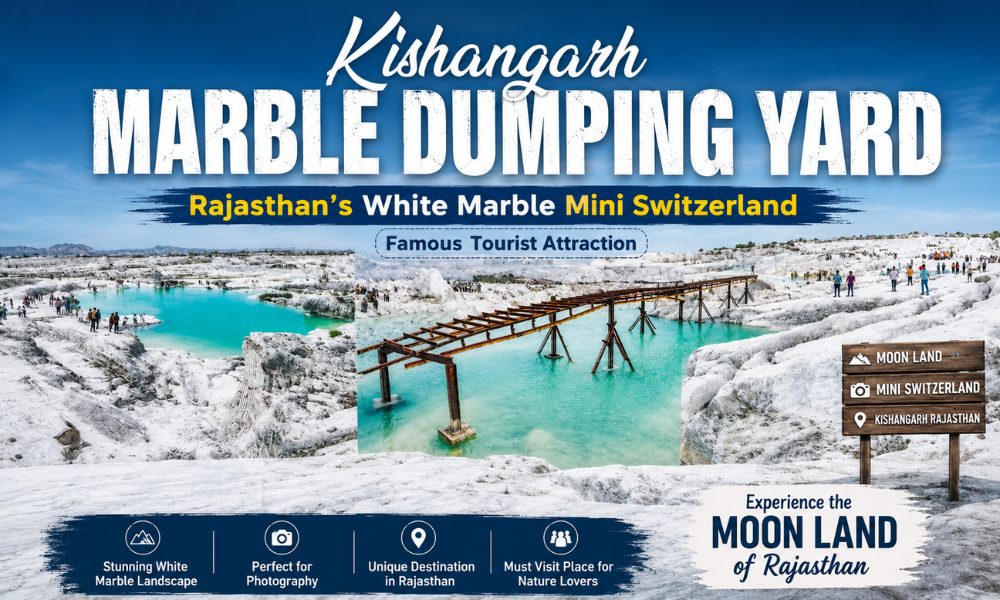
The photographs featured in the newspaper report show how an area associated with marble waste and abandoned mining landscapes has gradually become a place of curiosity for visitors. What was once mainly connected with the marble industry is now attracting people who want to experience a landscape that looks remarkably different from the surrounding region.
A White Wonderland Near Kishangarh
Kishangarh, located in Rajasthan, is widely associated with the marble industry. Marble is extracted, cut and processed in large quantities in and around the region. During mining and processing, huge amounts of stone fragments, powder and unwanted material are generated. Over time, these materials have created enormous white mounds and unusual formations.
The landscape visible in the photographs looks almost unreal. Large stretches of white marble surround pools of blue-green water, creating a dramatic contrast. In some places, the marble appears like snow-covered ground, while the water resembles a small turquoise lake. This unusual combination has made the area increasingly interesting for photographers, travellers and visitors looking for something different from conventional tourist destinations.
The bright white surroundings are one of the main reasons people compare the place with landscapes seen in Switzerland or on the surface of the moon.
Why Is It Called the Moon Land of Rajasthan?
The nickname Moon Land of Rajasthan comes from the extraordinary appearance of the marble landscape. The white ground, irregular stone formations and wide-open surroundings can create an almost lunar appearance, especially when photographed from a distance.
Visitors standing among the white marble piles can feel as though they have entered an entirely different environment. The absence of the typical green landscapes associated with many tourist destinations makes the scenery particularly distinctive.
Sunlight also changes the appearance of the area throughout the day. During bright daylight, the white marble reflects sunlight and creates a glowing landscape. When the sky is slightly cloudy, the contrast between the white stone and blue-green water becomes even more prominent.
These visual characteristics have helped the destination become popular among people searching for unique places to visit in Rajasthan.
The Mini Switzerland of Rajasthan
Another popular description associated with this destination is the Mini Switzerland of Rajasthan. Although it is very different from the mountains and natural lakes of Switzerland, the comparison comes from the area’s striking white landscape and clear-looking blue-green water.
kishangarh marble dumping yard distance from Jaipur is around 100 Km, if you are visiting Ajmer must go at this place.
The photographs in the newspaper report show visitors walking around the marble landscape and standing near the water. A temporary-looking bridge can also be seen crossing one of the water-filled areas. These features demonstrate how visitors have begun exploring the unusual environment as a recreational and photographic destination.
The nickname is therefore more of a popular tourism description than a literal comparison. Its purpose is to express the visual appeal of the white marble landscape.
From Marble Waste to Tourist Attraction
Perhaps the most interesting aspect of this destination is its transformation. Marble mining and processing are industrial activities, and the leftover material does not initially appear to have any tourism value. However, the accumulation of white marble waste has created a distinctive landscape that is visually appealing.
The newspaper article highlights how abandoned or unused mining areas in Rajasthan have attracted visitors. Places that may once have been viewed primarily as industrial or discarded spaces are now being photographed and shared as unusual tourist spots.
This transformation shows how unexpected landscapes can become attractions when their visual and cultural characteristics are recognised. The Kishangarh area already has a strong identity because of its marble industry, and the dumping yard has added another dimension to that identity.
The Beauty of Blue-Green Water and White Marble
One of the most eye-catching features of the Famous Tourist Place Kishangarh Marble Dumping Yard Rajasthan is the contrast between the marble and the water.
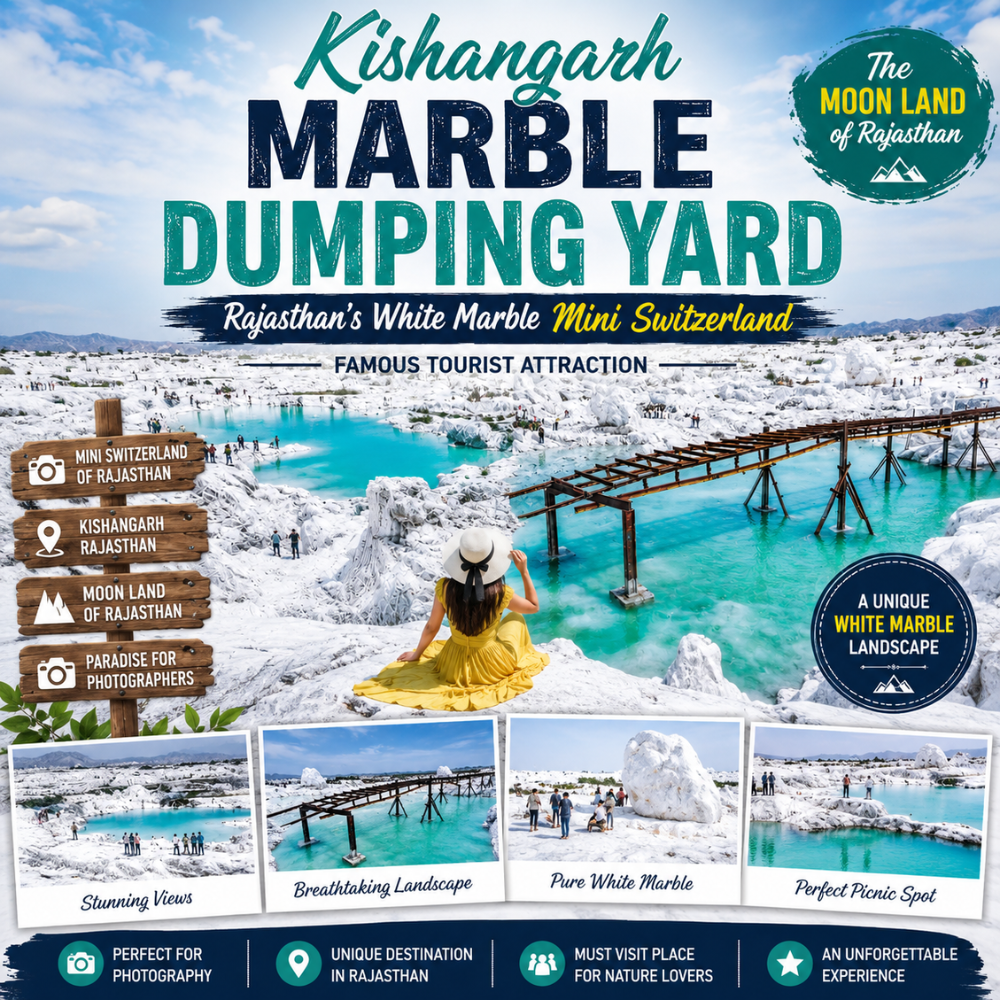
The photographs show large pools of striking blue-green water surrounded by white stone. The unusual colour combination gives the location an almost artificial appearance, even though the landscape has developed through mining-related activities.
In some images, people can be seen standing near the edge of the water, while other visitors walk across the white terrain. The contrast provides excellent opportunities for photography, particularly for wide-angle landscape photographs.
The area also offers a different visual experience from Rajasthan’s famous golden deserts. Instead of yellow sand and traditional architecture, visitors encounter white stone, blue-green water and open skies.
A Best Place for Photography
The unusual scenery has naturally made the area popular for photography. Social media has also played an important role in introducing lesser-known destinations to a wider audience.
Photographers can capture several different perspectives here. Wide landscape photographs highlight the enormous white terrain, while closer photographs can focus on the texture of marble fragments and the contrast with the water.
The bridge shown in the photographs adds another interesting element. People walking across or standing near it can provide scale and perspective, helping viewers understand how extensive the landscape is.
For visitors interested in creative photography, the combination of white marble, water, sky and human activity provides many possibilities.
A Different Side of Rajasthan Tourism
Rajasthan tourism is often represented through places such as Jaipur’s palaces, Jodhpur’s forts, Udaipur’s lakes and Jaisalmer’s desert. The Kishangarh marble landscape presents a completely different side of the state.
It demonstrates that tourism is not always about monuments that were deliberately constructed as attractions. Sometimes industrial landscapes, unusual geological formations and transformed spaces can also become interesting destinations.
It is therefore an example of how a place can develop a new identity through its distinctive appearance.
Responsible Tourism Is Important
While the landscape is visually attractive, visitors should remember that this is closely connected with mining and marble-processing activities. Such locations may contain uneven ground, deep pits, unstable stone piles or water bodies. Visitors should therefore avoid entering restricted areas or climbing unsafe formations.
The photographs show people exploring the area, but responsible tourism should always be encouraged. Visitors should follow local instructions, avoid littering and respect private or industrial property.
The beauty of the destination can be preserved only when visitors treat the landscape responsibly.
How the Destination Became Famous
The growing popularity of this unusual landscape is closely linked to photographs and word-of-mouth publicity. Once images of the white marble terrain and turquoise water began circulating, more people became interested in seeing the place themselves.
The nickname Moon Land of Rajasthan adds to its curiosity, while the term Mini Switzerland of Rajasthan makes it easier for travellers to understand the kind of visual experience they can expect.
For people who have already explored Rajasthan’s traditional attractions, this destination offers something completely different.
A Unique Identity for Kishangarh
Kishangarh has long been an important name in India’s marble industry. The marble landscape adds another chapter to the region’s story. It shows how an industrial area can unexpectedly develop tourism potential because of its unusual visual character.
The Kishangarh Marble Dumping Yard Rajasthan has therefore become more than a place associated with discarded marble material. Its vast white surroundings, blue-green water and striking appearance have made it a memorable photographic location and an emerging tourist attraction.
The destination also reminds us that Rajasthan’s beauty is not limited to its forts, palaces and deserts. The state continues to surprise travellers with landscapes created through history, industry and changing human activity.
Known popularly as the Moon Land of Rajasthan and the Mini Switzerland of Rajasthan, the destination has developed a unique identity among people searching for offbeat places to explore. The newspaper photographs beautifully capture this transformation, showing visitors surrounded by an extraordinary white landscape that looks almost otherworldly.
For anyone interested in discovering a less conventional side of Rajasthan, Kishangarh’s marble landscape offers a fascinating story—one where marble waste, abandoned mining areas and human activity have come together to create a destination unlike the traditional tourist attractions of the state.
Conclusion
The Kishangarh Marble Dumping Yard Rajasthan offers one of the most unusual visual experiences associated with Rajasthan. Its brilliant white marble landscape and contrasting blue-green water have transformed an industrial and mining-related environment into a place that attracts visitors and photographers.