




Apple’s Smart Glasses Could Mark Its Next Big Bet in the Wearable Tech Race
For years, there have been rumors that Apple is working on smart glasses, but the project has mostly stayed secret.
That could change soon.New reports suggest Apple is speeding up the development of AI-powered smart glasses, with a possible launch sometime next year.If these reports are true, Apple will join a fast-growing market where Meta has already taken the lead with its AI-enabled eyewear.
This move shows Apple is trying to make AI and wearable tech a key part of its future, moving beyond the smartphone that has been its main focus for almost 20 years.
A New Way to Use Wearable Tech
Unlike the high-end Vision Pro headset, Apple’s upcoming smart glasses are likely designed for everyday use.
Instead of offering a fully immersive augmented reality experience, the first version might focus on simple, useful features that people can use all day without needing a heavy headset.
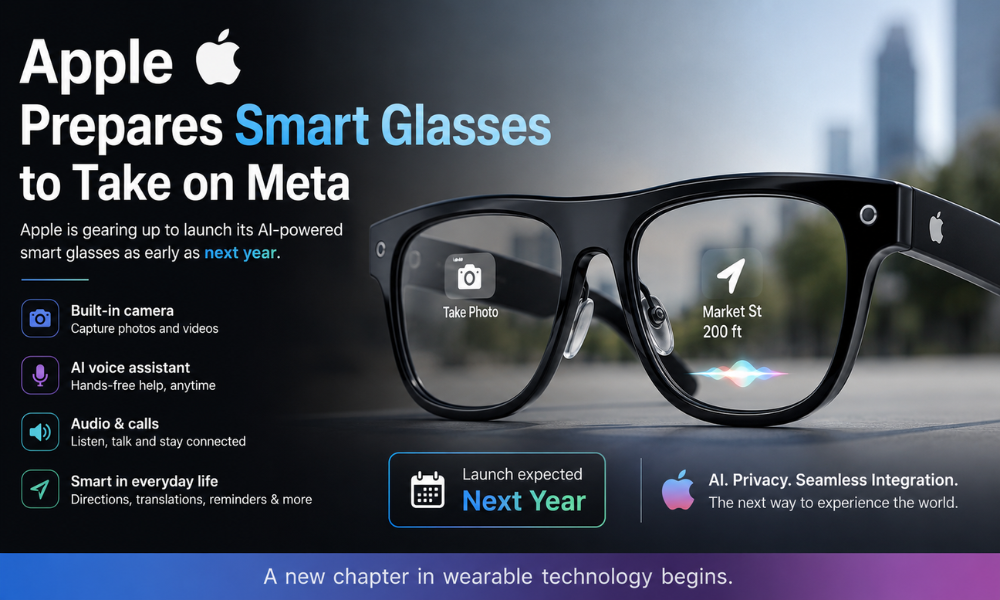
Reports say the glasses could have built-in cameras, microphones, and speakers.
This would allow users to take photos, answer calls, listen to music, get directions, and use Apple’s AI assistant with voice commands.The focus is on convenience, not creating a full digital world.
This approach is similar to the growing trend of AI-powered smart glasses that combine regular eyewear with smart features.
Facing Off Against Meta’s Lead
Apple’s main rival in this area is Meta, which has been steadily improving its line of smart glasses over the past few years.
Working with EssilorLuxottica, Meta has launched several smart glasses that include cameras, AI help, and voice controls, all while looking like normal eyewear.
These products have helped smart glasses become more mainstream by focusing on everyday uses rather than futuristic AR.
Users can take photos, stream music, translate conversations, and ask questions using AI, all without needing to pull out their phones.
Apple seems ready to take a similar path but with its own strengths.
Rather than trying to beat Meta with more hardware, Apple is expected to use its strong connections with other Apple products like iPhones, AirPods, Apple Watches, and Macs.
AI at the Core of the Smart Glasses
Artificial intelligence is expected to be the main feature of Apple’s smart glasses.
Apple has already started adding AI features to its devices through Apple Intelligence.
Adding these capabilities to wearable glasses would let users interact with technology in a more natural way.
Imagine asking the glasses for directions while walking, recognizing landmarks, translating signs in another language, or getting reminders without looking at a phone.
Cameras and microphones could give the AI visual and audio information, helping it understand what the user is seeing.
This kind of smart help is one of the biggest chances for wearable tech.
Instead of needing to open an app or type a question, the device could answer instantly through voice.
Learning from the Vision Pro
Apple’s Vision Pro showed the company’s ability to create complex mixed-reality hardware, but it also showed the limits of expensive, bulky headsets for everyday use.
The headset is still a premium product aimed at developers, professionals, and early users, not the general public.
Smart glasses are a different chance.
They are lightweight, stylish, and meant for daily use.If Apple can balance function, comfort, and battery life, they could reach a much bigger audience.
Apple often enters new product categories after competitors, improving on existing ideas instead of making something completely new.
The iPhone, Apple Watch, and AirPods all followed this path, eventually changing their markets.
Apple may hope the same happens with smart glasses.
Still Some Challenges
Even with growing interest, smart glasses still face big technical challenges.
Battery life is a major concern.
Fitting cameras, microphones, speakers, connectivity, and AI processing into a light frame without sacrificing all-day use is a big engineering challenge.
Privacy is another big issue.
Glasses with cameras naturally raise questions about recording people without their knowledge.Companies have added visible indicators and privacy settings, but public acceptance is still a challenge.
Pricing is also a big question.
Apple’s products usually cost a lot, but smart glasses need to compete in a market where affordability might be key for widespread use.
Finally, Apple’s AI system is still developing.
Delivering smooth voice interactions, accurate understanding, and reliable on-device AI will be important if the glasses are to work well in everyday life.
The Market Is Growing
Apple and Meta are not the only companies going after this new category.
Many tech firms are investing heavily in AI-powered wearables, seeing them as a possible future or companion to smartphones.
The idea is simple: instead of constantly looking at a screen, users can interact with digital services naturally through voice, audio, and visual cues in everyday accessories.
Whether this idea becomes popular depends on how useful these devices are in daily life.
People won’t adopt smart glasses just because they’re new or fancy.They’ll need real convenience that makes wearing them all day worthwhile.
Conclusion
What’s Next
If Apple releases its smart glasses next year, it could be one of its most watched hardware launches since the Apple Watch.
Success will depend not only on the physical product but also on how well Apple uses AI, software, and user experience together.
Apple’s strength has always been bringing mature tech together into products that feel natural, not experimental.
If it applies that same approach to smart glasses, it might help make wearable computing much bigger.
But expectations should stay realistic.
The first version probably won’t offer the full AR experience imagined in sci-fi.Instead, it’s expected to be an intelligent wearable that works with the smartphone rather than replacing it.
This more practical approach might end up being the better way forward.
By focusing on real AI features instead of big futuristic promises, Apple could help smart glasses become a common part of everyday life.
As competition between Apple and Meta grows, the coming year could mark the start of a new era in wearable technology—a time when the next major computing platform is not in our hands, but on our faces.