India’s $5 Billion Energy Gamble: Can the Oman-Gujarat Deep-Sea Pipeline Secure the Nation’s Future?
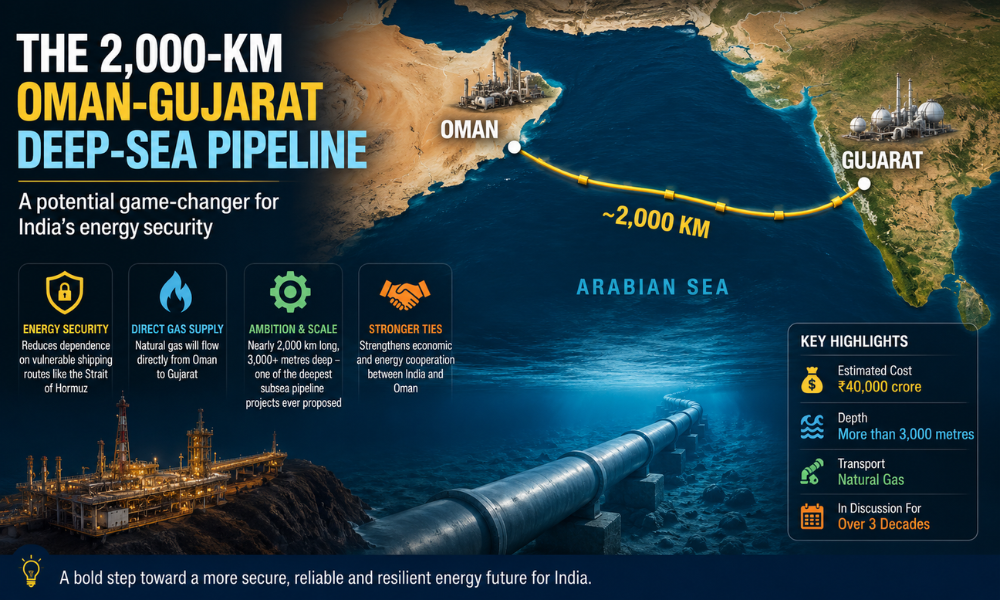
As geopolitical instabilities persist to pose risks to global energy supply sources, India seems set to revive an ambitious yet unimplemented plan that was conceived some three decades ago – construction of an undersea gas pipeline running from Oman to Gujarat measuring almost 2,000 km in length. Estimated to have a cost of up to ₹40,000 crore, the plan would establish a reliable energy link between the Gulf and India while minimizing reliance on potentially risky sea transport routes like the Straits of Hormuz. While the proposal presents benefits in terms of energy security and improved regional relations, there are many hurdles as well.
Reasons Why an Alternative to the Strait of Hormuz Is Needed in India
India is highly dependent on energy imports, and hence ensuring the uninterrupted flow of the same becomes extremely important for it. Most of the natural gas and oil imports from India are sourced from the Middle East countries and are made via the Strait of Hormuz. Hence, there could be serious repercussions if anything goes wrong at this particular location due to political instability, warfare, or any security threat to ships.
The current volatility witnessed in West Asia has once again brought into focus the need for India to find some alternatives to avoid the same. Not only have there been some fluctuations in oil prices and LNG, but also some tanker-related issues have made it necessary for the Indian government to think in terms of energy security for the future. One such alternative is the Oman-Gujarat Deep-Sea Gas Pipeline, which promises to connect Oman with Gujarat and provide natural gas for the coming decades.
Inside the Oman-Gujarat Deep-Sea Pipeline Project
The Oman-Gujarat Deep-Sea Gas Pipeline will be the largest ever constructed between India and the Gulf. Stretching over 1,200 miles under the Arabian Sea, the line will enable the flow of natural gas directly from Oman to the state of Gujarat, avoiding traditional shipping routes and eliminating reliance on liquefied natural gas (LNG) from tankers. The estimated cost of the project is about ₹400 billion (or $5.8 billion) and it will create a dedicated energy corridor between these two countries.
One of the many amazing aspects about the Oman-Gujarat project is how far down it is going to be built. Some sections of the proposed routing will be deeper than 3,000 meters below sea level – making this among the deepest subsea (submarine-constructed) pipeline projects ever constructed. Pipelines enable continuous natural gas flow from producers to consumers, as opposed to liquefied natural gas (which must be liquefied, transported as a liquid on tankers, and then re-gasified at destination terminals). Proponents argue that this will create a more reliable supply of energy to both countries at potentially lower transportation costs in the long run. Additionally, it will not only enhance India’s energy security, but also create a reliable and long-term export market for Oman’s natural gas resources.
An Idea That Has Been in The Making For More Than Thirty Years
It is not a recent development for the concept of a gas pipeline between Oman and India. The idea has been floating around for over three decades. Through various projects, many ideas have been raised over these three decades as to the feasibility of the subsea pipeline through the Arabian Sea. The cost of building the pipeline, the technology available and uncertainties as far as pricing and commercial viability had held up the progress of the projects for many years.
The proposal is receiving some attention again due to engineering advancements and energy security issues. SAGE is reported to be behind the revival of interest in the project with the conduct of several technical and financial assessments and seabed surveys along the proposed route of the pipeline. It is expected that these exercises would prove if it is feasible to implement the project using the current engineering technology. The latest news on the matter is that the ministry of petroleum has directed government firms including GAIL, Engineers India Ltd. and Indian Oil Corp. to produce a feasibility report.
The Challenges, Risks and Future of India’s Energy Security
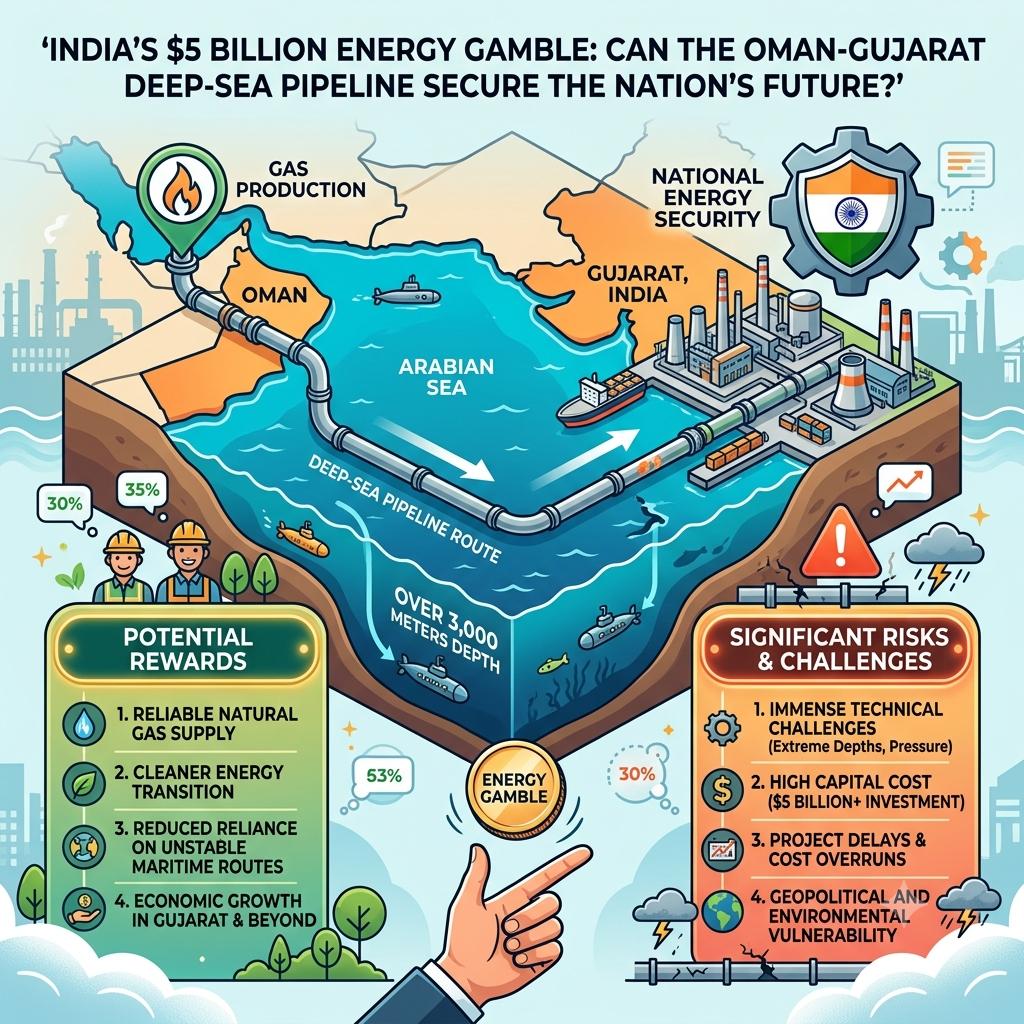
Despite having immense opportunities for India, there are various challenges involved in building and implementing the pipeline which could decide the future of the project. Engineering difficulties constitute the largest risk. Constructing and maintaining a pipeline under the sea floor, which would have to operate in depths surpassing 3,000 meters, is no mean feat and would require advanced technologies, equipment, and precautions. Should there be any problem or leakage, it would be very difficult and expensive to fix because of the nature of the environment.
Economic feasibility is yet another consideration. Even if the cost estimates for the project stand at roughly ₹40,000 crore, such infrastructural projects tend to experience delays and cost overruns. However, for investors, it must be assured that future gas demands, transport charges, and long-term pricing agreements are feasible in terms of generating profits. Moreover, the financial model, as well as cost distribution, still requires clarification. Nevertheless, there are several advantages associated with this project. For instance, the pipeline would ensure enhanced energy security for India and protect it from future geopolitical tensions, thus increasing economic relations with countries in the Gulf region. In some circles, it has been even suggested that the pipeline can be repurposed for hydrogen transport in the future.
Conclusion
The Oman-Gujarat Deep Sea Gas Pipeline is arguably one of the more audacious projects for developing energy infrastructure in India, which has the possibility of enhancing the nation’s energy security while minimizing vulnerability due to reliance on maritime transportation channels. Although it comes with its fair share of technical, economic and commercial hurdles, the significance of the project cannot be ignored in light of the uncertain political climate. With favorable circumstances, the pipeline may prove to be an energy artery for decades to come.