





From $22 Billion to Bankruptcy: How Greed Destroyed Byju’s Empire
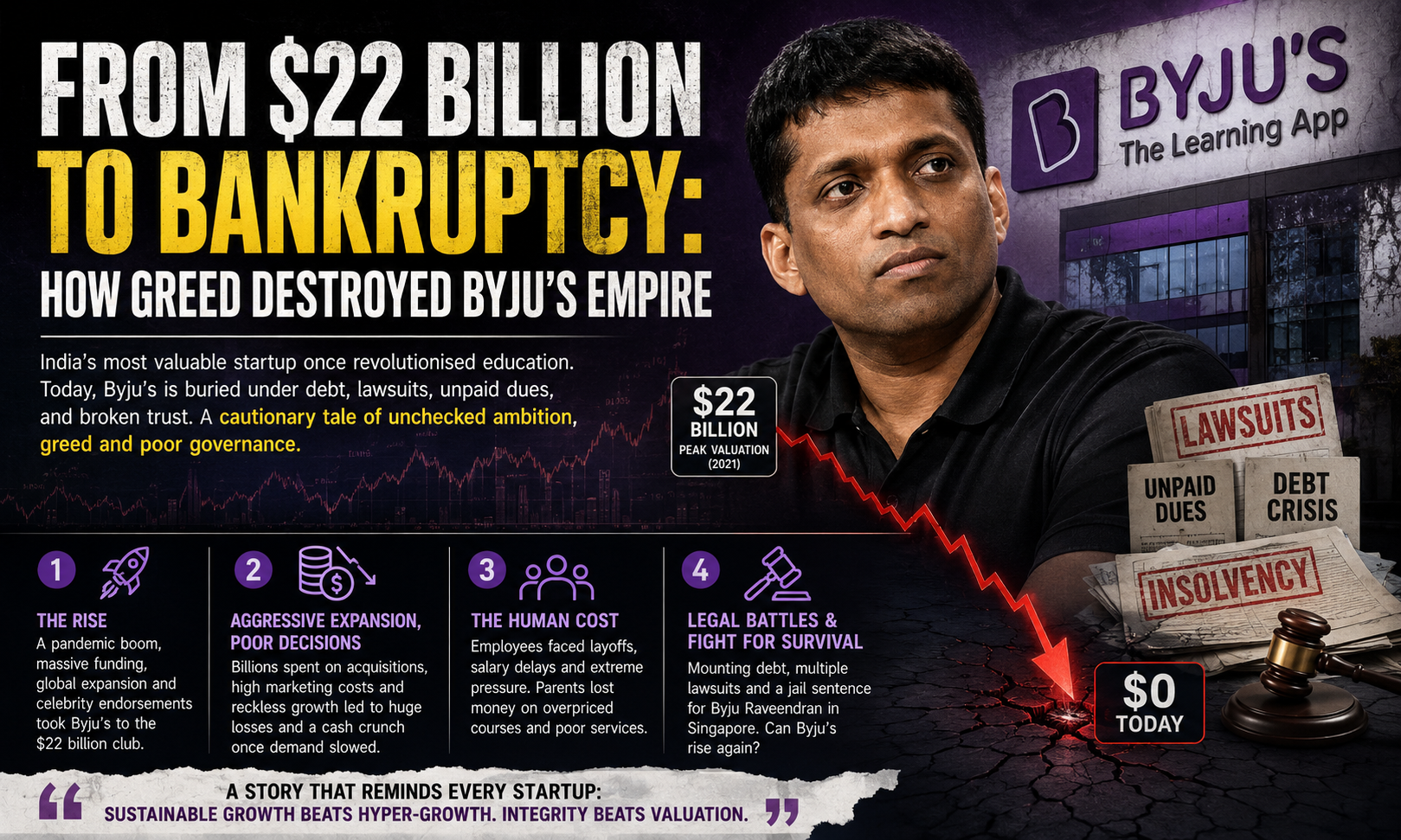
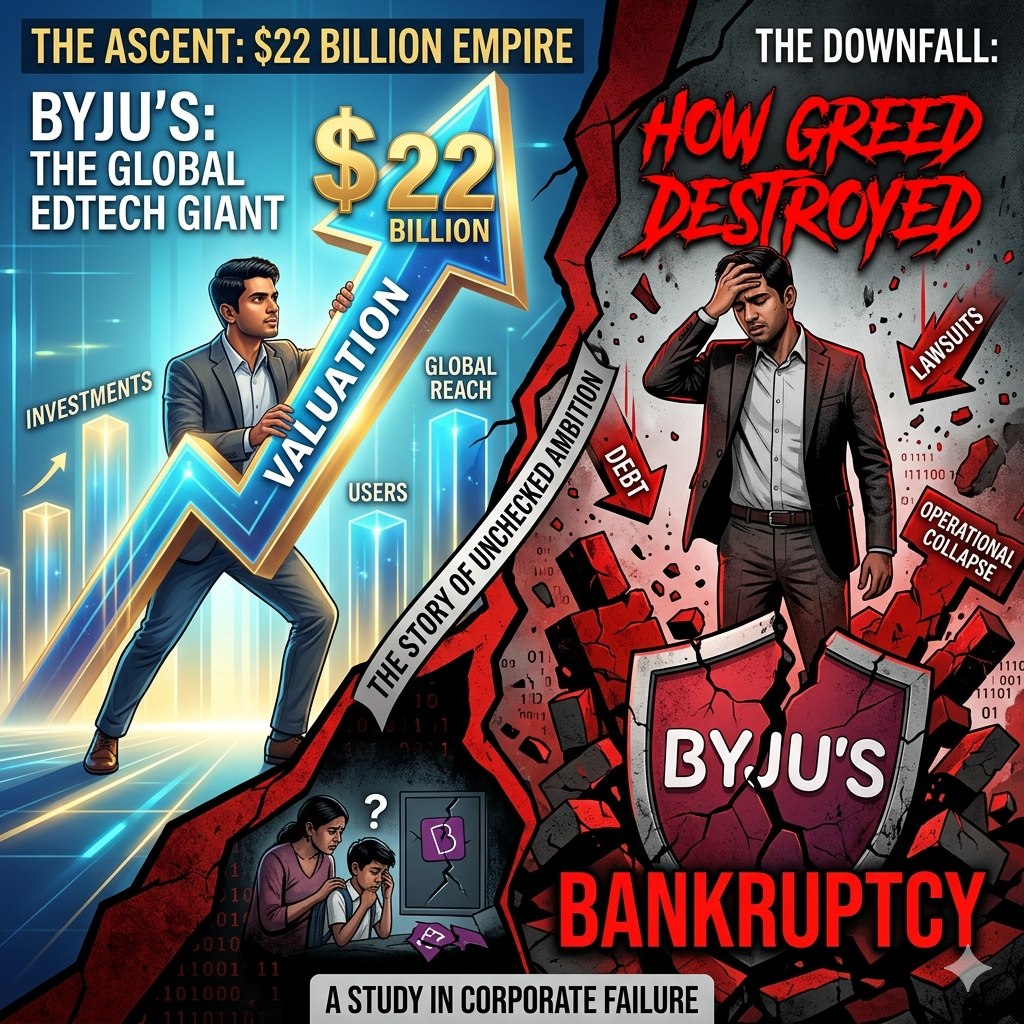
Once, Byju’s stood out as one of the most successful EdTech ventures from India, achieving an amazing valuation of $22 billion during the period of the coronavirus pandemic. Established by Byju Raveendran, the venture changed the face of online education in India and spread its wings across the world aggressively. Rapid growth, high costs of acquisitions, debt, and bad management practices eventually brought down the giant. Currently, Byju’s is struggling to manage multiple lawsuits, debt, labor unrest, and severe liquidity problems. Once considered to be the future of education, Byju’s turned into a case study in business greed and incompetence.
Meteoric Growth of Byju’s amid Pandemic
Initially, Byju’s was set up by Byju Raveendran, a former teacher known for breaking down complicated mathematics subjects for easy understanding. In the years that followed, the firm transformed into one of the best-known and popular EdTech organizations in the country. The rise of the Covid-19 outbreak was the game-changing period for the business as countries all around the world locked down schools and coaching centers, leaving millions of students with only one alternative left – online learning platforms. Byju’s seized the opportunity with both hands and managed to grow incredibly fast as millions of new users were registered on its website. Billions of dollars from private investors helped the firm to achieve a valuation of almost $22 billion, as well as hire brand ambassadors including Shah Rukh Khan and Lionel Messi. Byju’s organized several big sports and cultural events and declared a user base of over 150 million. Nonetheless, behind the numbers and publicity, the company continued to grow without establishing its finances.
Rapid Growth Through Ambition
During the COVID-19 pandemic, Byju’s received a tremendous amount of funding from global investors which led to rapid international expansion through large-scale consolidation of many educational companies. Byju’s spent billions of dollars to acquire other companies such as Aakash Educational Services, WhiteHat Jr., Toppr, Epic, Great Learning and Osmo between 2019 until 2022. This was part of a multi-faceted approach to rapidly build a large user base and to enter into multiple sectors of education at once. Unfortunately, most of their acquired companies were not fully integrated into Byju’s existing business model; thus, even after significant capital investment, many of the acquired companies were still operating at losses thus overburdening Byju’s with debt. Additionally, once schools re-opened post-COVID, the demand for online learning products diminished significantly and Byju’s expenses, including: sales and marketing expenses, operational expenses, and acquisition-related expenditures, remained at elevated levels causing extreme cash flow concerns. Despite these ongoing financial pressures, Byju’s continued to pursue their growth strategy and their forward financial goals which exacerbated their financial difficulties and highlighted the company’s governance weaknesses.
Byju’s Employees, Byju’s Parents, Human Impact of the Fall
The fall of Byju’s has resulted in severe losses to the company’s employees, customers, and parents. Although, as mentioned above, high-level executives have managed to remain financially safe despite all the troubles, most mid-level and lower employees have experienced salary delays and even job cuts along with excessive workload. As reported by some of the Byju’s employees, they have been forced to sell products to meet unattainable sales targets and put in extra-long hours of work. Several employees say that they received termination notices on their phones and email addresses without any prior warnings. Furthermore, parents whose children use the products of Byju’s lost a lot of money, too. Many consumers said that the brand used false sales techniques and did not provide proper refunds while pressuring customers to buy courses through EMI programs. In addition, some of the parents complained about the poor quality of the learning tablet and unsatisfactory results from the educational program promised during sales talks.
Legal Troubles, Debt Crisis, and Byju Raveendran’s Fight for Survival
Byju’s finances have seen a steady decline and as such the business has entered into numerous legal capacities and engaged in various debt-related battles across the globe. Many creditors believe that Byju’s has mismanaged all of the finances it has borrowed and cannot answer for how they used these funds. A number of the subsidiaries of Byju’s have filed for insolvency, and lenders continue to demand repayment from Byju’s for billions of dollars.
In addition to this, the financial situation of Byju’s worsened significantly when a court in Singapore sentenced Byju Raveendran to 6 months in jail for failing to comply with disclosure requirements with regard to the assets in the company. Raveendran states that this conviction is merely procedural and does not reflect any wrongdoing. This legal conviction has gravely damaged Byju’s public perception. Furthermore, there continue to be numerous lawsuits proceeding in both the United States and India over loans and damages as well as disputes between Byju’s and different parties about corporate governance.
In spite of all of these events surrounding Byju’s, its founder Byju Raveendran has repeatedly stated that Byju’s is more than capable of recovering and rebuilding; however, Byju’s will face tremendous opposition as the company attempts to address the increase in its debt, the damage to the companies credibility and declining confidence from investors going forward.
Conclusion
Byju’s rise and fall have gone beyond a mere business disaster; it is also a lesson to all startups who chase success through rapid expansion without maintaining good financial management and ethical management practices. An organization that once boasted of being the most successful EdTech company from India ended up collapsing due to excessive expansion and poor management. The negative effects of this company’s collapse did not only affect the investors but also impacted its employees, students, and their parents. As lawsuits against Byju’s continue and Byju Raveendran tries to salvage his company, Byju’s still serves as an example of what could happen when one prioritizes financial gain over sustainable development.