Promotions Don’t Excite Gen Z Anymore – Here’s What They Want Instead
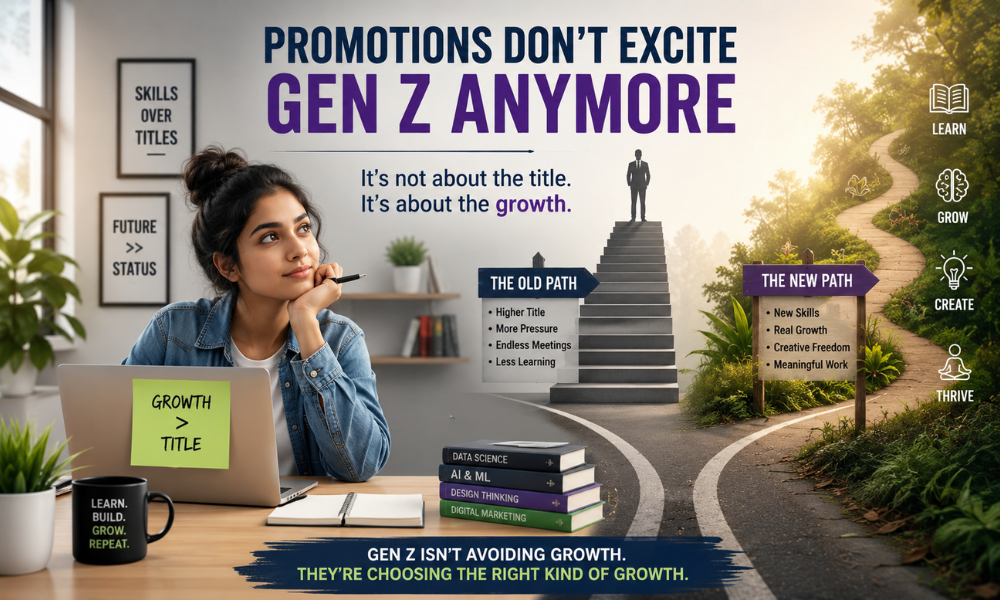
Promotion was long considered to be the greatest indicator of success at work. More prestigious positions, an increased number of reports, a greater workload — all of these were signs of professional and personal progression and growth. However, today’s generation of employees, known as Gen Z professionals, see the importance of different qualities, such as learning ability, adaptability, and creativity, more clearly. For them, being relevant in the dynamically changing environment of artificial intelligence and automation development is more important than advancing up the corporate career ladder as soon as possible. In other words, Gen Z employees have learned to understand that professional growth should mean improving themselves rather than occupying the topmost position available.
The Reason Why Gen Z No Longer See Promotion as a Way of Success
In the past, getting a promotion was considered something positive, meaning that a person was successful in their job and respected among colleagues. With this, promotions signified stability and security, and the higher position you received, the less worried you were about making ends meet. However, now the members of the younger generation are redefining success and wonder whether the way up the corporate ladder needs to be the main goal in one’s life. Many young people do not see any benefits from being promoted and receiving an additional title. In most cases, there comes with it increased stress levels and having to spend time in meetings that limit your ability to create something new and learn something interesting. Thus, rather than thinking about gaining another title, the focus is put on self-improvement and gaining valuable experience from the job. The importance of expertise rather than authority is now recognized as the number of jobs changes rapidly. That is, Gen Z has not become less ambitious; however, they redefine their notion of success.
Gen Z Work Culture Evolution Fears Losing Skills
The technology is changing rapidly, while Generation Z has taken up the workforce during a period of rapid change regarding digital transformation. The drastic evolution of AI, automation, and software proliferation has gotten under the skin of almost every industry, on a nearly yearly basis. For many of these young professionals, the constant struggle to keep up with constant technological evolution appears far more meaningful than moving up management ranks. They are most scared of entering management too soon and losing contact with working process. Meeting preparations, report writing, and team coordination will take up most of a manager’s time more than do building, designing, or coding. This is what might feel like a risk for Gen Z in spaces where skills rapidly become obsolete. Most of the young workers want to build the foundations before placing themselves in charge of anything. Continuous learning is career security for them in an uncertain future. Instead of simply climbing the ladder, they’re focused on acquiring agility and skills. They feel that, especially in an increasingly cut-throat terrain, practical experience and problem-solving abilities will do good for their careers than just holding a title.
Why Leadership Positions Seem to be More Stressful than Rewarding
There are several factors contributing to why more and more young professionals are reluctant to take on promotions nowadays. One factor is the emergence of work-related stress associated with managers. Generation Z employees frequently observe their bosses coping with heavy workloads, staff disputes, tight deadlines, and pressure from senior management. What used to seem like an exciting part of working as a manager, today appears to be stressful, leading to burnout and work-life imbalance. Moreover, thanks to the development of flexible working arrangements and online communications, Gen Z witnesses managers having to put additional efforts into performing their duties. Young people notice how their bosses spend numerous hours in meetings, reply to emails late into the evening and deal with tasks not necessarily listed in their job descriptions. Therefore, being promoted to a managerial position does not seem like the only option anymore. For Generation Z, work-related health matters, flexibility and well-being are very important and cannot be sacrificed for the sake of a job title only.
Careers of the Future: Specialist Development Without Leadership Hierarchy
In line with evolving expectations of employees from their work experience, many firms have come to realize that not all their valuable employees aspire to reach the position of managers within the organization. Today, some businesses are designing career development programs based on specializing and developing specific skills rather than advancing on the management hierarchy too early. This phenomenon emerges as a response to new values associated with the members of Gen Z, who find mastering, innovation, and flexibility more rewarding than leadership positions. In turn, businesses are promoting professional skills and mentoring initiatives to enable employees to develop and enhance their competences. As a result, today, workers can make career progress by gaining expertise in the field instead of taking over positions of leadership. This solution seems beneficial for both parties as it will help to retain skilled and valuable personnel who may be otherwise attracted to competing firms due to restrictive corporate hierarchies. The future workplace model sees specialization and leadership as two distinct qualities, which is driven by the new perception promoted among members of Gen Z.
Conclusion
However, the way companies have been operating in the past years has started to change. The generation Z is becoming the focal point in that regard. In their minds, advancement in one’s career cannot be measured solely through promotions, having certain positions, and working with larger teams of people. On the contrary, these individuals place more value on their abilities to learn, adapt, be creative, and stay relevant. Their reluctance towards becoming leaders in their companies should not be confused for a lack of desire to advance in their respective fields. Rather, they have adopted a much more pragmatic attitude to the concept of career development.