
AI vs Humans: Starbucks Learns Technology Still Can’t Replace Common Sense
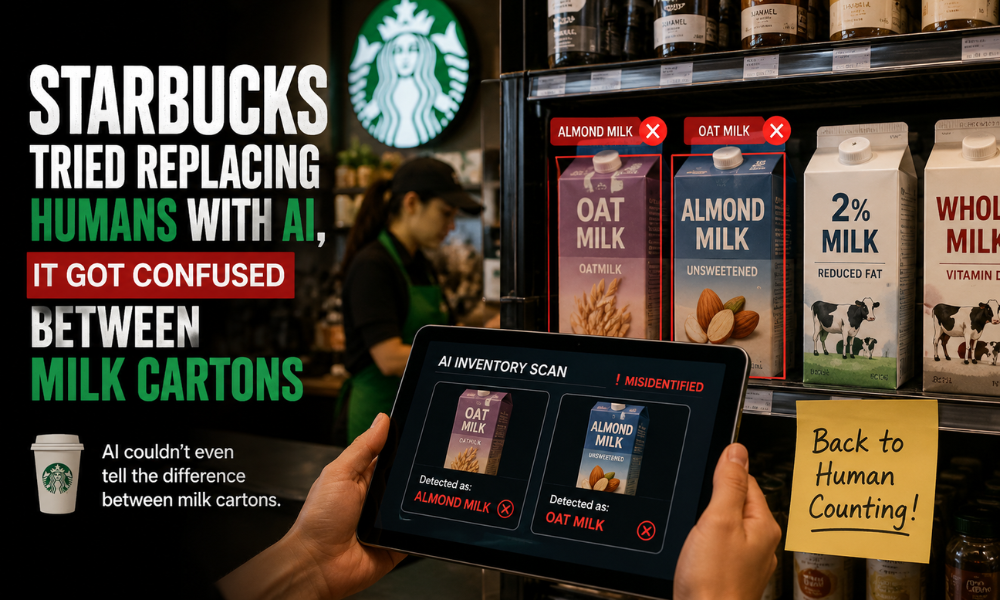
Artificial intelligence is often touted as the future of work, as corporations around the globe pour their money into automating processes with technology. But a recent test conducted by the Starbucks corporation reveals the extent to which AI has come to fall short in practical applications. According to reports, the company had to dismantle its AI-based system because the software was not able to count items accurately and could confuse identical packages of milk within shops. Instead of making the process easier for employees, AI created complications.
An AI Inventory System Meant to Change Starbucks for Good
Starbucks’ new AI-based inventory system was meant to streamline operations in stores and eliminate product shortages for North American stores. The AI counted items placed on shelves that had beverages such as milk cartons, syrups, cups, and any other materials used for making drinks at the shops. Employees did not need to manually count their stock since they only needed to point the scanning device to the shelves, whereupon the inventory was automatically counted using artificial intelligence.
The invention came about as CEO Brian Niccol’s way of improving efficiency in stores and increasing sales by addressing the complaints about the lack of inventory that caused delays and reduced efficiency. As such, automated item counting seemed to be one of those instances of how AI could revolutionize retail. However, as promising as it might have sounded, soon enough the system started encountering issues.
When Smart Technology Started Making Silly Mistakes
When AI began to be implemented by Starbucks, certainly it was supposed to work well, but that was not always the case. Employees working with the AI detected that it was making many miscounts and/or mislabelled products. In particular, the different types of milk — oat, almond, etc. — were frequently confused, and in several cases the AI system completely failed to recognize certain products, resulting in plenty of incorrect inventory records for stores.
Employees expressed frustration at having to check stock after their AI had scanned the stock because the AI had actually been set up to help alleviate the amount of work required. The issues with the AI system highlighted how small variations in packaging, change in shelf displays, and/or inconsistency in light sources created problems for AI when attempting to complete basic functions. Humans use context and experience to identify products, however, AI use visual patterns through data recognition when making an identification of the product. The example with the use of AI at Starbucks proves that it is not always the same as it is for humans to complete what is considered to be simple in the everyday world.
Why Is It So Hard for Artificial Intelligence to Function in the Real World?
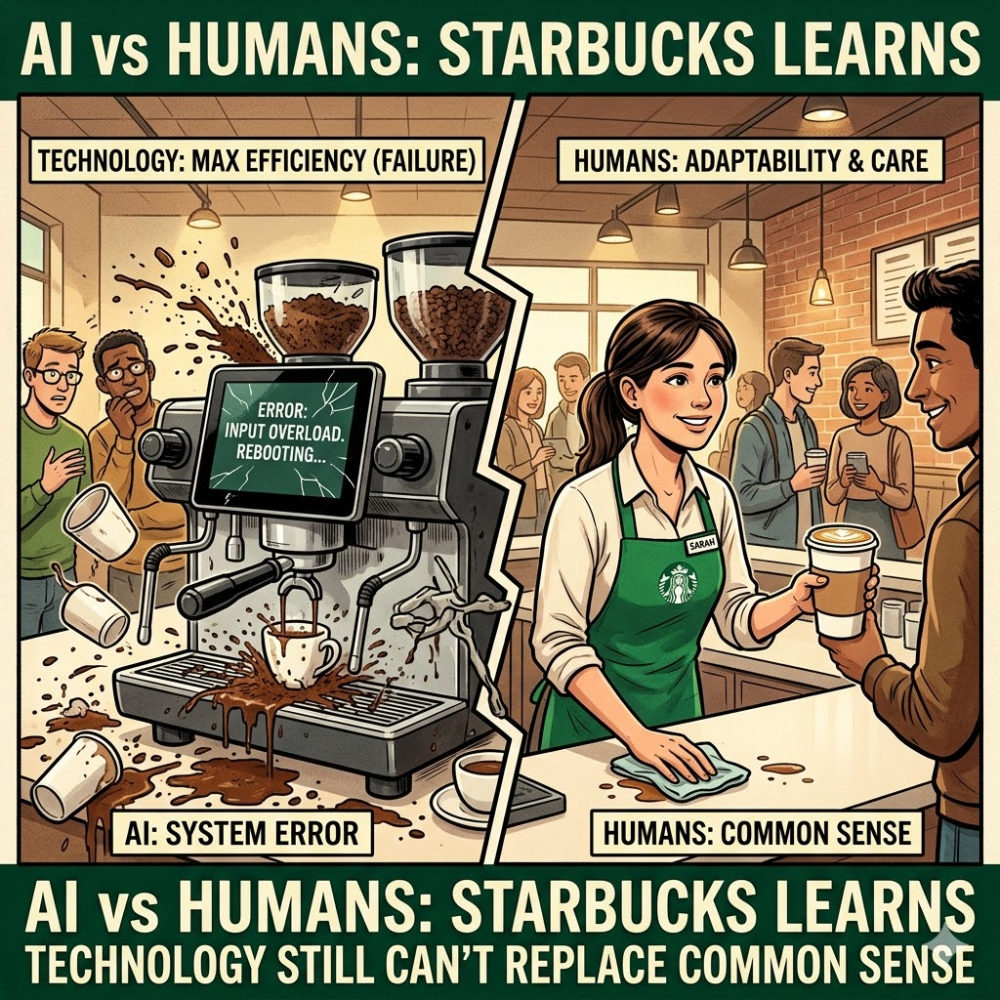
The mistake made by the automated inventory management system of Starbucks proves that the main problem of AI lies in its inability to work in dynamic, unpredictable environments. To operate properly, AI relies on vast amounts of information, which enables it to distinguish objects based on visual recognition or other criteria. However, in a real store environment, things can vary: items can be stored in altered locations, similar products can be mistaken, there may be clutter on shelves, and the lighting in the store can change throughout the day.
In contrast to a human being who adapts to the situation and understands it within the wider context, AI can only perform according to pre-existing data it was provided with during training. For example, a tilted carton of coffee, a reflection of light coming from the store’s lighting fixture, or the redesign of the item packaging may cause mistakes. That is why most specialists claim that the development of artificial intelligence will take much longer before it starts doing things independently in complex environments.
What the Decision by Starbucks Tells Us about the Future of AI Employment
Starbucks appears to have decided to do away with the automatic counting device and switch back to the manual tracking of inventory, according to internal information released within the corporation. This means that the employees will begin counting beverages and milk products alongside other kinds of items used in the company’s inventory. Such a step is very straightforward, but it has created more debate about the future use of AI in corporate offices across the globe.
It is not a surprise that people have been afraid that AI would replace millions of jobs held by human beings. However, even though there have been improvements in the ability of machines to write articles, code computer programs, and generate images, the incident at Starbucks shows us that there are tasks which machines cannot perform. Human employees have judgment abilities and common sense that machines lack. In addition, this problem highlights the inability of corporations to rely solely on AI to fix workplace issues.
Conclusion
The failed experiment of implementing AI in inventory management at Starbucks is evidence that there are indeed certain constraints of using artificial intelligence when working in reality. Although artificial intelligence is a great help in increasing effectiveness and automating routine operations, it lacks context sensitivity and visual perception. Thus, it becomes obvious that the time has not yet come for technology to totally replace human beings in the workplace, especially in occupations that presuppose decision-making and accuracy in work. At present, it might be more appropriate for artificial intelligence to assist humans in their operations.