
China’s Robot Revolution: How Chongqing Built the World’s Largest Railway Station in Just 38 Months
China has once again astounded the world by constructing the Chongqing East Railway Station, which is believed to be the largest railway station in the world, within a time period of 38 months only. Being situated in the fast-growing megacity of Chongqing, the project demonstrates the enormous capacity that China has when it comes to infrastructural developments and technology. The most striking aspect of this construction process was that of the application of AI robots and machines for the completion of construction work at a remarkably fast pace.
The Rise of Chongqing: From Inland City to Economic Powerhouse
Chongqing evolved from being an ancient inland city to becoming one of China’s strongest centers of industry and economy. The city’s existence dates back almost 3,000 years; however, its significance grew greatly in the late 1960s under Mao Zedong’s “Third Front Movement”. The Chinese government initiated significant construction in their inland regions in order to develop industries independent from coastal regions. Large-scale constructions, such as railways, factories, military industries, and power plants, have been constructed in Chongqing and surrounding provinces, thus providing the basis for further development.
Nowadays, Chongqing is considered an up-to-date megacity famous for automobile production, electronic goods production, semiconductor fabrication plants, and logistic services. Chongqing’s geographical location on China’s Yangtze River Economic Belt, as well as its participation in China’s Belt and Road Initiative, resulted in the emergence of an important traffic and trade center. In addition, Chongqing boasts a highly advanced metro, port facilities on the Yangtze River, roads, and high-speed railways.
Chongqing East Railway Station: How It Compares to the Largest Rail Stations
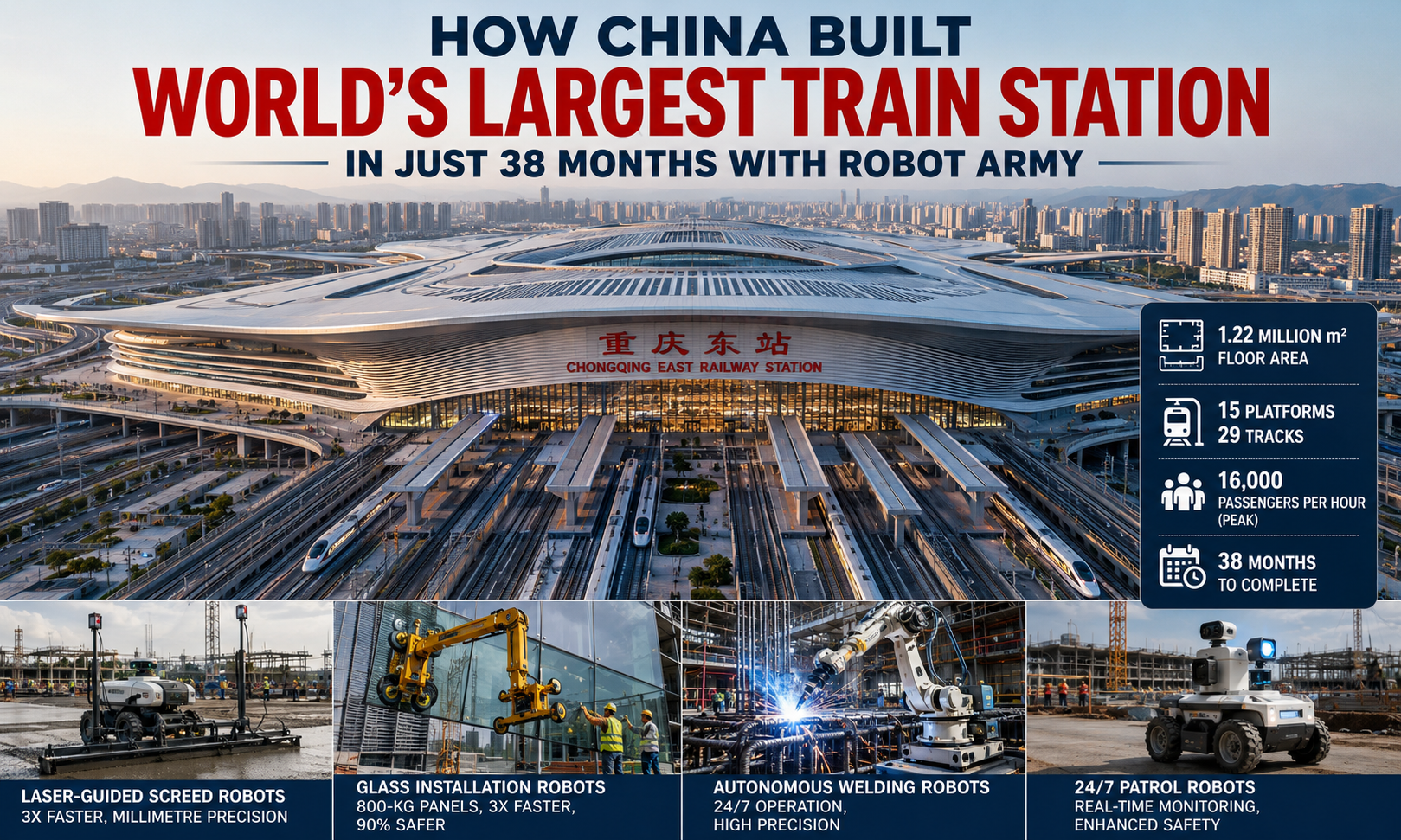
By area, Chongqing East Railway Station has been awarded ‘World’s Largest Railway Station’-1,220,000 sq. meters of rail station space was built and opened as of May 2025. To accommodate for the continued and rapid increase of transportation demand both within Chongqing itself and throughout Southwest China, Chongqing East serves as the major rail transportation terminal for all of this region; it includes 15 platforms and 29 tracks located in multiple rail yard configurations. Due to its enormous size and design, Chongqing East serves as a major hub that connects high-speed rail (HSR), standard rail, metro systems, buses, taxi, and long-distance coach service—as one large seamless transportation network.
Chongqing East Railway Station reportedly carries approximately 16,000 passengers per hour during peak usage times. Furthermore, it is critical to the continued expansion of China’s HSR by connecting Chongqing to other metropolitan areas (i.e., Beijing, Shanghai, Guangzhou, Chengdu, Wuhan and Xi’an); significantly reducing travel times between various cities and improving trade, tourism and overall economic integration. Finally, in addition to serving as a transportation hub, Chongqing East Railway Station is a remarkable demonstration of China’s ability to undertake major engineering and infrastructure projects.
The Army of Robots That Help Build a Megastructure Fast
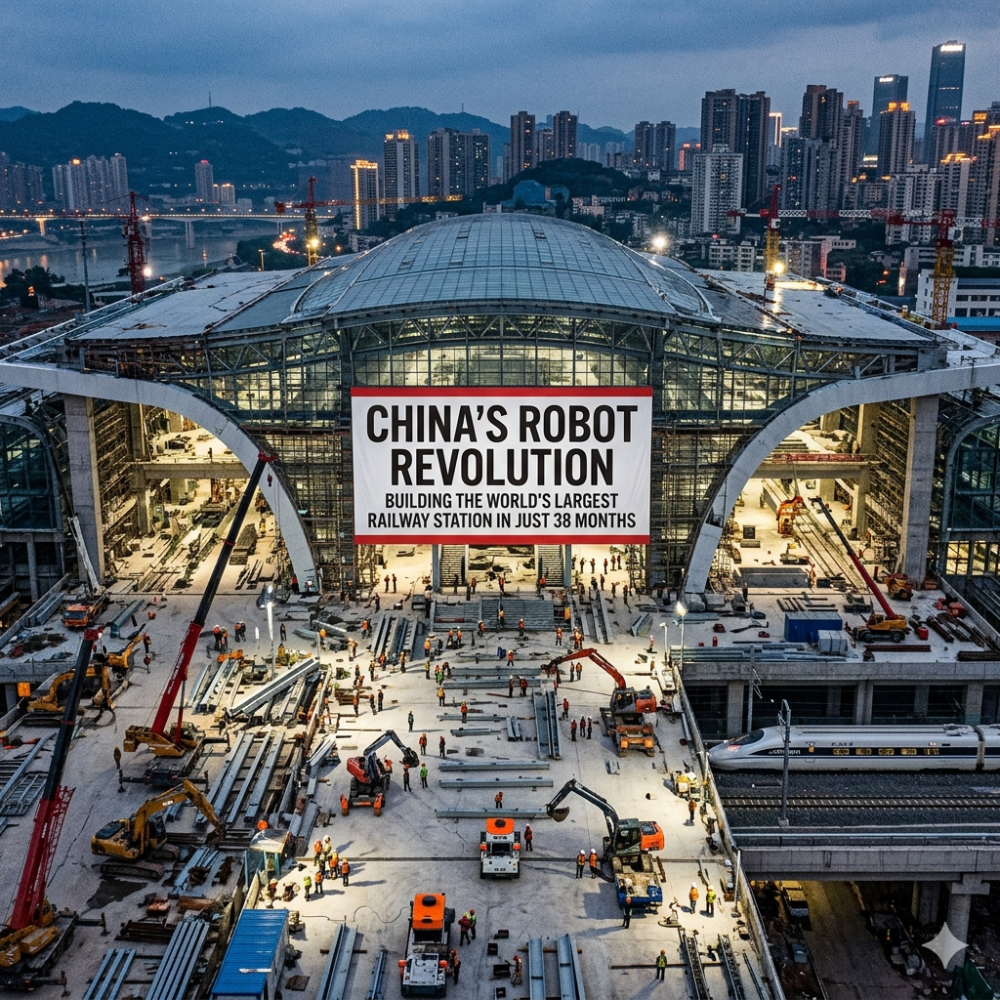
What makes Chongqing East Railway Station so intriguing is its construction which utilized highly sophisticated robotic technology in order to erect this building. As reported in the Chinese media, this project was finished in a mere 38 months thanks to the extensive use of an army of robots equipped with AI, LiDAR and 5G technology. Machines that usually perform jobs that take years to finish required thousands of people to do have been replaced with such robots.
Laser-controlled screed robots made concrete smooth up to millimetres while being faster than a human three times over. Glass installation robots lifted heavy glass panes weighing 800 kilograms without posing any threat of accidents occurring. Welding robots worked around the clock in order to make sure construction process is fast and of a high quality. Robots patrolling construction sites helped to monitor them for potential hazards. In addition, officials said that robotics decreased cost of labour threefold, increased efficiency thrice and cut the number of work-related accidents down by about 90%.
Chongqing East and Its Significance in Relation to China’s Future Ambitions
The opening of Chongqing East Railway Station marks another step that shows how serious China is about becoming one of the leading nations in terms of its advancements in infrastructure, smart cities, and technology. Many nations cannot accomplish their public infrastructure projects within the set timeframe, but not China. The station is an example of how automation, robots, and long-term vision can change the approach to large infrastructure developments.
The station shows that China is actively working on making sure that inland regions and their economy benefit from faster connections with coastal economic hubs through transportation networks. This way, China is able to promote its economic development even further in the future through improved mobility. The fact that Elon Musk shared a video of its construction made many people start discussing China’s rapid advancements in terms of technologies used to create such an amazing piece of infrastructure.
Conclusion
Construction of Chongqing East Railway Station isn’t merely a success story about the construction of infrastructure but a story of development in China, which is driven by innovation and foresight. By using robotics and other cutting-edge technologies, China managed to finish constructing one of the largest railway stations within the shortest period possible. Not only is the construction of this station contributing to better transport infrastructure in China, but also demonstrating how automation can revolutionize construction and shape the way we see building projects.