Why India’s Economy Is Still Growing Strong in a Weak Global Market
The Indian economy remains a shining example in an otherwise slowing global economy. While many of the world’s major economies are struggling with problems such as inflation, low demand, and geopolitical issues, India has continued to sustain its growth rate. Domestic demand, favourable policies, and a solid financial system are all contributing factors for the Indian economy. This blog will discuss the key factors that are keeping the Indian economy on a growth trajectory in spite of the prevailing global uncertainty.
Domestic Demand Driving Growth
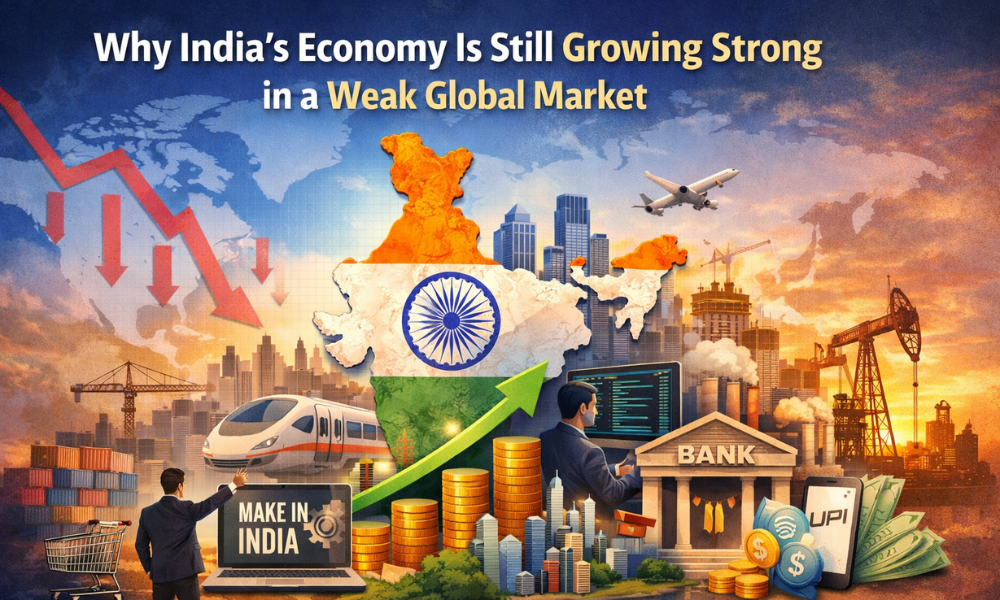
Another major factor that accounts for the high economic growth of India is its high domestic demand. Unlike other countries that rely heavily on export-based economies, India has the advantage of having a high and ever-increasing population that drives the economy through domestic consumption. As the economy grows with more and more people moving towards the middle class and having more money to spend on products and services, the economy grows with the increased consumption of products such as real estate and the internet. Even as the global economy slows down with decreased consumption patterns across the globe, India continues to thrive with its high domestic consumption patterns. As the economy grows with more and more people moving towards the middle class and having more money to spend on products such as real estate and the internet, the economy grows with the increased consumption of products such as real estate and the internet.
Infrastructure and Government Policies Push
Government incentives have been essential for sustaining India’s economic growth. Examples are an increased focus on infrastructure development, manufacturing, and investment, as well as creating an attractive environment for companies to work in. One of the more common programs, pli (production linked incentive) policy, is a programme to encourage companies to manufacture in India so that the Indian economy will be less dependent on imports and more export oriented. Significant infrastructure investment has resulted in massive opportunities for the development of India’s economic development; improving the built environment creates value in a country like India by giving people easier access to employment, by providing better infrastructure and connectivity than before, and by attracting increased foreign and domestic investment through all of the above. Reforms related to the ease of doing business in India, providing tax simplifications, and promoting startups have all enhanced create a supportive ecosystem for business. Examples of government policies helping companies create a greater economy are programs like `make in India` and `digital India; both are enabling India to become home to increased levels of technological receivership and innovation. Collectively, these policies are creating long-term economic growth opportunities. Use along with a resilient economic environment across the globe as development continues to work towards more sustainable economies.
Resilient Banking and Financial Sector
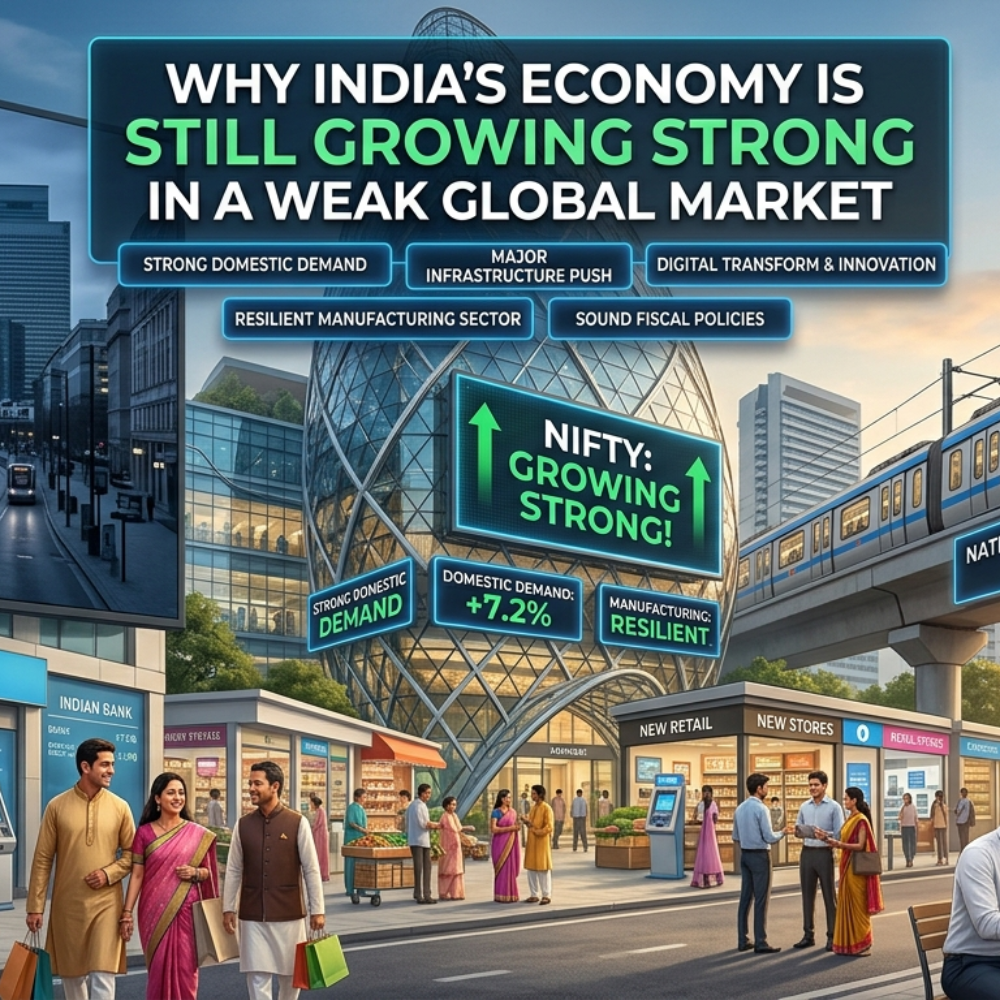
The banking and financial sector in India has become much stronger in the last ten years, and this has helped the economy become much more stable. The regulation and risk management in the sector are better, and the non-performing assets (NPAs) are lower, which has helped banks become more reliable and efficient. The banks are in a better position to support businesses with loans and credit, even in uncertain global markets. Digital banking has also helped the sector become more efficient, and the sector has been able to achieve greater financial inclusion for the people. This has helped the people, as they are able to access formal financial services, and it has also helped small businesses. It has been possible because of digital technologies such as UPI, which has helped revolutionize the way people make transactions. The low inflation rate has helped the economy become stronger, and the monetary policies have been effective, which has helped people become more confident in the financial sector. This has helped people and businesses continue spending, and it has helped the economy become stronger. This has helped the economy become stronger, and it has been able to absorb global shocks more efficiently than several other developing economies.
Key areas of Growth: Manufacturing, Technology, Service
India’s diverse economic structure has played a significant role in its continued growth. Technology has been a major contributor to India’s growing economy through IT services and start-up firms. These two sectors are responsible for a substantial amount of exports and employment in India. Digital transformation, cloud computing and AI services have been in high demand, despite slowdowns around the world. Additionally, the manufacturing sector is being bolstered by the Indian government’s efforts to attract multinational corporations and promote local businesses to create jobs and build a more diversified manufacturing base. Global companies are from companies that have been successfully diversifying their supply chains beyond one Country and have begun to turn to India as a manufacturing hub for their future. At the same time, the Services Sector continues to play a vital role in India’s growing economy, contributing to both GDP and the overall economy; therefore, the balanced growth rate of these 3 sectors reduces dependency on a single sector to drive growth within an economy. Another aspect that contributes to India’s potential for rapid economic growth is the large amount of entrepreneurial innovation and young workers in the Indian labour market. The combination of these three areas within the Indian economy has produced an extremely resilient economic environment and continues to do so despite challenges faced by the global economy.
Conclusion
The economic resilience of India in a difficult global market is a reflection of the robustness of the internal base of the Indian economy. With robust domestic demand, supportive government policies, a sound financial system, and growth in major sectors, the Indian economy is moving ahead despite the challenges posed by the global market. The balanced and diversified growth of the Indian economy not only shields it from external shocks, but it is also recognized as the growth leader of the major economies of the world.