
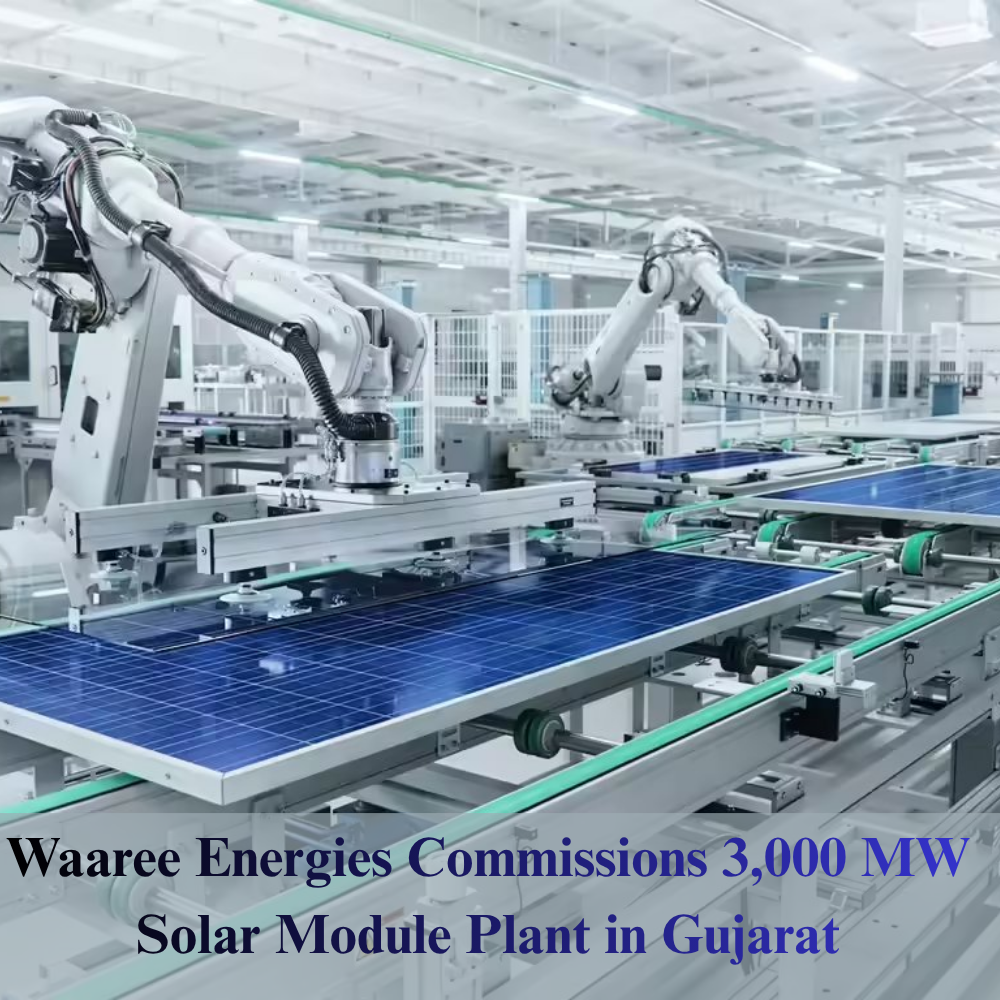
Waaree Energies Commissions 3,000 MW Solar Module Plant in Gujarat
India’s renewable energy sector continues to witness rapid growth, and a major milestone has been achieved with the commissioning of a 3,000 MW (3 GW) solar module manufacturing plant in Gujarat by Waaree Energies. This development strengthens India’s position as a global hub for solar manufacturing and supports the country’s ambitious clean energy goals.
The expansion of this large-scale facility marks a significant step toward self-reliance in solar equipment production while also boosting domestic manufacturing capabilities under the “Make in India” initiative.

Overview of the 3,000 MW Solar Module Plant
Waaree Energies has expanded its solar module manufacturing capacity in Gujarat to 3 GW at its Samakhiali facility in Kutch. Waaree Energies achieved this by adding 1.5 GW of new high-efficiency N-type solar module production lines to the existing infrastructure.
This plant is one of the most advanced solar manufacturing facilities in India and plays a key role in scaling up the country’s renewable energy infrastructure.
Key Highlights:
- Total capacity: 3,000 MW (3 GW) annually
- Location: Samakhiali, Kutch, Gujarat
- Technology: High-efficiency N-type solar modules
- Expansion: Additional 1.5 GW production capacity added
- Focus: Domestic supply and global exports
Importance of the Project for India
The commissioning of this solar module plant is not just a corporate achievement but also a strategic development for India’s energy sector.
1. Boost to Renewable Energy Goals
India aims to achieve 500 GW of non-fossil fuel energy capacity by 2030, and solar energy plays a crucial role in this mission. A 3 GW manufacturing plant contributes significantly to meeting the growing demand for solar modules.
2. Strengthening Domestic Manufacturing
India has long depended on imports, especially from China, for solar equipment. Projects like this reduce dependency and promote self-reliance in solar manufacturing.
3. Supporting Government Initiatives
The plant aligns with key initiatives such as the following:
- Make in India
- Production Linked Incentive (PLI) Scheme
- Atmanirbhar Bharat
Technological Advancements in the Plant
The Gujarat facility uses N-type solar module technology, which is considered more efficient and durable than traditional P-type modules.
Benefits of N-type Modules:
- Higher energy efficiency
- Better performance in low-light conditions
- Lower degradation over time
- Longer lifespan
This positions Waaree Energies as a leader in advanced solar technology manufacturing.
Expansion of Waaree Energies’ Global Capacity
With this commissioning, Waaree Energies has significantly strengthened its global presence.
- Total global solar module capacity: 22.3 GW
- India capacity: 19.7 GW
- US capacity: 2.6 GW
The Gujarat plant plays a major role in this expansion and helps the company meet rising global demand for solar modules.
Economic Impact of the Plant
1. Job Creation
The plant is expected to generate:
- Direct employment in manufacturing
- Indirect jobs in logistics, supply chain, and services
2. Boost to Local Economy
The project contributes to economic development in Kutch and surrounding regions by:
- Increasing industrial activity
- Supporting MSMEs
- Improving infrastructure
3. Export Opportunities
With growing global demand for renewable energy, the plant enables India to become a major exporter of solar modules.
Role in the Solar Value Chain
Waaree Energies is building an integrated solar ecosystem by expanding across the value chain.
Key Segments:
- Solar modules
- Solar cells (5.4 GW capacity in Gujarat)
- Inverters (3.05 GW facility in Gujarat)
- Energy storage systems
This integration ensures better quality control, cost efficiency, and supply chain stability.
Gujarat as a Solar Manufacturing Hub
Gujarat has emerged as a leading state for renewable energy investments due to:
- Strong industrial infrastructure
- Favorable government policies
- Availability of land and logistics support
- Proximity to ports for exports
The state is home to several major solar projects, and Waaree’s 3 GW plant further strengthens Gujarat’s position as a solar manufacturing hub in India.
Environmental Benefits
The commissioning of the solar module plant has several environmental advantages:
1. Reduction in Carbon Emissions
Solar energy helps reduce dependence on fossil fuels, leading to lower greenhouse gas emissions.
2. Clean Energy Production
The plant supports the production of clean and sustainable energy solutions.
3. Contribution to Climate Goals
India has committed to reducing carbon intensity and achieving net-zero emissions in the long term. Projects like this contribute significantly to these targets.
Challenges and Future Outlook
While the project is a major success, the solar manufacturing industry faces certain challenges:
Challenges:
- Global price competition
- Supply chain disruptions
- Trade barriers (such as import duties in international markets)
Future Outlook:
Despite challenges, the future remains highly promising due to
- Increasing global demand for solar energy
- Government support for domestic manufacturing
- Technological advancements
Waaree Energies is expected to continue expanding its capacity and strengthening its global footprint.
Key Takeaways (Points)
- Waaree Energies commissioned a 3,000 MW solar module plant in Gujarat
- The plant is located in Samakhiali, Kutch
- Uses advanced N-type solar technology
- Boosts India’s renewable energy capacity
- Supports Make in India and Atmanirbhar Bharat
- Enhances global manufacturing capacity to 22.3 GW
- Generates employment and economic growth
- Strengthens India’s position in the global solar market
Conclusion
The commissioning of the 3 GW solar module plant by Waaree Energies in Gujarat is a landmark achievement for India’s renewable energy sector. It reflects the country’s commitment to clean energy, self-reliance, and industrial growth.
With advanced technology, large-scale production capacity, and strong government support, this project not only meets domestic energy demands but also positions India as a global leader in solar manufacturing. As the world transitions toward sustainable energy, initiatives like this will have an important role in shaping a greener and more energy-secure future.