
Tiny crystal stores massive data: scientists develop 5TB storage in a 12 cm quartz plate
The digital age has transformed the way humans create, store, and access information. Every day, enormous amounts of data are generated through smartphones, computers, satellites, research laboratories, and digital services. As the amount of digital information continues to grow rapidly, one of the biggest challenges facing scientists and technology companies is finding reliable ways to store this data for extremely long periods of time.
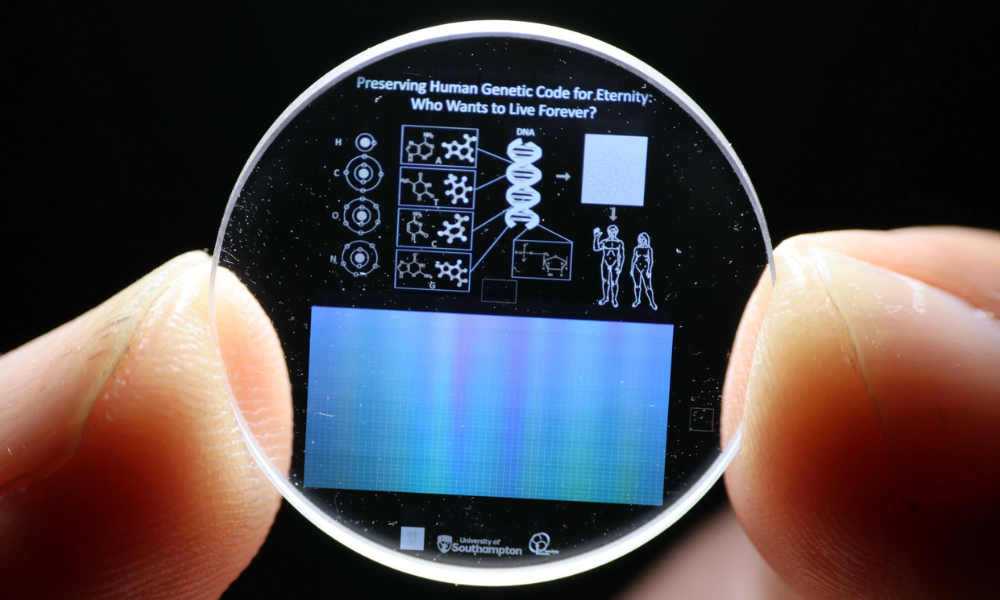
In a major technological breakthrough, researchers have developed an innovative data storage method using a small quartz crystal plate. Despite its compact size of only about 12 centimeters, this crystal device can store as much as five terabytes of data. This amount of storage is equivalent to approximately two thousand high-definition films.
growing need for long-term data storage
Modern society produces an enormous amount of digital data every year. Governments, research institutions, companies, and individuals rely on digital storage systems to preserve information.
However, most existing storage devices have limited lifespans.
For example,
hard drives may last only a few years before failure
flash drives and memory cards can degrade over time
optical discs such as CDs and DVDs may become unreadable after several years
cloud servers require constant maintenance and energy
Because of these limitations, scientists are exploring new technologies that can store information safely for hundreds or even thousands of years.
development of quartz crystal storage
To solve this challenge, researchers have experimented with a special type of quartz crystal. Quartz is known for its durability, stability, and resistance to environmental damage.
In this new technology, a thin quartz crystal plate is used as a data storage medium. Although the plate measures around twelve centimeters, it has the capacity to store up to five terabytes of digital information.
Five terabytes of data can include
thousands of books
large scientific databases
historical documents
high-definition films and videos
massive digital archives
This compact storage solution has the potential to revolutionize the way long-term digital information is preserved.
how data is stored inside the crystal
Unlike traditional storage devices that store data using magnetic or electronic signals, crystal storage uses advanced laser technology.
The process involves
powerful lasers that create microscopic structures inside the crystal
tiny points inside the crystal that represent digital data
three-dimensional storage layers within the crystal
Each of these microscopic structures acts like a digital pixel that stores information. Because the data is stored inside the crystal rather than on its surface, it remains protected from external damage.
This technique allows scientists to store extremely large amounts of information within a small physical space.
durability and longevity of the technology
One of the most remarkable aspects of quartz crystal storage is its extraordinary durability. Traditional storage devices can degrade due to environmental factors such as heat, humidity, or magnetic interference.
Crystal storage technology is designed to withstand these conditions.
The stored data can remain safe even when exposed to
extreme temperatures
water or moisture
radiation
electromagnetic interference
physical aging
Scientists believe that the data stored in this crystal could survive for up to ten thousand years without degradation. This makes it one of the most stable storage mediums ever created.

protection against extreme conditions
Another important feature of this technology is its ability to protect data even in harsh environments.
The crystal storage device can tolerate very high temperatures and still preserve the stored information. Some tests have shown that the crystal can withstand temperatures of hundreds of degrees without losing the stored data.
This durability makes it suitable for
scientific archives
national libraries
historical record preservation
space exploration data
important government documents
Such long-term storage could ensure that valuable information is preserved for future generations.
advantages compared with current storage systems
Crystal-based storage offers several advantages over traditional digital storage technologies.
Key benefits include
extremely long lifespan
very high storage capacity
resistance to environmental damage
reduced risk of data loss
compact and durable physical structure
Because the storage medium is highly stable, it does not require constant power or maintenance like many digital storage systems.
potential applications in the future
This breakthrough technology could transform several industries and sectors in the future.
Possible applications include
long-term preservation of scientific research
storage of cultural and historical records
archiving important government documents
backup storage for global digital libraries
data preservation for space missions
For example, space agencies may use crystal storage to preserve data collected during long-term space exploration missions.
Similarly, national archives and museums could use this technology to protect historical records for thousands of years.
challenges before commercial use
Although the technology is promising, it is still in the research and development stage. Scientists must overcome several challenges before crystal storage becomes widely available.
Some of these challenges include
developing cost-effective manufacturing processes
creating compatible reading devices
ensuring fast data retrieval
scaling up production for commercial use
Researchers continue to work on improving the technology so that it can be used in real-world applications.
the future of data preservation
As digital information becomes increasingly important, the need for long-lasting storage systems will continue to grow. Technologies like quartz crystal storage represent an exciting step toward solving this challenge.
If successfully implemented, crystal storage could become one of the most reliable methods for preserving digital knowledge for future generations.
The possibility of storing massive amounts of data in a small, durable object could reshape the way humanity protects its digital heritage.
Conclusion
The development of quartz crystal data storage marks a significant milestone in the evolution of digital technology. With the ability to store five terabytes of data in a small crystal plate and preserve that information for up to ten thousand years, this innovation could redefine long-term data preservation.
As digital data continues to grow rapidly, reliable storage solutions are becoming increasingly essential. Crystal storage offers a promising alternative to traditional storage systems by providing exceptional durability, stability, and longevity.