
Gujarat to Establish Four Centres of Excellence for Natural Farming, Plans Expansion to Every District
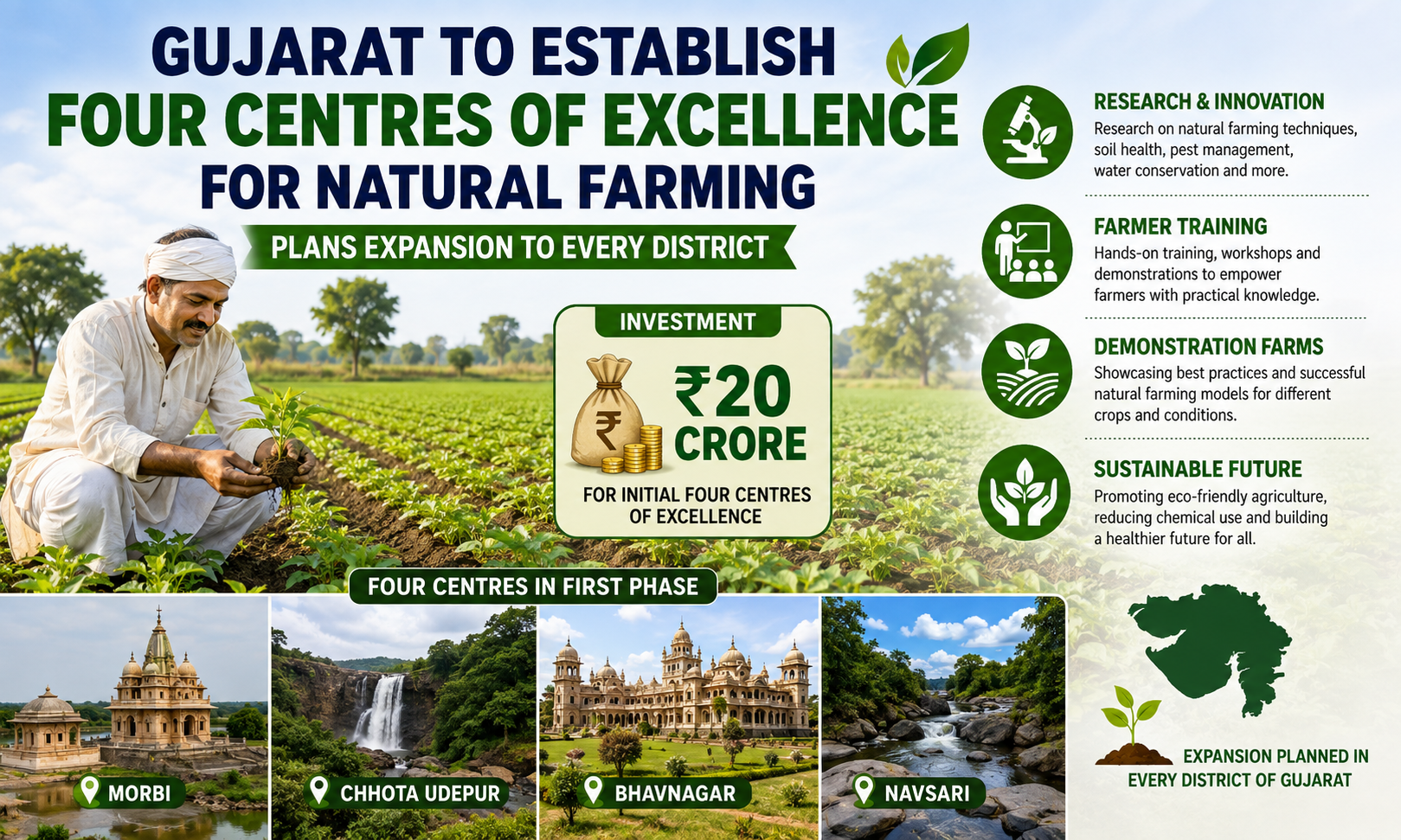
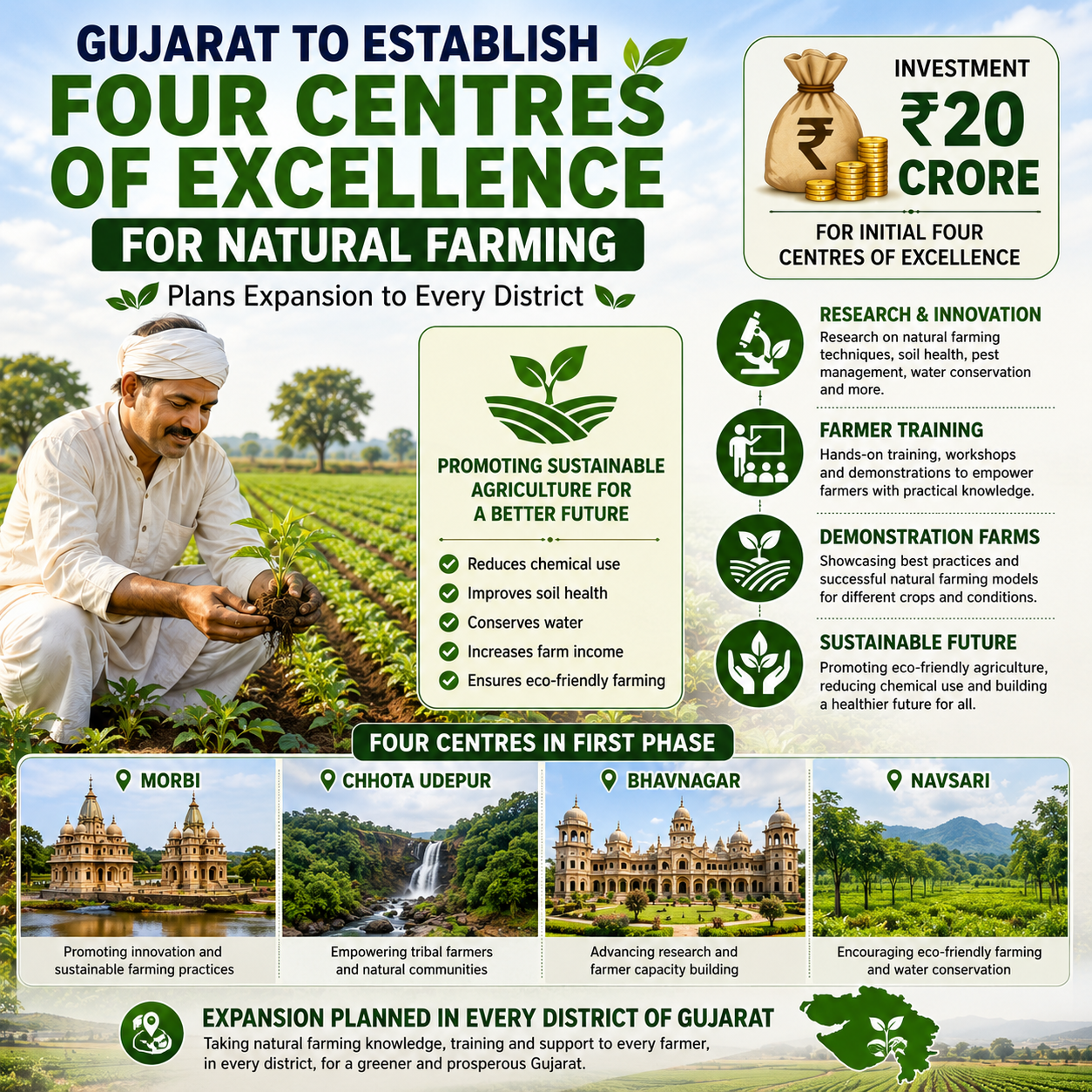
The Gujarat Government has announced a major initiative to strengthen natural farming across the state by establishing four Centres of Excellence (CoEs) dedicated to research, innovation, training, and farmer support. The project marks an important step toward promoting sustainable agriculture while reducing dependence on chemical fertilizers and pesticides. With an initial investment of Rs 20 crore, the Centres of Excellence will be set up in Morbi, Chhota Udepur, Bhavnagar, and Navsari. The government has also revealed plans to gradually expand this model by establishing similar centres in every district of Gujarat in the coming years.
The initiative is expected to play a significant role in transforming the state’s agricultural landscape by helping farmers adopt eco-friendly, cost-effective, and sustainable farming practices.
A Major Push Towards Natural Farming
Natural farming has gained significant attention in recent years as governments and agricultural experts encourage farming methods that protect soil health, conserve water, and produce chemical-free crops. Gujarat has been actively promoting sustainable agriculture, and the new Centres of Excellence are expected to accelerate this movement.
The centres will function as dedicated institutions where farmers can learn modern natural farming techniques through demonstrations, practical training sessions, and scientific guidance. They will also serve as research hubs to develop region-specific farming solutions suitable for Gujarat’s diverse climatic conditions.
Four Districts Selected for the First Phase
Under the first phase of the project, four Centres of Excellence will be established in strategically selected districts:
- Morbi
- Chhota Udepur
- Bhavnagar
- Navsari
Each location has been chosen considering its agricultural importance and potential to promote natural farming in surrounding regions.
The centres will act as model institutions that can later be replicated across other districts as the programme expands statewide.
Investment of Rs 20 Crore
The Gujarat Government has allocated Rs 20 crore for establishing the initial four Centres of Excellence.
The investment will be used to develop modern infrastructure, demonstration farms, research facilities, training halls, laboratories, irrigation systems, and other essential resources required to support natural farming activities.
In addition to infrastructure development, funds will also be utilized for farmer education programmes, technical support, and capacity-building initiatives.
Research and Innovation at the Core
One of the primary objectives of the Centres of Excellence is to strengthen agricultural research related to natural farming.
Scientists and agricultural experts will work on:
- Improving soil fertility naturally
- Developing eco-friendly farming techniques
- Efficient water management
- Pest and disease control without chemicals
- Crop diversification
- Organic nutrient management
- Climate-resilient farming practices
Research conducted at these centres will help farmers increase productivity while maintaining environmental sustainability.
Practical Training for Farmers
Farmer education will be a major focus of the initiative.
The Centres of Excellence will organize regular training programmes covering various aspects of natural farming, including:
- Preparation of natural fertilizers
- Organic pest management
- Seed treatment techniques
- Soil conservation methods
- Water-saving irrigation practices
- Crop planning
- Integrated farming systems
Hands-on demonstrations will enable farmers to understand practical applications rather than relying only on theoretical knowledge.
Demonstration Farms to Showcase Best Practices
Each Centre of Excellence will include demonstration farms where visitors can observe natural farming methods in real agricultural conditions.
These demonstration plots will showcase successful cultivation of different crops using environmentally friendly techniques. Farmers will be able to compare conventional and natural farming practices while understanding the long-term benefits of sustainable agriculture.
The demonstration farms will also help agricultural students, researchers, and extension workers gain valuable practical experience.
Supporting Sustainable Agriculture
Natural farming offers several environmental and economic advantages.
Some of the major benefits include:
- Reduced dependence on chemical fertilizers
- Lower production costs
- Improved soil fertility
- Better water conservation
- Enhanced biodiversity
- Healthier food production
- Reduced environmental pollution
- Improved long-term farm sustainability
The new Centres of Excellence are expected to promote these benefits by providing continuous guidance and technical support to farmers.
Expansion Planned Across Gujarat
While the first four centres will serve as pilot institutions, the government has announced plans to gradually establish Centres of Excellence in every district.
This district-wise expansion will ensure that farmers across Gujarat have easy access to expert guidance, research support, and training opportunities.
As the network grows, the state aims to create a comprehensive ecosystem that supports sustainable agricultural development throughout Gujarat.
Boosting Farmer Income
Natural farming not only benefits the environment but can also improve farmers’ financial stability.
By reducing expenditure on chemical fertilizers, pesticides, and other external inputs, farmers can significantly lower cultivation costs. Additionally, the growing demand for naturally produced food may provide better market opportunities and higher income.
The Centres of Excellence will guide farmers on improving productivity while minimizing production expenses.
Promoting Eco-Friendly Agriculture
The initiative aligns with broader efforts to promote environmentally responsible farming practices.
Chemical-intensive agriculture has contributed to soil degradation, declining groundwater quality, and environmental pollution in many regions. Natural farming seeks to reverse these challenges by encouraging ecological balance and sustainable resource management.
The Centres of Excellence will help farmers transition toward practices that protect natural resources while ensuring stable agricultural production.
Capacity Building and Knowledge Sharing
Apart from farmer training, the Centres of Excellence will also become knowledge-sharing platforms for agricultural officers, researchers, students, and rural development organizations.
Workshops, seminars, field visits, and collaborative research programmes will encourage continuous learning and innovation in the natural farming sector.
The exchange of practical knowledge between experts and farmers will strengthen agricultural extension services throughout the state.
Strengthening Gujarat’s Agricultural Future
Agriculture remains one of Gujarat’s most important economic sectors, supporting millions of farming families. Investments in research, education, and sustainable farming practices are essential for ensuring long-term agricultural growth.
The new Centres of Excellence represent an important step toward creating a resilient farming ecosystem capable of addressing challenges such as climate change, rising input costs, and environmental degradation.
By combining scientific research with traditional farming wisdom, the initiative aims to prepare farmers for a more sustainable future.
Conclusion
A Significant Step Towards Sustainable Development
The Gujarat Government’s decision to establish four Centres of Excellence for natural farming demonstrates its commitment to promoting environmentally friendly agriculture and supporting farmers through innovation and education. With an initial investment of Rs 20 crore, the centres in Morbi, Chhota Udepur, Bhavnagar, and Navsari will become hubs for research, demonstration, and skill development.
As the programme expands to every district, it has the potential to transform Gujarat into a leading state for natural farming. By encouraging sustainable cultivation practices, improving soil health, reducing chemical dependency, and empowering farmers with modern knowledge, the initiative is expected to contribute significantly to both agricultural prosperity and environmental conservation in the years ahead.