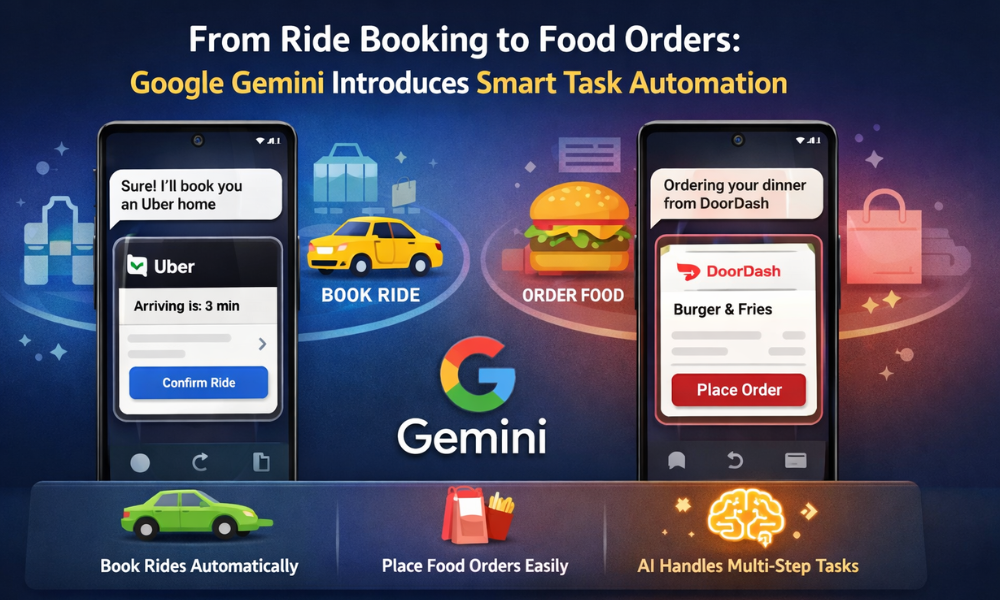
From Ride Booking to Food Orders: Google Gemini Introduces Smart Task Automation
Artificial intelligence is rapidly moving beyond answering questions and generating content to actually getting things done. In its latest evolution, Google has taken a major step in that direction by introducing Smart Task Automation in Google Gemini. This new capability allows the AI assistant to perform real-world digital tasks on behalf of users—ranging from booking rides to ordering food—marking a significant shift in how people interact with AI in their daily lives.
What Is Smart Task Automation in Google Gemini?
Smart Task Automation is designed to reduce manual effort by allowing Gemini to understand intent, take action, and complete tasks across apps and services. Until now, users had to switch between multiple apps—ride-hailing, food delivery, calendars, browsers—and manually enter information. With this update, Gemini can manage these steps autonomously after receiving a simple command.
For example, instead of opening a ride-booking app, selecting a location, choosing a time, and confirming payment, a user can simply say:
“Book a cab to the office at 9 AM tomorrow.”
Gemini interprets the request, checks available options, and completes the booking process.
The same applies to food orders, appointments, reminders, and other routine activities.
How It Works Behind the Scenes
Google Gemini’s new automation feature relies on three core elements:
- Context Awareness – Gemini understands user preferences, previous behavior, location, and timing.
- Multi-Step Reasoning – The AI can break down a task into smaller steps and execute them in the correct order.
- App and Service Integration – Gemini works with supported third-party apps and Google’s own ecosystem to complete tasks securely.
This combination allows Gemini to function not just as a chatbot, but as a digital assistant capable of execution.
From Ride Booking to Food Orders: Everyday Use Cases
The most talked-about aspect of this update is how practical it is. Some key real-world use cases include:
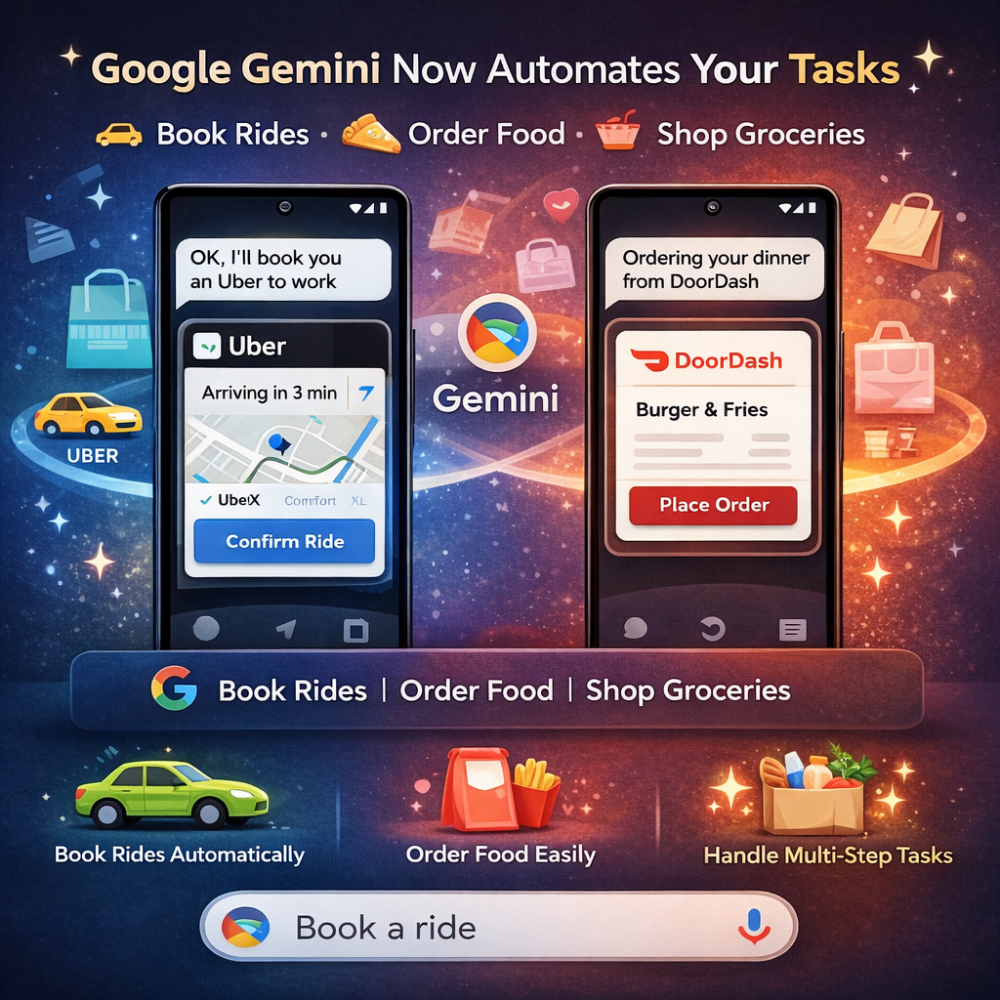
- Ride Booking: Schedule or instantly book cabs, track pickup times, and receive confirmations.
- Food Orders: Reorder favorite meals, browse menus, and place orders based on past preferences.
- Daily Scheduling: Add meetings, set reminders, and reschedule appointments automatically.
- Shopping Assistance: Find products online, compare prices, and place orders where supported.
- Travel Planning: Manage hotel reservations, local transport, and itinerary reminders.
By handling these routine actions, Gemini frees users from repetitive digital chores.
Focus on User Control and Safety
With automation comes responsibility, and Google has emphasized user control, privacy, and safety as central pillars of this feature.
- Permission-Based Actions: Gemini cannot perform tasks without user authorization.
- Confirmation Steps: For sensitive actions like payments or bookings, user confirmation is required.
- Limited Access Mode: Automation works only within predefined boundaries set by the user.
- Data Protection: Google states that user data used for automation is protected under existing privacy policies.
This approach ensures that while Gemini becomes more powerful, it does not compromise trust.
Limited Rollout and Device Compatibility
Currently, Smart Task Automation is being rolled out in phases. Initially, it is available to select users and supported devices, particularly on newer Android versions. Google is testing performance, reliability, and user feedback before expanding access globally.
This controlled rollout helps prevent errors and ensures that automation works smoothly across different regions and services.
Why This Update Matters
The introduction of Smart Task Automation represents a broader shift in AI development—from informational AI to operational AI. Instead of merely assisting with suggestions, Gemini now actively participates in completing tasks.
This has several important implications:
- Time Savings: Users spend less time navigating apps.
- Reduced Cognitive Load: Fewer decisions and steps are required.
- Increased Productivity: Professionals can delegate routine tasks to AI.
- Better Accessibility: Users who find complex apps difficult to use benefit greatly from voice- or text-based automation.
In essence, Gemini is becoming a true digital helper rather than just a smart search tool.
Impact on Businesses and App Ecosystem
This update could significantly impact businesses, especially those in ride-hailing, food delivery, and e-commerce. Apps that integrate smoothly with Gemini may see higher engagement and repeat usage, as AI-driven convenience encourages faster decision-making.
For businesses, this means:
- Optimizing services for AI-based interactions
- Ensuring accurate menus, pricing, and availability
- Providing seamless APIs for automation support
Those who adapt early may gain a competitive edge in an AI-first ecosystem.
Challenges and Limitations
Despite its promise, Smart Task Automation is not without challenges:
- Service Availability: Not all apps and services are supported yet.
- Regional Restrictions: Some features depend on local regulations and partnerships.
- Learning Curve: Users may need time to trust AI with real-world actions.
- Error Handling: Incorrect interpretations can lead to wrong bookings if not carefully reviewed.
Google is actively refining the system to address these issues through user feedback and updates.
The Future of AI Assistants
With this move, Google Gemini joins a growing trend where AI assistants aim to become proactive digital managers. Future updates may include deeper personalization, broader service integrations, and even predictive actions where Gemini suggests tasks before users ask.
Imagine an assistant that notices you leave work late on Fridays and automatically suggests booking a cab or ordering dinner. That future is now closer than ever.
Conclusion
From ride booking to food orders, Google Gemini’s Smart Task Automation marks a major milestone in everyday AI usage. By transforming simple commands into completed actions, Gemini bridges the gap between digital intelligence and real-world convenience.
As the feature expands and matures, it has the potential to redefine how people interact with technology—making AI not just smart, but truly useful in daily life.