




Satya Nadella’s AI Warning: Will a Handful of Tech Giants Control the Future of Entire Industries?
Artificial intelligence has begun to change the world economy in ways that bring about higher levels of productivity and innovation within various fields. There has been growing concern about who might gain the most from the rise of artificial intelligence. According to Satya Nadella, the CEO of Microsoft, this might lead to economic inequality since only a handful of firms may possess the most powerful forms of artificial intelligence. He argues that a firm must utilize human expertise alongside its AI technologies instead of relying entirely on outside vendors. Such concerns have emerged against the background of discussions about job losses and disruption in various industries. The central issue now is whether AI will generate possibilities for all industries or be monopolized by a select few.
The Reasons for Nadella’s Concern about AI Creating Economic Power Imbalances
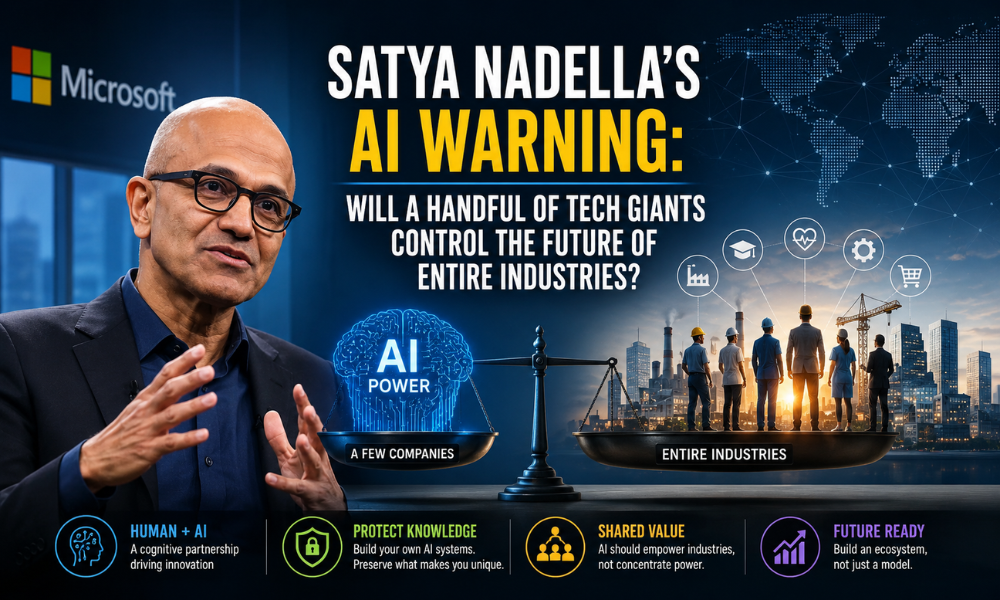
Artificial intelligence becomes an essential part of the processes taking place within organizations, facilitating automation of operations, better decision-making and increasing efficiency. But Microsoft CEO Satya Nadella warns that all these benefits might turn out to be concentrated within just a few tech giants. The problem, according to him, lies in the fact that if businesses are completely dependent on external services when implementing artificial intelligence technologies into processes, they will eventually lose any control over their own value creation. As industries grow increasingly reliant on external suppliers of AI models, they will inevitably face market domination in which a small group of organizations can reap most of the profits and have significant influence. Nadella fears that as a result, there might emerge an imbalanced economic system where companies will be supplying AI providers with data, their expertise and industry know-how but will receive no substantial value in return. Such is the reality that worries him. He advises businesses not to let this happen and work towards creating their own AI-based processes and learning mechanisms.
Human Capital vs Token Capital: Nadella’s Vision for the AI Era
Satya Nadella believes that one of his most significant views about future workers is the need to create a balance between what he calls human capital and what he refers to as “token” – the ability to use artificial intelligence (AI) to support people and help them create value for themselves and their employer.
Human capital means everything your employees bring to your organization – the skills and talents that enable them to add value to your organization, such as knowledge, creativity, judgment, relationships, and expertise.
What does Nadella mean when he says “token” capital? Token capital refers to the difference between the capabilities of employees that companies have created and the capabilities created by AI.To be successful during this AI era of technology, it is imperative that all businesses invest in both types of workers (human and technological). As Nadella stated: “You cannot replace [your] employees with AI.” Rather, you will employ AI to help develop what’s next for [your] employees.
As AI can process vast quantities of data to complete tasks in ways that were traditionally accomplished by humans, AI is meant to augment, and ultimately enhance, our human capital by providing greater efficiencies than humans could produce alone.
The human workforce still depends on its capabilities to produce the future vision of AI through strategic planning, determining optimal customer engagement methods, and identifying how to add value to the organization. Human workers should collaborate with AI systems to produce complementary outcomes that achieve both parties’ needs.
Throughout this process of learning, humans and machines will continuously experience interdependent learning cycles. As such, they are inherently creating a cognitive loop through both partners that produces higher-quality, faster productivity within organizations.
The Danger of Knowledge Loss due to AI Systems
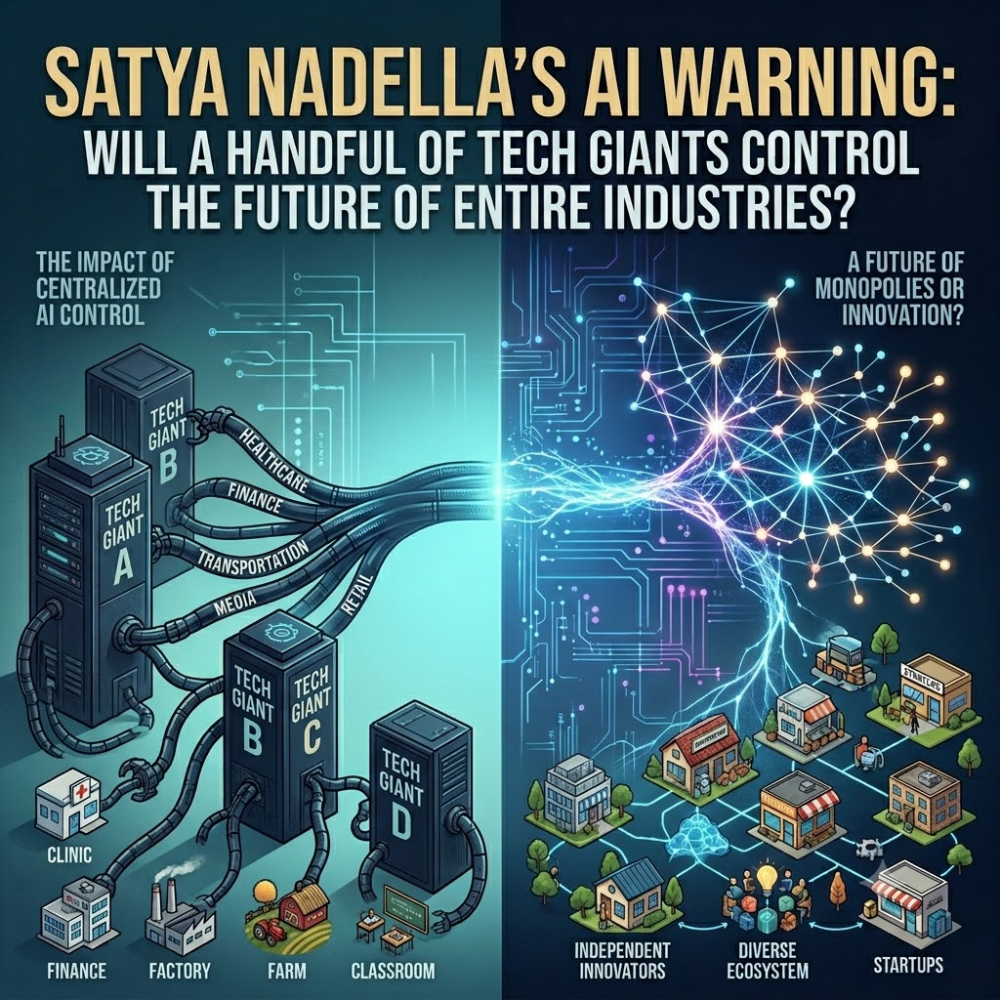
Another important point raised by Nadella is that corporations may involuntarily give away their industry-specific knowledge to a few dominant players of the AI market. As more and more companies start to rely on AI systems provided by external organizations, they also tend to invest their knowledge into improving those systems. In consequence, there might be a tendency towards the monopolization of industry-specific knowledge in the hands of several companies while businesses lose their competitive edge. According to Nadella, this situation may lead to commoditization and thus further undermine the competitive ability of organizations in question. The risk described above is similar to the one seen during the process of globalization when economic development remained constant while many societies experienced major disruptions due to job losses and loss of expertise. However, in the current situation, it is the intellectual assets that should be preserved rather than the physical presence of production facilities. To solve this issue, Nadella suggests creating independent learning systems to preserve organizations’ intellectual property and experience.
AI’s Future: Growth of Ecosystem or Massive Job Losses?
The future implications of artificial intelligence have been a matter of fierce dispute between tech executives. While Satya Nadella considers the problem of economic value distribution, other representatives see the threat of massive job loss due to AI implementation. Anthropic CEO Dario Amodei has expressed his fear of possible decrease in demand for some kinds of human labor because of AI, which will result in irreversible job losses. According to him, the measures aimed at overcoming such adverse consequences include retraining programs and wage insurance. In turn, Satya Nadella emphasizes the importance of making AI contribute to the strengthening of sectors rather than consolidating power in the hands of a few providers of AI models. On the contrary, Nvidia CEO Jensen Huang suggests that job cuts were common phenomena even before the advent of generative AI and that there are multiple reasons for job cuts. The divergent views indicate the lack of certainty regarding the impact of AI in the future. It is crucial whether AI becomes the source of prosperity for everyone or exacerbates economic disparities.
Conclusion
Nadella’s observation brings out an important issue that should be considered in the AI age: that is, making sure that advancements can actually benefit industries, companies, and people in general, and not just the few companies working with AI. The success of the coming age will largely depend on balancing technology and human expertise.