
WWDC 2026: How Apple Is Turning AI Into a Developer Superpower Without Compromising Privacy
The WWDC 2026 event brought about the release of new AI capabilities from Apple, but it seems like this innovation will make developers’ lives much easier rather than that of consumers. The development of new Foundation models, Apple Intelligence capabilities, and advanced Siri AI will enable developers to build AI-based apps without having to create new AI capabilities. What makes this development exciting is the fact that this new initiative from Apple takes into consideration user privacy as developers will develop these apps locally on device. These are the sentiments echoed by the developers at Apple Park, who see the new developments as revolutionary in nature, and which could change the way software is developed going forward in terms of productivity, educational, and gaming software.
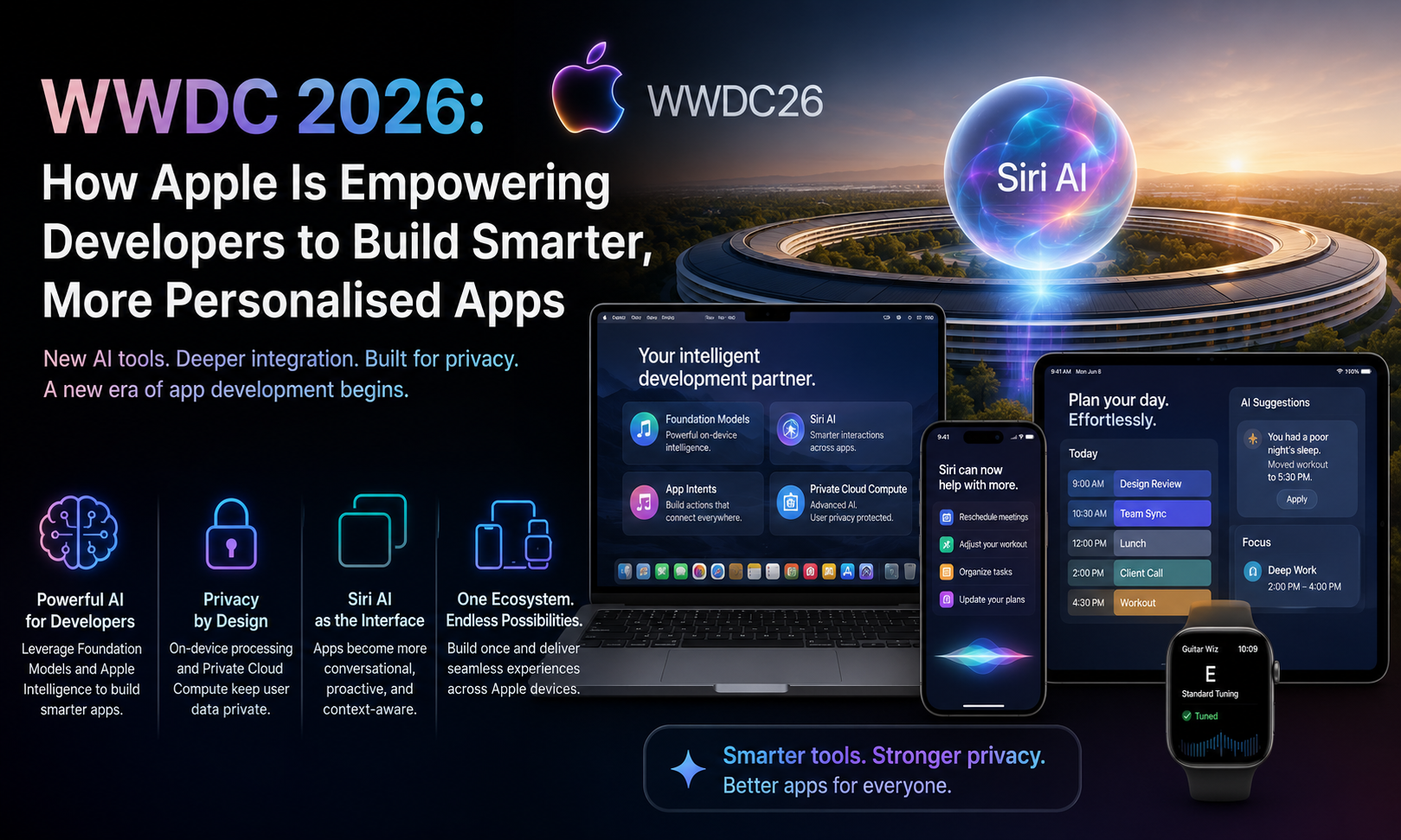
New AI Strategy of Apple – Allow the Developers to Create User Experiences Rather than AI Models
One of the most important revelations at the WWDC 2026 keynote speech is the further development of Apple’s initiative for Foundation Models and Apple Intelligence for developers. Rather than requiring developers to create and train AI models, Apple provides an intelligent layer which can be easily integrated in any application developed by third-party developers. This reduces the difficulty of using AI technologies in apps for small businesses which may not be able to afford costly AI infrastructure. In other words, developers will focus on creating user experience in applications while leaving the part of intelligence to Apple. An interesting application which demonstrates how AI can be used to facilitate everyday tasks is the productivity app Timo. In Timo, users are helped by AI to organize the activities and create the schedule of tasks for each day in a more efficient way. In the future, it might be possible to integrate more intelligence so that the app can predict the user’s needs.
Privacy-First AI: Why Developers Are Embracing Apple’s On-Device Intelligence
The rise of artificial intelligence has brought about numerous privacy concerns. Apple is focused on making privacy a core part of its artificial intelligence strategy through the use of on-device processing to limit the amount of user data sent to remote servers, and instead, using the capabilities of Foundation Models and Private Cloud Computer to process the majority of user generated artificial intelligence features on-device. Developers at WWDC 2026 indicated this was one of the greatest benefits of using the platform. Timo’s founders discussed many of their features were designed to be A.I.-enabled on-device, limiting how much personal, sensitive data needs to be collected and stored for A.I. applications to correctly function. Developers can build intelligent experiences for their users without compromising their trust when building with Apple. Additionally, for smaller development teams, building their own privacy-centric A.I. infrastructure to compete with the Apple infrastructure is unfeasible. Apple’s strategy as a privacy centric A.I. technology company, that promotes and markets privacy as a benefit, will help to differentiate them from competitors. With these two points of focus in conjunction with Apple’s vision, developers will have an environment to grow their ideas around innovation and protect user data through a combination of A.I. powered applications. Ultimately, consumers will have increased confidence in using applications powered by A.I. from Apple.

Siri AI May Be the Future of App Interaction
At WWDC 2026, Apple also revealed its desire to evolve Siri into an AI-powered helper that will be able to communicate with other applications efficiently. Until now, people used touch screens, buttons, and menus to manage their apps. Now Apple envisions that conversations might become the preferred method of communicating with different apps. According to developers, the new Siri AI has the potential to dramatically affect the usage of the applications in question. Users no longer need to launch their apps to adjust settings or organize schedules. Instead, one needs only to ask Siri to do something on his or her behalf. In case of a productivity app, Siri can rearrange meetings and workouts as well as plan the rest of the day for a person. With such changes, apps become background services performing their functions at all times. The new Siri is going to rely on Apple Intelligence and various AI integrations from third parties.
Apple’s Ecosystem: Creating an Even Better Experience With AI Integration
Though there was talk of AI at WWDC 2026, developers also talked about the importance of the ecosystem. In my opinion, one of Apple’s best aspects is that it can connect all kinds of products to one another to create a consistent experience. For instance, apps created for the iPhone, iPad, Mac, Apple Watch, and Vision Pro can easily be compatible with each other without problems. An example of this came from the music learning platform, Guitar Wiz, which created features for the Apple Watch, widgets, Siri Shortcuts, iMessage, and Live Activities. At the same time, Apple is using AI in their ecosystem by tailoring lessons based on each person’s skill level. As such, beginners receive easier explanations and advanced players get more complicated ones. Gaming developers have also profited from both the integration of Apple’s products and AI, as demonstrated by Azra Games. Overall, I believe that it is great when developers can take advantage of these two factors to improve the user experience.
Conclusion
It should be noted that from WWDC 2026 we have come to understand that the vision of Apple concerning AI technology does not end with simple consumer features. Through the provision of developers with Foundation Models, improved Siri, and privacy intelligence technology, Apple is helping to develop the basis for smarter and more personalized applications through its system. Instead of having developers start from zero in terms of creating their own AI, Apple has provided developers with a platform to focus on innovation. As this technology continues to grow, we can look forward to seeing applications that provide us with a more personalized and efficient experience in all aspects of use.