
Gujarat University to Train 5,000+ Professors in AI Across 350 Colleges
The delivery of education is changing rapidly, and technology plays a pivotal role in this process. In what is considered a bold move, Gujarat University plans to train more than 5,000 professors on the application of artificial intelligence in their field of work. It is a significant milestone towards embracing modern ways of educating. By incorporating artificial intelligence in teaching, the university seeks to not only improve the quality of education but also provide students with a unique learning experience.
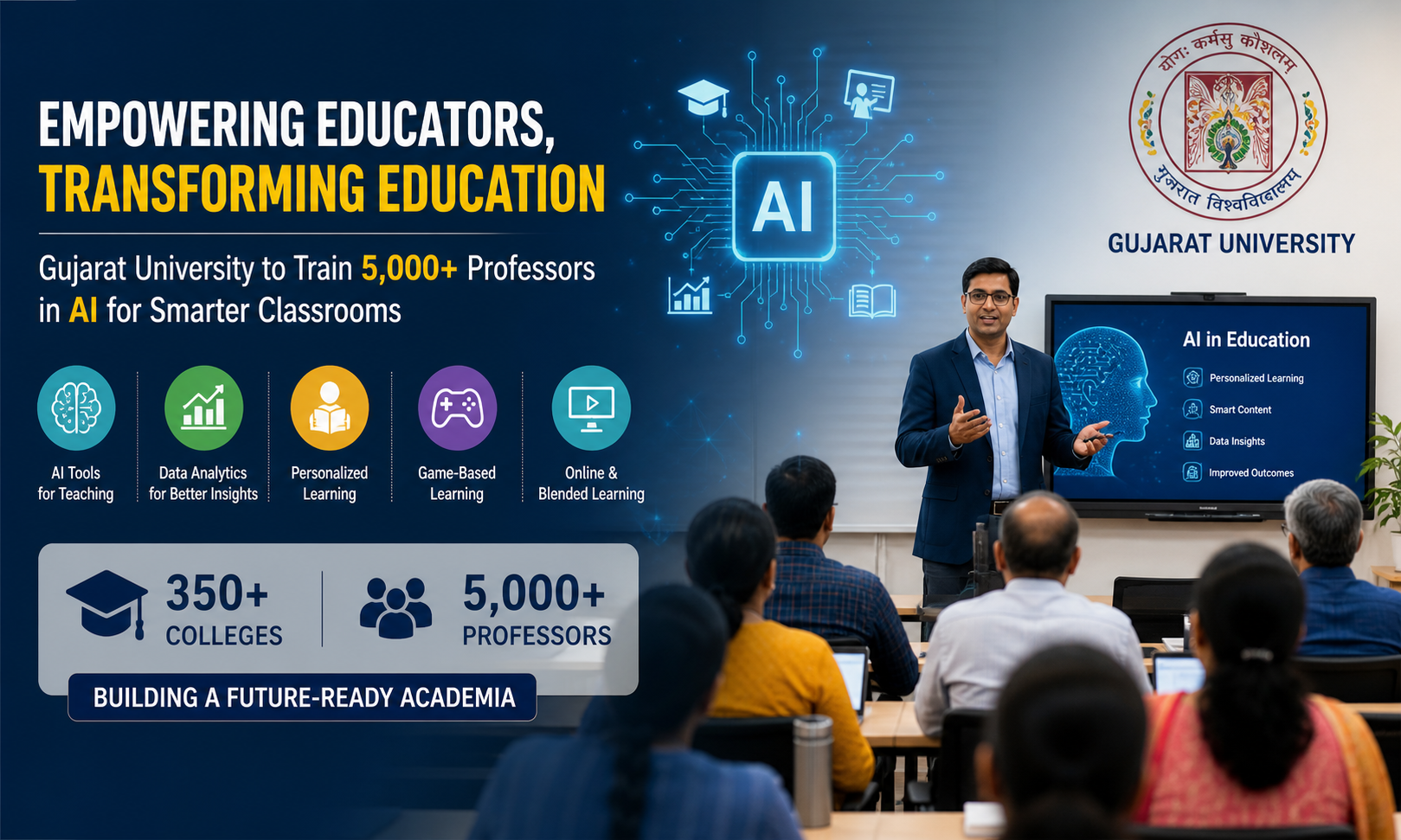
Big Shift: The Importance of AI Training for Professors in Current Times
Learning is no longer confined to textbooks, classes, and conventional modes of teaching. The emergence of artificial intelligence technology means that methods of delivering knowledge are rapidly changing. Nowadays, students have a higher level of awareness when it comes to the use of computers, and they want to be able to engage with what is being taught using modern technologies. This is why it is necessary to train professors in artificial intelligence. It is not enough to use some modern software in the classroom – one needs to be aware of how today’s students acquire knowledge and skills through various applications. Through AI usage, one can see if there are any gaps in students’ knowledge or skills and how they develop throughout the educational process.
Inside the Initiative: Gujarat University’s Plan to Train 5,000+ Educators
The plan by Gujarat University for professional development of over 5,000 professors demonstrates their innovative and large collaboration with many initiatives across the country such as the Malaviya Mission regarding elevating the quality of higher education. There will be over 350 colleges participating in the program which will be one of the largest ever created in the region. The university will begin training for the new skills for the educators when exams are completed in approximately June allowing for all of the educators to have their full attention on their learning of the new skills. This program clearly indicates an understanding that the direction of the education process depends on how well the faculty are trained. The investment in faculty development at this level by the university is the standard for which other institutions should model.
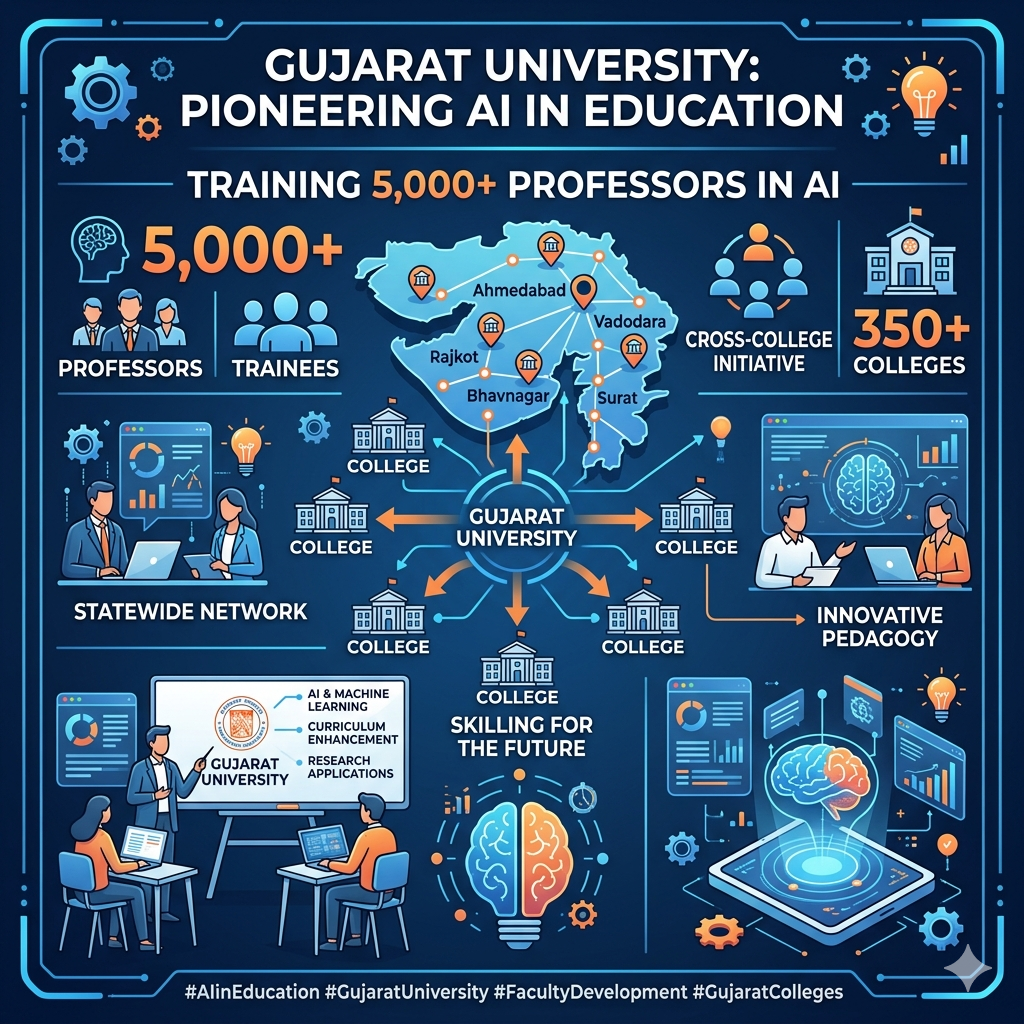
New Approaches to Classrooms for Professors Will Present New Ideas and Tools
AI Training will not only cover the theory, but the implementation tools and proven classroom practices can be applied immediately in your classroom. During this training course, professors will be taught what personalized instruction means and how to create personalized learning based on each student’s level of mastery and pace of learning. Flipped classrooms allow students to learn about concepts at home and utilize classroom time with the teacher for constructive conversations and to solve problems together.
Teachers will also have the ability to use data analytics tools to track their student’s performance and to make sound choices about their instruction. Visual storytelling, animation, and games will provide a variety of options for presenting facts in the classroom, creating exciting and stimulating learning and allowing for a new approach to presenting material through an online platform that increases learning opportunities beyond the physical classroom. As instructional practices begin to shift toward a student-centred, interactive, and efficient teaching method, we can be certain that future generations of students will have the opportunity to reshape education.
The Future of Education – Using AI to Revolutionise How We Teach Students
Although the main beneficiaries of the program will be educators (during training), the biggest benefit will come from students. AI-powered teaching methods can provide engaging, interactive and effective learning experiences. Rather than providing students with a standard type of instruction, AI will provide an opportunity for each student to receive a custom-made experience that meets individual needs and abilities. Fast learners will be able to progress faster than slower learners who require additional support. With the use of data analytics, teachers will be able to quickly identify students who may be struggling and offer timely assistance. Innovative teaching strategies such as game-based learning and visual storytelling will help students understand complex topics and enjoy learning. Exposure to AI-based education will provide students with the tools they need to succeed in technology-driven careers. In addition, exposure to teaching methods that leverage technology will foster critical thinking and problem-solving skills in students. In conclusion, students who experience a transformation in education through AI will not only score better in academics overtime, they will also be more prepared/adaptable to transition into adulthood.
Conclusion
With education continually moving forward, this kind of initiative demonstrates how educational institutions are adapting for the future through concrete steps. By equipping over 5,000 professors from 350 colleges, the Gujarat University is definitely taking a huge leap towards technologically advanced learning. However, this strategy does not only seek to make use of innovative tools; it aims to provide an enhancement in teaching and learning processes to benefit both educators and learners.