
In History First Time Indian Railways Launches Special Milk Train from Ahmedabad to Jammu & Kashmir
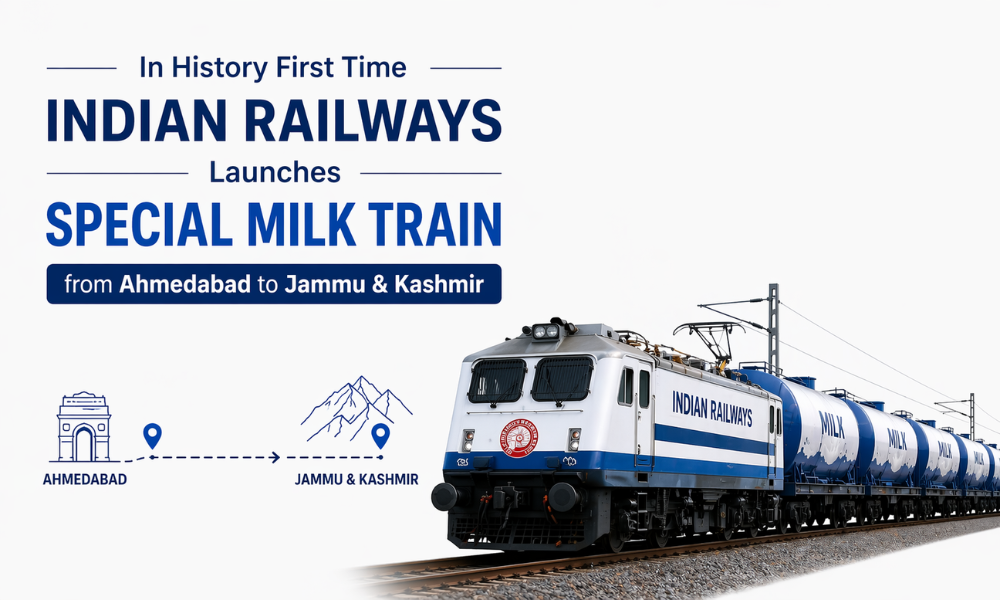
In a landmark step toward strengthening India’s dairy logistics network, Indian Railways has introduced its first-ever special milk train connecting Ahmedabad in Gujarat to Jammu & Kashmir. This historic initiative is not just a transportation achievement it represents a powerful integration of agriculture, infrastructure, and national supply chains.
For the first time, fresh milk and dairy products from Gujarat are being transported directly to the northernmost region of India through a dedicated freight train. This move is expected to ensure a consistent supply of dairy products in Jammu & Kashmir while creating new opportunities for dairy farmers and producers in Gujarat.
Background and Need for the Initiative
Gujarat is widely known as one of India’s leading dairy-producing states. With a strong cooperative network and high milk production capacity, the state often has surplus dairy output. Meanwhile, regions in Jammu & Kashmir face logistical challenges due to difficult terrain, weather conditions, and limited local production.
To address this imbalance, Indian Railways has taken a proactive step by launching a dedicated milk train. This initiative ensures that surplus milk from Gujarat reaches areas where demand is high, thereby balancing supply across regions.
Railway officials have described this as a “historic success”, as it guarantees the continuous availability of essential dairy products in remote areas.
Train Route and Connectivity
The special milk train operates over a long-distance route, covering multiple states and railway zones.
- Origin Station: Ahmedabad, Gujarat
- Destination Region: Jammu Division, Jammu & Kashmir
- Key Route Coverage: Gujarat → Rajasthan → Punjab → Jammu & Kashmir
This route connects western India to the northern region, ensuring efficient transportation of perishable goods over thousands of kilometers.
Train Composition and Capacity
The milk train has been specially designed to transport dairy products safely and efficiently. Key details include:
- Total 20 BCN (covered) wagons
- Suitable for transporting milk and dairy products
- Designed to protect goods from environmental exposure
- Ensures hygienic and safe movement of perishable items
Wagon Distribution:
- 10 wagons designated for Bari Brahmana (Jammu region)
- 10 wagons designated for Anantnag (Kashmir region)
This division ensures that both Jammu and Kashmir regions receive adequate supply.
Train Schedule & Timing
- Train Type: Special Freight Train (Milk Supply)
- Departure Station: Ahmedabad Railway Division
- Departure Date: 20 April 2026
- Departure Timing: Evening dispatch (as per freight schedule)
- Estimated Transit Time: 48 to 72 hours
- Arrival Points:
- Bari Brahmana (Jammu)
- Ananta (Kashmir)
- Unloading Process: Conducted at designated freight yards
- Frequency: Initially introduced as a special service; may become regular based on demand
Key Objectives of the Milk Train
- Ensure continuous and reliable milk supply to Jammu & Kashmir
- Support dairy farmers and cooperatives in Gujarat
- Strengthen inter-state trade and logistics
- Reduce transportation delays and wastage
- Promote rail-based freight solutions for perishable goods
Benefits of the Initiative
For Dairy Farmers and Producers
- Access to new markets in northern India
- Better demand and pricing opportunities
- Reduced spoilage due to faster transport
For Consumers in Jammu & Kashmir
- Regular availability of fresh milk
- Improved product quality
- Stabilized prices due to consistent supply
For Indian Railways
- Increased freight revenue
- Efficient use of railway infrastructure
- Expansion into perishable goods logistics
Operational Advantages
The milk train offers several operational benefits:
- Faster and more reliable than road transport
- Cost-effective for bulk transportation
- Reduced carbon footprint compared to trucks
- Better handling of large volumes
This initiative highlights how Indian Railways is modernizing its freight services to meet evolving market demands.
Challenges and Solutions
Transporting milk across such a long distance involves several challenges:
Challenges:
- Maintaining freshness of dairy products
- Handling temperature-sensitive goods
- Ensuring timely delivery across multiple states
- Managing different climatic conditions
Solutions Implemented:
- Use of covered wagons for protection
- Efficient scheduling to reduce transit time
- Coordinated logistics between railway divisions
- Quick unloading and distribution systems
The successful execution of this train proves that these challenges can be effectively managed.
Economic and National Impact
This initiative goes beyond logistics—it has broader economic and national significance:
- Strengthens agriculture-to-market connectivity
- Promotes balanced regional development
- Supports rural economy and dairy sector
- Enhances national integration through trade
By connecting Gujarat to Jammu & Kashmir, the milk train symbolizes unity and cooperation between regions.
Future Scope and Expansion
The success of this milk train opens up new possibilities:
- Introduction of regular milk train services
- Expansion to transport fruits, vegetables, and other perishables
- Development of cold-chain railway infrastructure
- More routes connecting production hubs to consumption centres
If demand continues to grow, similar initiatives may be launched across other parts of India.
Why This Initiative is Historic
This is the first time in Indian railway history that a dedicated milk train has been launched from Gujarat to Jammu & Kashmir. It represents:
- Innovation in freight transportation
- Efficient use of railway networks
- A major step toward modern logistics
It also reflects the commitment of Indian Railways to support essential supply chains and economic growth.
Conclusion
The launch of the special milk train from Ahmedabad to Jammu & Kashmir is a milestone achievement that will have long-lasting benefits for farmers, consumers, and the overall economy. By ensuring the smooth transportation of dairy products across states, this initiative strengthens India’s supply chain and promotes sustainable growth.
With continued success and expansion, this milk train could become a model for transporting perishable goods across the country. It is not just a train—it is a symbol of progress, connectivity, and innovation in India’s logistics sector.
This historic journey marks the beginning of a new era in railway freight services and national integration.