





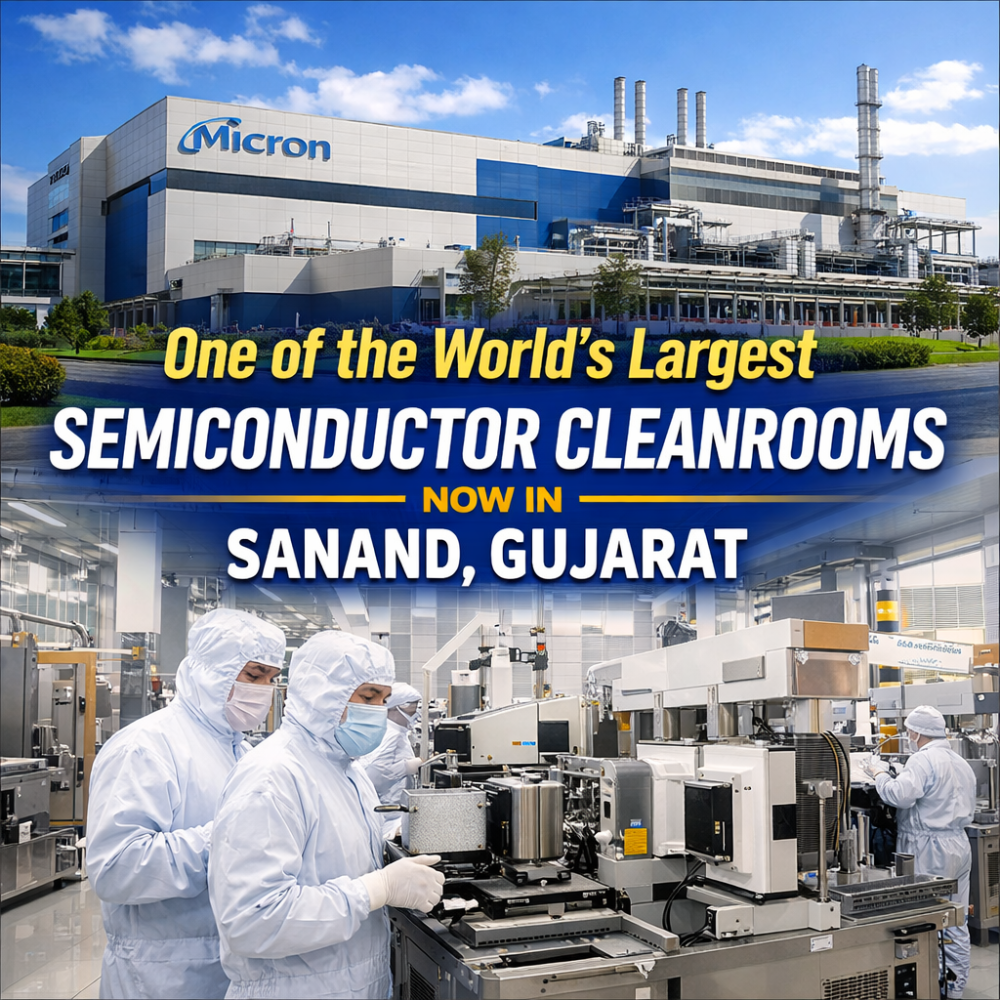
One of the World’s Largest Semiconductor Cleanrooms Now in Sanand, Gujarat
Gujarat has taken a significant leap toward becoming a global semiconductor hub with the establishment of one of the world’s largest cleanroom facilities in Sanand. Developed by Micron Technology, this state-of-the-art plant marks a milestone not only for the state but also for India’s ambitions to become self-reliant in semiconductor manufacturing.
A cleanroom is the heart of any semiconductor fabrication unit, where microchips are manufactured under extremely controlled conditions. Even the tiniest particle of dust can damage a chip, making such facilities highly sophisticated and technologically advanced. The scale and capability of the Sanand cleanroom have placed it among the largest globally, showcasing India’s growing role in the high-tech manufacturing sector.

Key Highlights of the Sanand Semiconductor Cleanroom
- Global Scale Facility
The cleanroom in Sanand is designed to meet international standards and is counted among the largest semiconductor cleanrooms in the world. Its massive size allows for large-scale production of advanced memory chips. - Strategic Location Advantage
Sanand, located near Ahmedabad, has already established itself as an industrial hub. With excellent connectivity, infrastructure, and supportive policies, it has become an ideal destination for semiconductor investments.- Boost to ‘Make in India’ Initiative
This project aligns with the Indian government’s vision to strengthen domestic manufacturing under the “Make in India” initiative, reducing dependency on imports for critical technologies.
- Boost to ‘Make in India’ Initiative
- Cutting-Edge Technology
The cleanroom is equipped with advanced air filtration systems, temperature control, and humidity regulation to ensure a contamination-free environment essential for chip production. - Employment Generation
The facility is expected to create thousands of direct and indirect job opportunities, ranging from highly skilled engineers to support staff. - Strengthening Supply Chain
With semiconductor production within India, industries such as electronics, automotive, and telecommunications will benefit from a more reliable supply chain.
Why Cleanrooms Matter in Semiconductor Manufacturing
Semiconductor chips are built at nanometer scales, meaning even microscopic contaminants can lead to defects. Cleanrooms maintain extremely low levels of airborne particles through high-efficiency particulate air (HEPA) filters and strict protocols. Workers wear specialized suits to prevent contamination, and every process is monitored with precision.
The Sanand cleanroom represents a technological ecosystem where precision engineering meets innovation. Its inclusion among the world’s largest facilities reflects the scale at which India is now operating in this domain.
Impact on Gujarat’s Economy
The establishment of such a mega facility is expected to have a transformative impact on Gujarat’s economy:
- Industrial Growth: Sanand will attract ancillary industries such as packaging, testing, and component manufacturing.
- Investment Magnet: The presence of a global giant like Micron is likely to draw more international investors to Gujarat.
- Skill Development: Local institutions may introduce specialized courses to meet the demand for semiconductor professionals.
- Export Potential: Chips manufactured in Sanand could contribute significantly to India’s export portfolio.
India’s Semiconductor Vision
India has long relied on imports for semiconductor needs, making it vulnerable to global supply disruptions. The COVID-19 pandemic and subsequent chip shortages highlighted the importance of domestic production. In response, the government launched incentives and policies to attract global players.
Micron’s investment in Sanand is one of the first major outcomes of these efforts. It signals confidence in India’s policy framework, infrastructure, and workforce capabilities. The project is also expected to encourage other semiconductor companies to set up operations in the country.
Challenges Ahead
While the development is promising, there are challenges that need to be addressed:
- High Capital Costs: Semiconductor manufacturing requires massive investments and long gestation periods.
- Technological Expertise: Continuous innovation and skilled talent are essential to remain competitive globally.
- Supply Chain Dependencies: Raw materials and equipment still depend on global suppliers.
- Energy and Water Requirements: Semiconductor plants consume large amounts of power and ultra-pure water, requiring sustainable solutions.
The Road Ahead
The Sanand cleanroom is just the beginning of India’s semiconductor journey. As the ecosystem develops, more investments in research, design, and manufacturing are expected. Collaboration between government, industry, and academia will play a crucial role in sustaining growth.
Gujarat, with its proactive industrial policies and infrastructure, is well-positioned to lead this transformation. The success of this project could pave the way for India to emerge as a key player in the global semiconductor market.
Conclusion
The inclusion of Sanand’s semiconductor cleanroom among the world’s largest is a landmark achievement for both Gujarat and India. It reflects the country’s growing capabilities in advanced manufacturing and its determination to reduce dependence on imports.
With strong government support, global partnerships, and a focus on innovation, India is steadily moving toward becoming a semiconductor powerhouse. The Micron facility in Sanand is not just an industrial project—it is a symbol of technological progress, economic growth, and a future driven by self-reliance.
As the world increasingly depends on semiconductors for everything from smartphones to electric vehicles, India’s entry into large-scale chip manufacturing marks a turning point. Sanand is now firmly on the global map, representing a new era of opportunity and advancement.