Google launches Stitch: The Rise of ‘Vibe Designing’ That Could Change How Apps Are Built Forever
The field of app and web designing is constantly changing, and Google is taking it to the next level once again with its latest innovation, Stitch. Unlike traditional wireframes, Stitch, which is based on artificial intelligence, is taking a whole new approach to designing interfaces through a concept known as “vibe designing.” It is based on the idea of designing interfaces based on ideas simply through natural language. Stitch is all about user experience and intent, making designing interfaces faster, smarter, and more accessible.
What Is Stitch and Why Google Is Betting Big on ‘Vibe Designing’
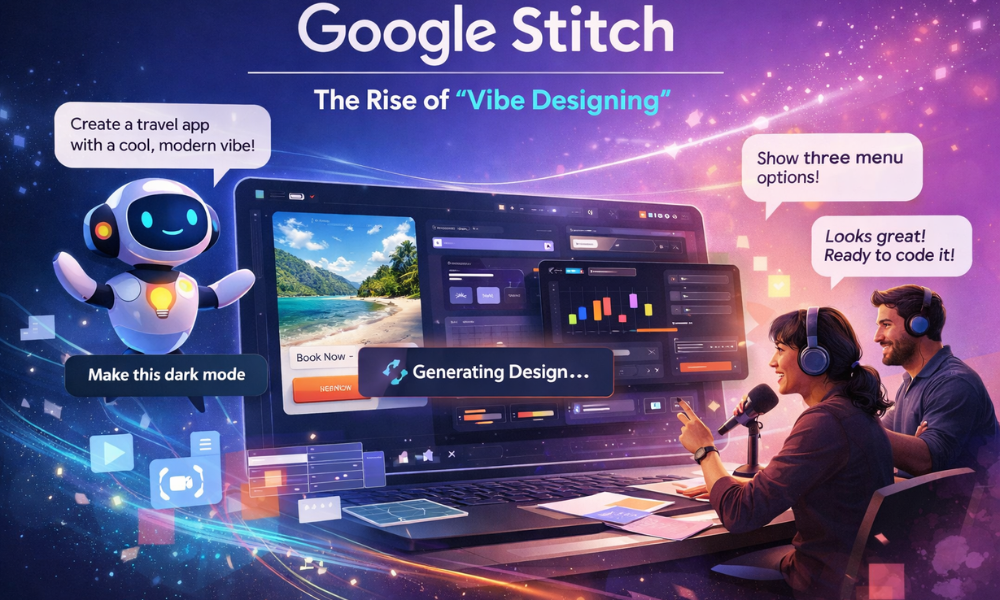
Google is revolutionizing the way digital products are being designed with the help of its AI-powered tool, Stitch. Unlike conventional design tools, which focus on wireframing, layout, and design, Stitch’s AI-powered tool is based on a new concept called ‘Vibe Designing.’ With this, users can simply tell the tool the way they want the app or website to feel, look, and behave, and the AI will do the job. The idea behind this is simple: design what you want, not how you will design it. This is also a part of the larger shift happening in the tech world, with AI taking over complex tasks, including creative ones. With this, Stitch is making designing easier, not only for professional designers but also for developers, founders, and new users.
From Prompt to Prototype: How Stitch Turns Ideas into Interfaces
Stitch offers one of the most remarkable features in converting a simple text prompt into a complete user interface. Users can tell Stitch exactly how they want their design, like “I’d like a straight eCommerce page” or “I’d like a nice-looking dashboard with graphs,” and Stitch creates that UI instantly without the user having to iterate through hours of sketching wireframes or defining layouts.
Stitch is able to use data about the all of its users to evaluate all the different contexts that you could use your interface in and to measure what would be the best user experience and visually appealing layout based on the data, along with multiple iterations through an unlimited number of prompts until completion.
With the ability to rapidly create and test multiple variations of your designs or different user flows using Stitch’s prompt-to-prototype feature, startups and product teams can quickly validate their concepts prior to full production, and do so without incurring significant cost.
Key Features That Make Stitch a Game-Changer
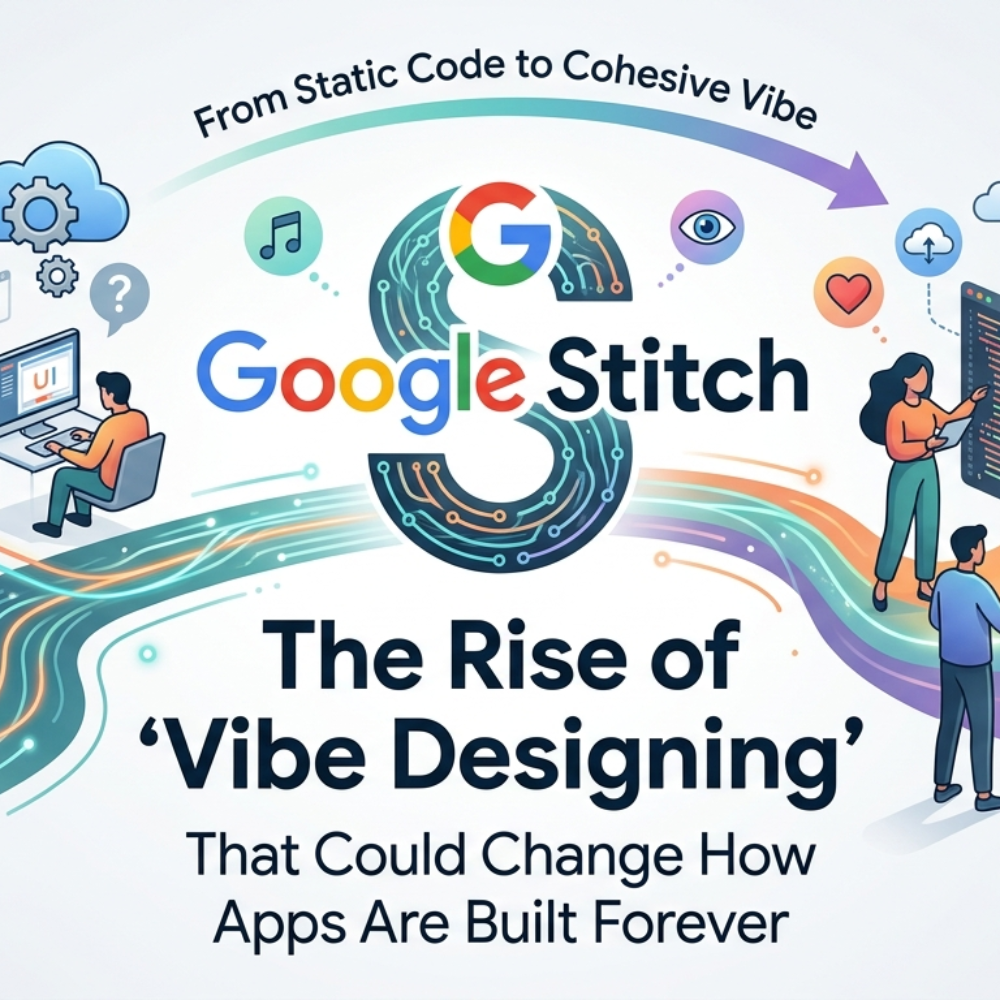
The most pronounced and significant features presented to users and designers through Stitch are those that can create a positive impact on the design process. The most important design possibility from a foundational point of view is the Infinite Canvas, powered by AI. Designers can create three-dimensional working environments with all forms of text, images, code, and UI components in a single location with an AI Assisted Spiral Workspace.
The Smart Designer AI Agent creates smart design agents (SDAs) that understand the full context and purpose of the project. These SDA’s can assist with improving a design component, creating alternate versions of a design, or developing new designs altogether.
With the Agent Manager feature, designers can easily track multiple iterations of a design component used in the project and perform risk-free experiments. The use of voice command features (i.e. say to change the theme, or add an element) enhances the overall experience of designing by allowing the designer to interact with the process naturally and without restriction.
Designers will have near real-time previews of their designs and instant updates throughout the design process by using the Stitch Design workspace (SDSW). Collectively, the features of Stitch do not function as an independent user tool but rather allow users to experience a collaborative AI partner in their overall design process.
Impact on Designers, Developers, and the Future of App Building
The emergence of Stitch represents a fundamental change in how future applications and websites will be created. Designers will experience a shift in how they perform work, as opposed to replacing their role with a new way of creating things. The result of this change will be giving designers the ability to concentrate on more creative aspects, strategy, and the usability of their designs rather than repeatedly performing the same task. Developers will experience faster workflow as a result of the ability to go from the design phase to the coding phase with less friction. Stitch will provide startup companies and individual entrepreneurs with new opportunities by reducing the need to hire large designer teams, thus making it easier than ever for them to create new products. The democratization of design could lead to previously unimagined levels of innovation as individuals without technical expertise (or traditional design skills) can create their designs without technical constraints. At the same time, questions will arise about what happens to traditional design skills in a world driven by AI and machine learning as products become ubiquitous. The development of tools, such as Stitch, that appear to be continuously improving will likely transform the entire product development life cycle into a faster and more efficient process that includes everyone in the product development process.
Conclusion
In conclusion, Google’s Stitch is a bold step towards the future of design where creativity meets efficiency through AI. The future of design is made easier through the concept of “vibe designing,” which makes it easier to get from idea to interface. The future of this technology is bright and has the potential to revolutionize the way we design and develop apps and web interfaces.